September 2026
The best due diligence in this market takes four minutes and almost nobody does it
I have watched a lot of people spend three weeks choosing between two units and four seconds checking where the money was going.
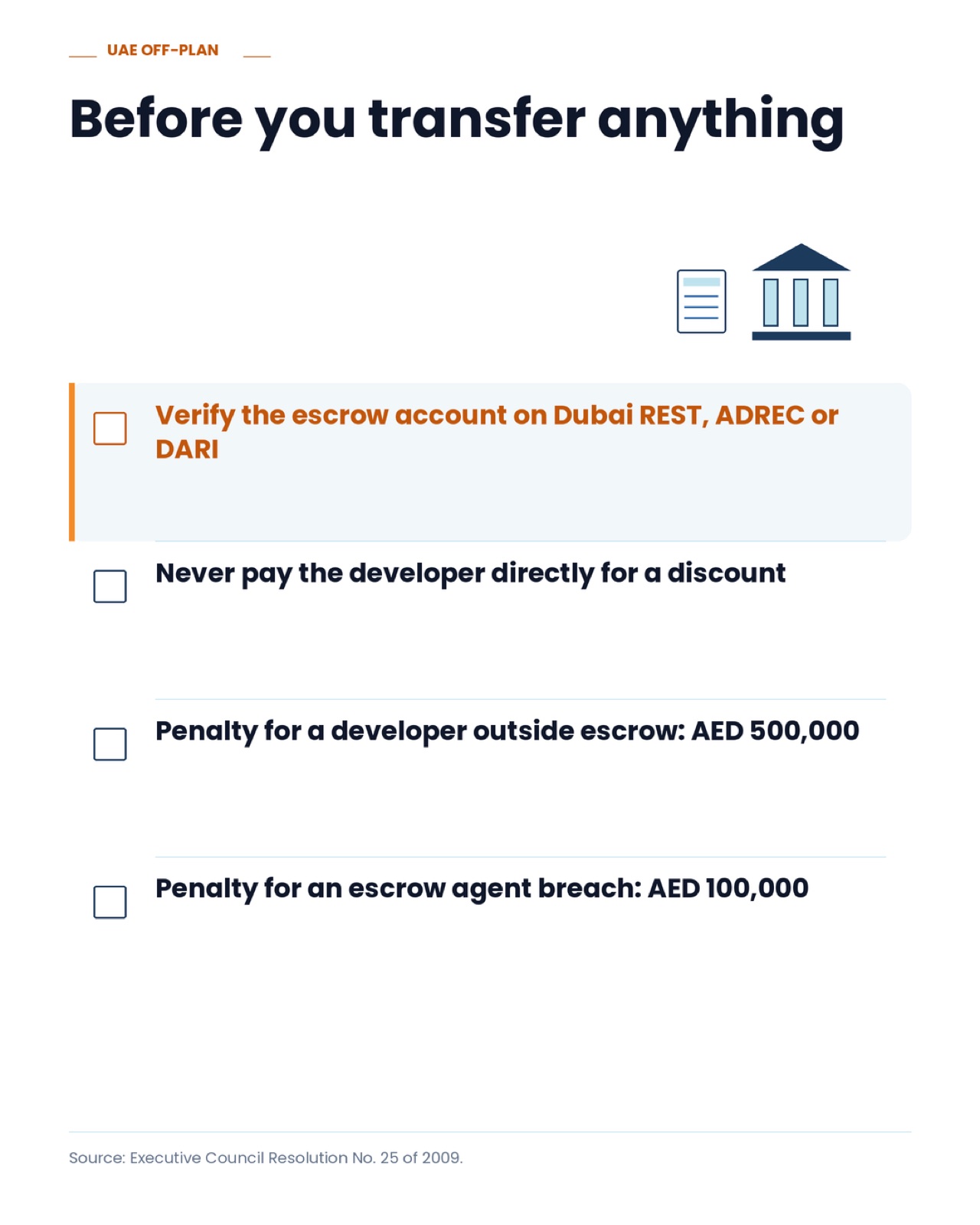
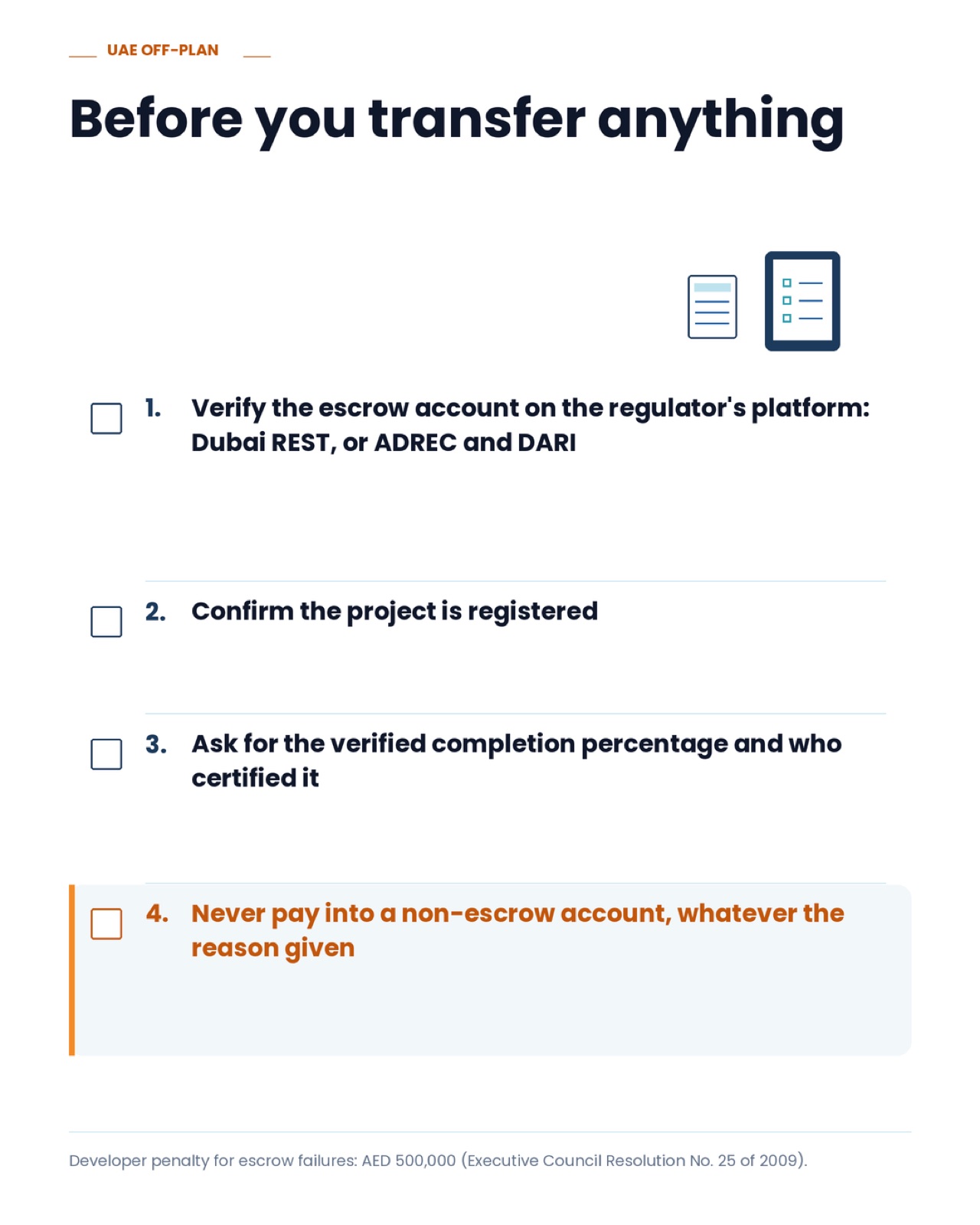
The escrow account number is the single highest-value piece of information in an off-plan transaction, and it is checkable by anyone, for free, on the regulator's own app, in about the time it takes to read this paragraph. It is also the thing that fails most often, because the way people lose money here is rarely dramatic. It is a payment instruction that looked slightly different from the last one, sent by someone helpful.

The thing I keep having to explain
People think escrow is insurance. It is not. It is a spending control.
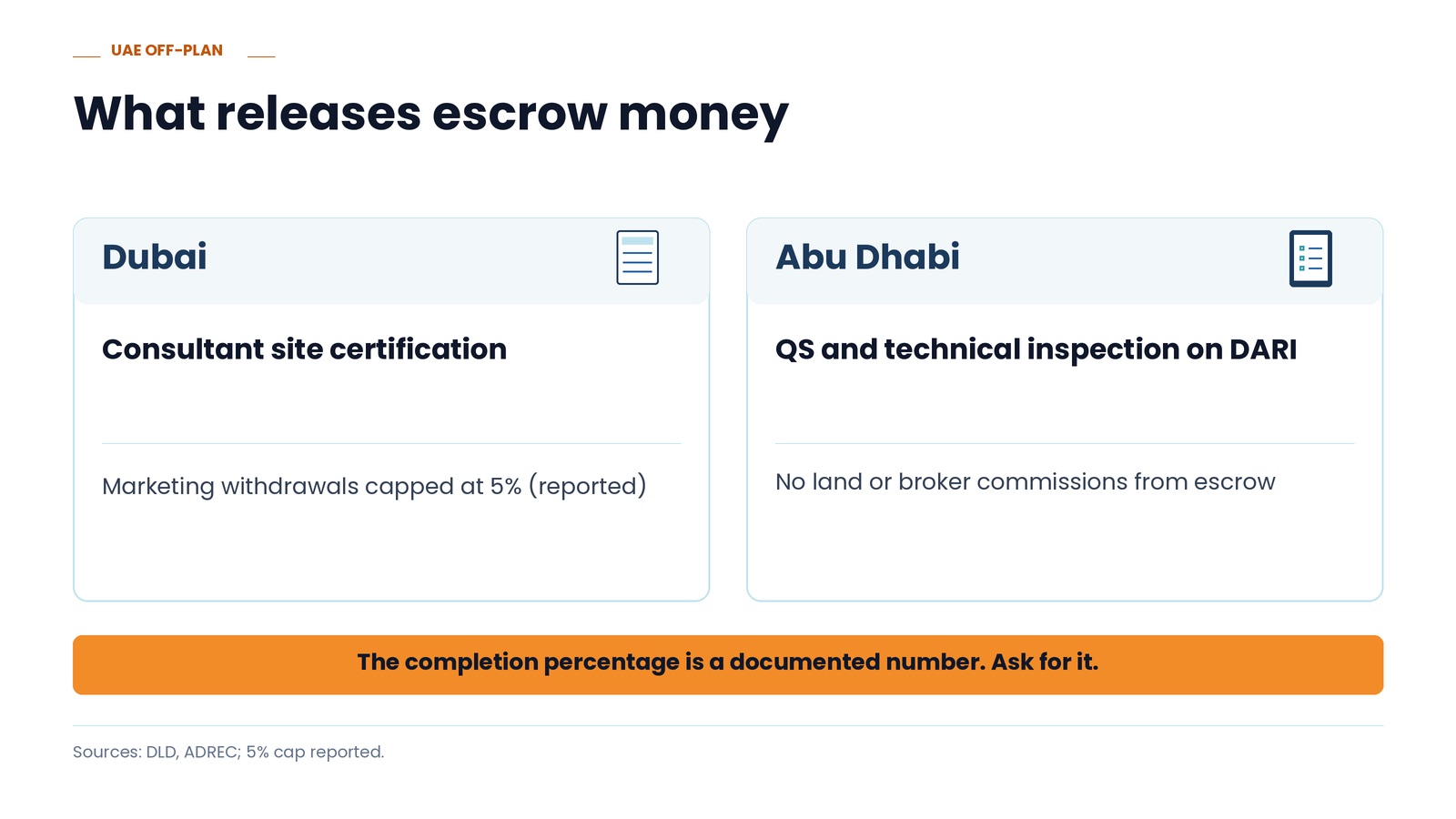
What the system actually does is stop a developer spending your money on something that is not your building, and stop the developer's other creditors reaching it if the wider business gets into trouble. In Dubai that second protection is statutory, and I think it is the most underrated provision in the whole framework. Your deposit sitting in a ring-fenced project account is genuinely safer than most people realise from a solvency point of view.
What it does not do is make a slow project fast, or turn a forfeiture into a refund, or certify that the building is any good. Certification is of progress, not of standard. Those are different words doing very different work, and the distance between them is where a lot of disappointment lives.

What actually changed
Abu Dhabi rebuilt this in 2025 and one detail in the rebuild is better than anything in the marketing around it.
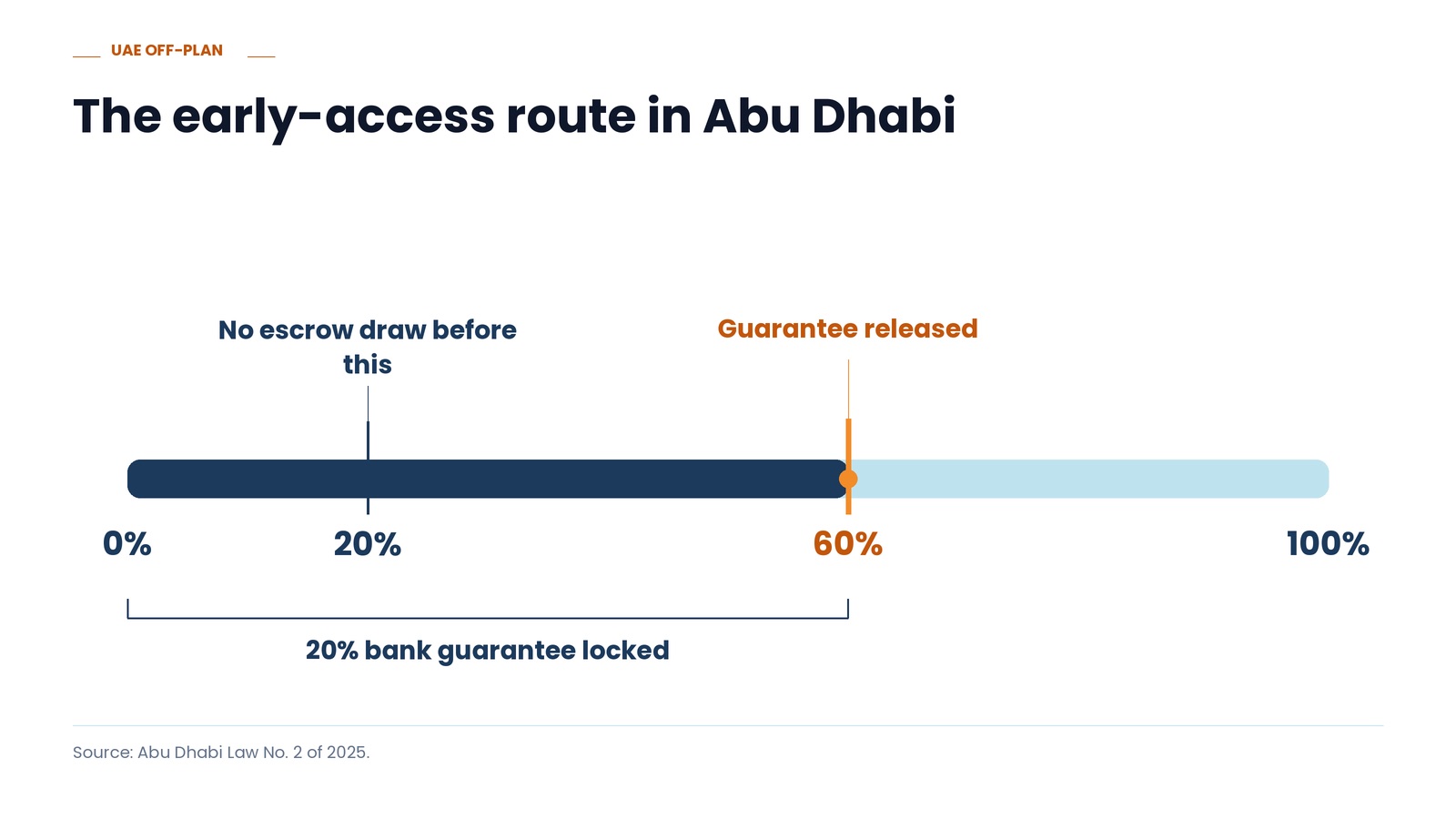
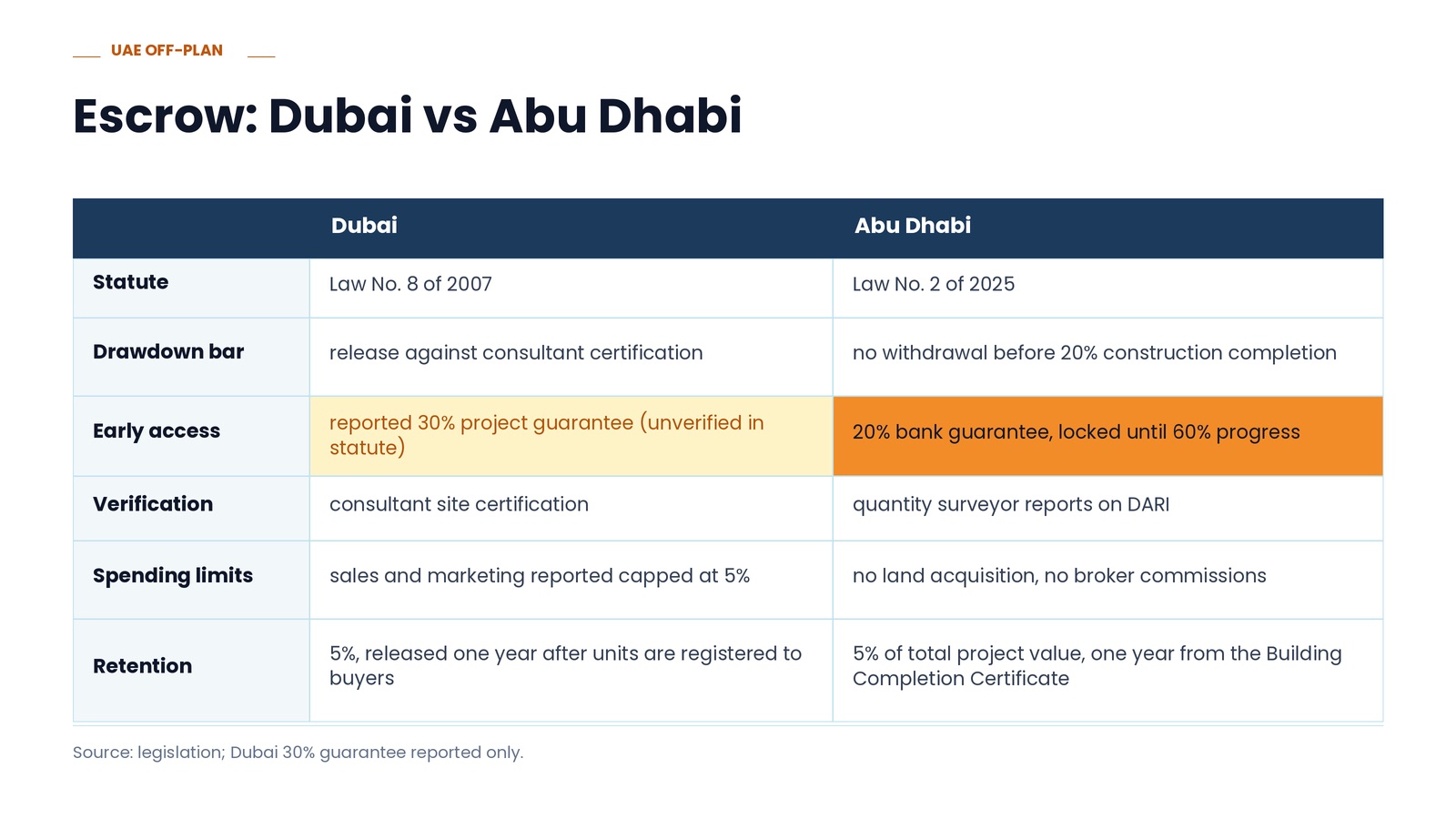
There is a statutory bar on drawing from escrow before twenty per cent construction completion. A developer who wants money earlier has to post an unconditional, irrevocable bank guarantee of at least twenty per cent with the regulator. And the reporting on it says the guarantee stays locked until physical progress reaches sixty per cent.
Sit with that. Not until the next milestone, not until the developer repays. Sixty per cent of the build.
That is a capital test dressed as a procedural rule. A developer using the early route has a fifth of construction cost immobilised for most of the project. Plenty of developers simply will not be able to do that, which means the route someone is on tells you something real about their balance sheet, and it is a question you are allowed to ask.
I would trade most of the due diligence advice circulating in this market for that one question.

The detail almost nobody is discussing
Here is the mechanism that explains behaviour buyers find baffling, and I have not seen anyone write about it in a buyer-facing way.
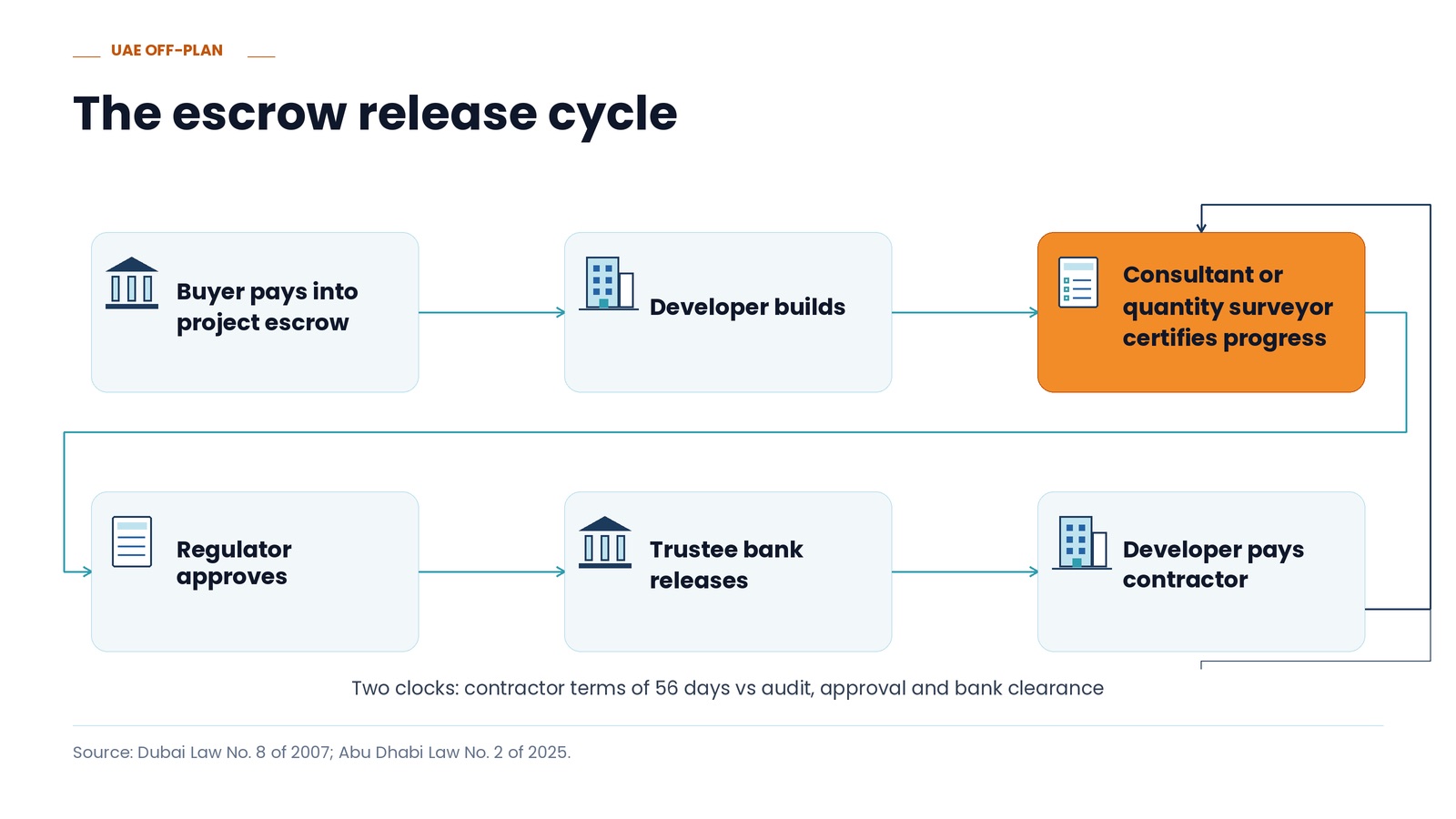
Construction contracts typically pay on fifty-six day terms. Escrow releases on a completely different clock: technical certification, then regulator approval, then bank clearance. Those two clocks do not line up, and the gap between them is a permanent working capital problem sitting inside every off-plan project in this market.
So a project can be fully funded, fully compliant, building on schedule, and still paying its contractors late. That is not a distress signal. It is the system working as designed, with a timing mismatch nobody has solved.
It gets worse at the end, which is the opposite of what people assume. At handover a developer is carrying two retentions at once: the statutory five per cent held by the escrow bank, and a contractual retention of five to ten per cent held back from the main contractor. Both bite in the same window.
And in Dubai the statutory five per cent does not release on completion. It releases a year after units are registered in purchasers' names, which is a conveyancing event. So a building can be finished, occupied, running, and the developer's last slice of margin is sitting behind title transfers and mortgage registrations it does not control.
Once you know that, a lot of end-of-project developer behaviour stops looking like bad faith and starts looking like cash management. That does not excuse any of it. It does explain it, and explanation is more useful than indignation when you are trying to predict what someone will do.
There is a second thing about the retention worth saying, because it reframes what that five per cent is for.
It is not a penalty and it is not a cushion for the buyer. It is a behavioural instrument. It exists so that a developer has a financial reason to send someone out when your air conditioning fails in August. The twelve-month defect liability period covers exactly the things that break first in a new building here, and the retention is what makes the phone get answered during it.
Which is why the timing of a snagging inspection is a money decision rather than an admin one. Inspect at handover and you are looking at a building that has not yet been through a summer. Inspect in months nine to eleven and you are looking at one that has, while the window is still open and the money is still held. A report costs two to five thousand dirhams. The retention it protects is five per cent of the unit. That is not a close call and most people get it wrong by doing it too early.
The honest trade
The escrow framework is the strongest buyer protection in this market and it is weaker than the way it is sold.
It is strong on one axis, which is misuse of funds, and it is very strong there: ring-fenced, independently certified, criminally enforced, with regulator penalties that are not nominal. Dubai's fines schedule sets five hundred thousand dirhams for a developer who fails to open or deposit into escrow. That is not a filing fee.
It is silent on timing, silent on quality and irrelevant to any money that never entered it.
And there is one thing I went looking for and could not find anywhere, which I find genuinely surprising. Nobody publishes the actual release schedule. Not which milestone releases what percentage, not how long the cycle takes from certification to funds landing, not what happens when a trustee bank disputes a release. The entire legal framework is public and its operation is undocumented.
That gap is interesting to me because it is where the real information sits. Anyone who has run twenty of these releases knows the answer and nobody has written it down.

What I think this adds up to
If you take one thing from this: the account number is the check that matters, and it is the one people skip because it feels administrative rather than analytical.
Verify it on the regulator's platform. Not a screenshot, not a letter, not a number in an email thread. And if anyone anywhere in the chain reacts badly to you doing it, you have learned the most useful thing you will learn in that transaction.
The rest of this, the two clocks, the retention mechanics, the sixty per cent lock, is the part that makes you better at reading the people you are dealing with. But the account number is the part that stops you losing everything.
Idris Dad writes about off-plan strategy across Dubai, Abu Dhabi and Ras Al Khaimah.
More on how I work with buyers at offplancrypto.com.