September 2026
A client asked me why his apartment had got more expensive after he bought it
The price had not changed. The payment plan had not changed. Nothing had changed in any document he held.
What had changed was that he earns in a currency that is not the dirham, and across the eighteen months since he signed, that currency had moved. Every instalment he had paid since booking had cost him more than the one before it, in the only currency he actually thinks in.
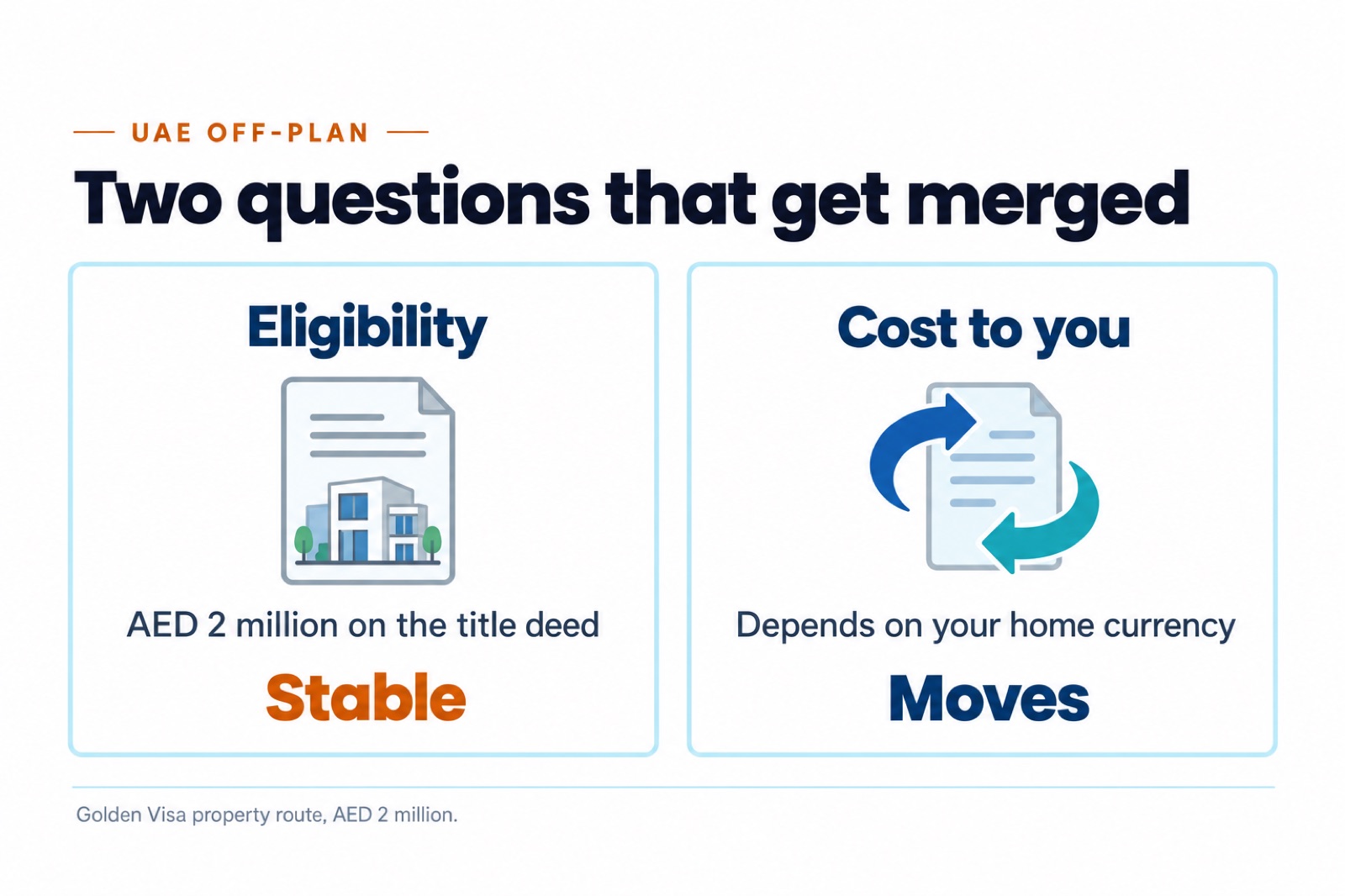
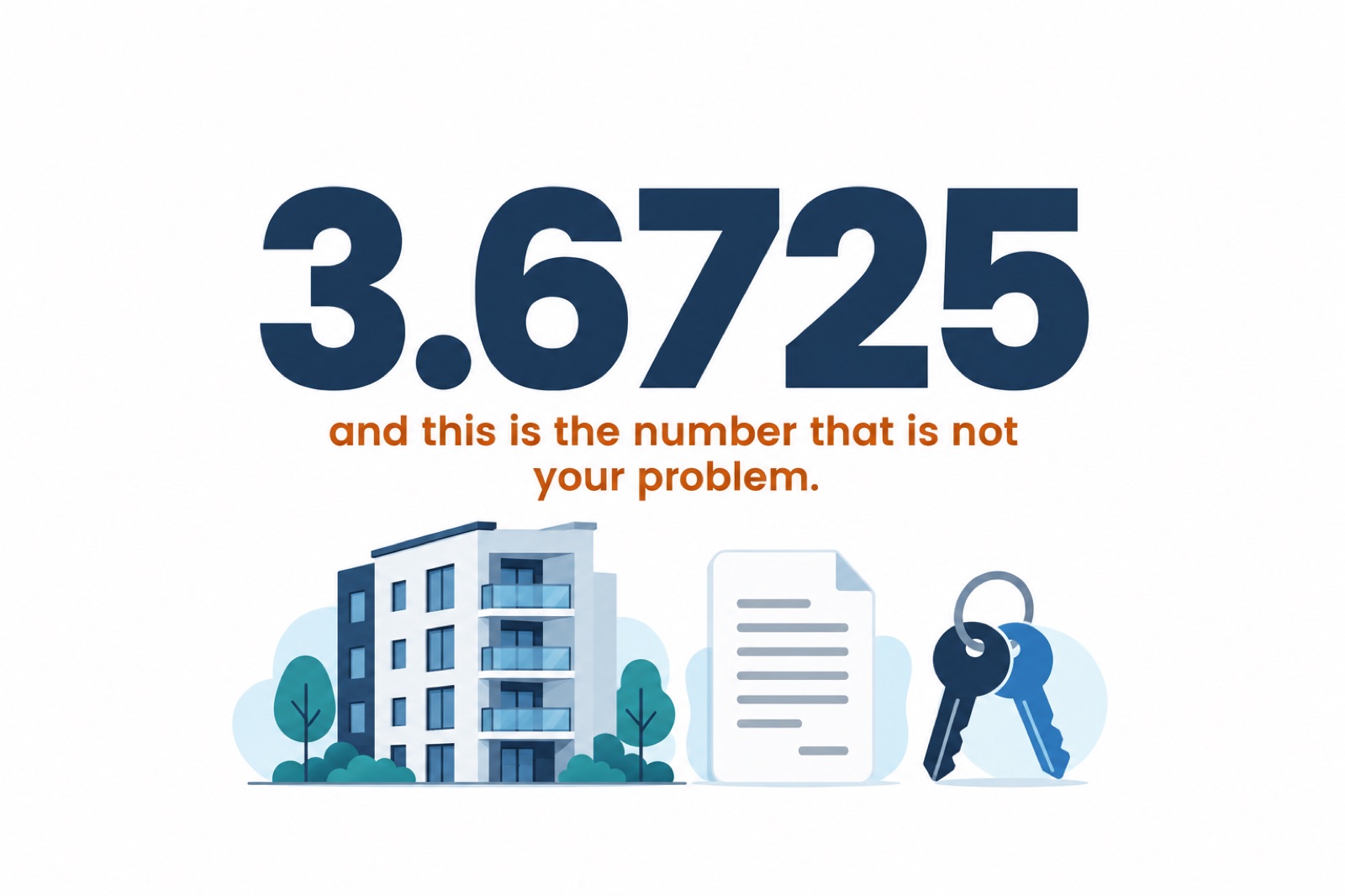
He had never seen it, because nothing in his paperwork ever moved. The purchase price on his SPA is the same number it was on day one. It will be the same number at handover. The dirham has been fixed to the dollar at 3.6725 since November 1997 and it did not budge while all of this was happening to him.
That is the thing I want to write about. Not the exchange rate. The fact that the stability of one side of the transaction is exactly what makes the instability of the other side invisible.
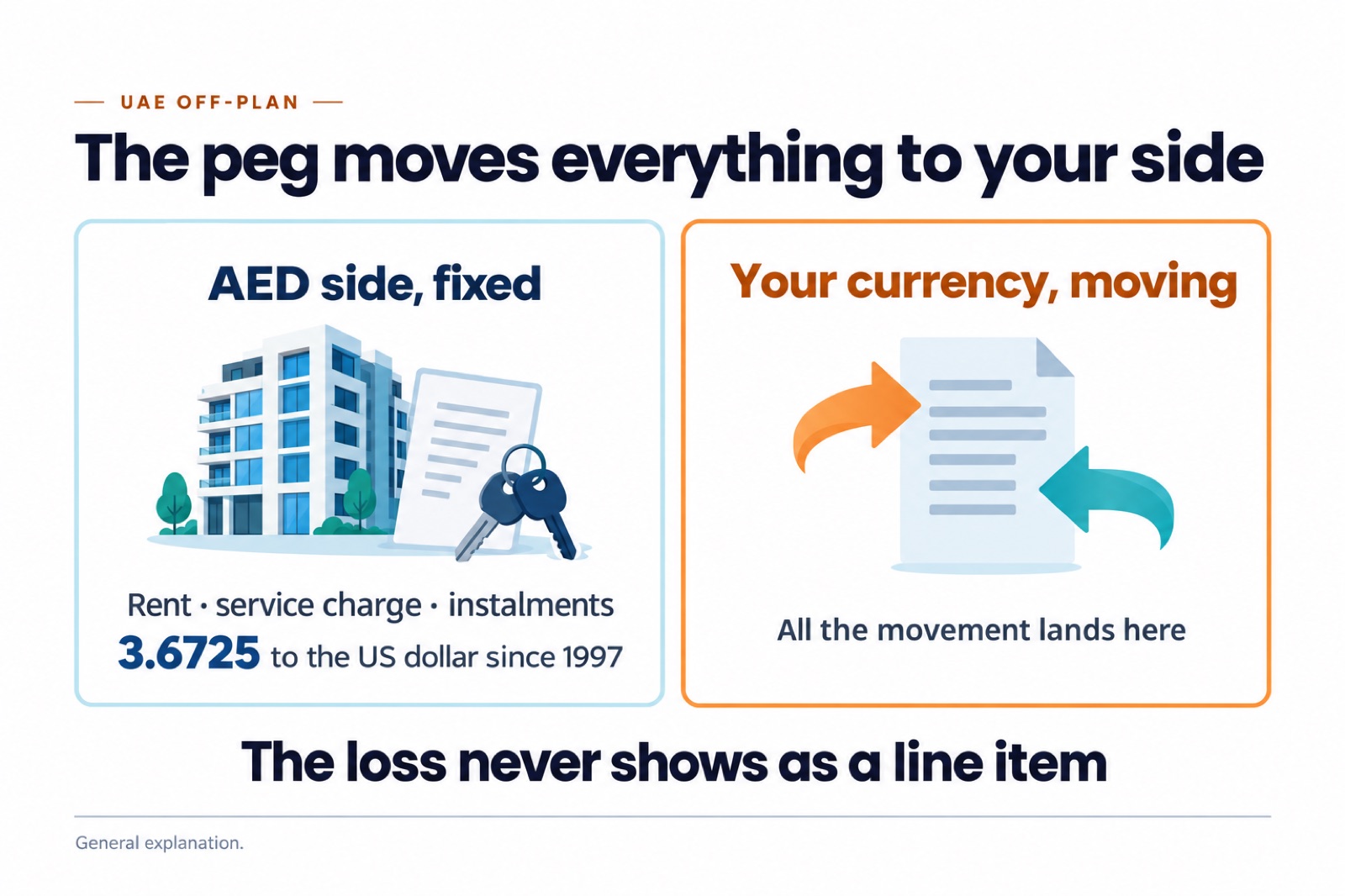
The peg is very good at its job, and that is the problem
Nearly thirty years at the same rate. Through 2008. Through the 2014 oil collapse. Through 2020. It is one of the most durable currency arrangements anywhere, and the result of that durability is that almost nobody buying here thinks about foreign exchange at all.
If you earn in dollars, that instinct is right. A dirham asset is a dollar asset wearing different clothes, and there is effectively no market risk in your purchase from this direction. I will add the one honest caveat and then leave it: a peg is a policy choice rather than a physical constant, so the accurate phrase is no market risk, not no risk. Thirty years of evidence and no indication of change, but those are different sentences and I would rather say the true one.
Everybody else is carrying a position they did not knowingly take.

Why off-plan is the worst possible shape for this
Here is the part I did not properly understand until I sat down with the research.
If you buy a completed property, you convert once. One day, one rate, done. It can go well or badly but it is a single event and you can at least see it happen.
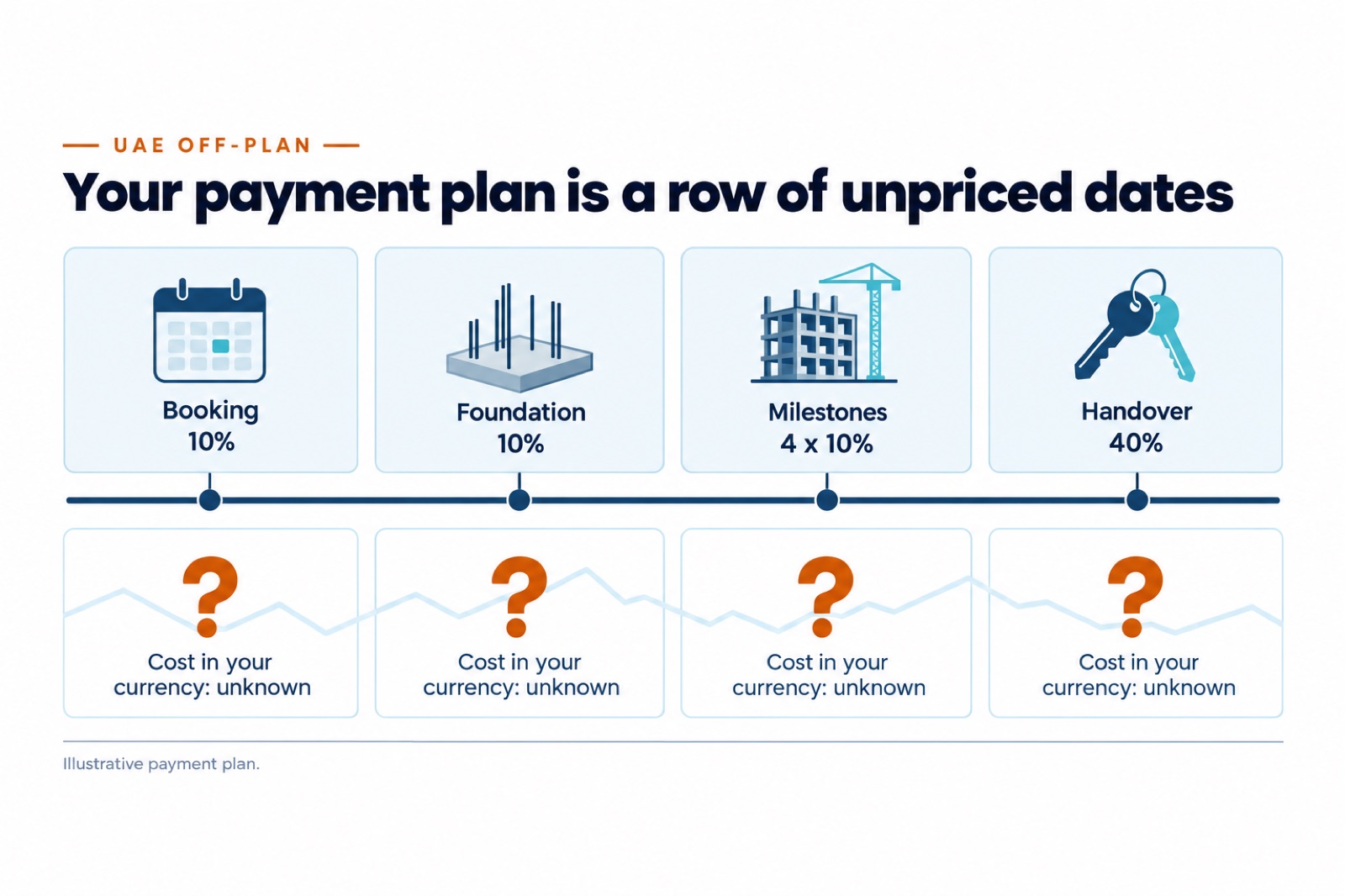
An off-plan purchase is structurally a different animal. It is a schedule of dated payments, in a fixed currency, stretching across two, three, four years. Ten per cent on booking, ten at foundation, ten at each milestone, forty on handover.
Strip the property out of that sentence and read what is left. A multi-year commitment to produce fixed amounts of a currency you do not earn, on dates you do not control.
That is not a property transaction with a currency footnote. That is a forward currency exposure with an apartment attached to the end of it. And the dates are not even reliable, because construction schedules slip, and a slipped milestone does not just move a date in a project plan, it moves the day you have to convert.
I have sold a lot of payment plans. I have never once seen a buyer draw a second row underneath the milestones and write what each one will actually cost them. Neither had I, until this year.
The idea that made me think this was worth writing about
I read a lot of material on this topic and most of it says the same thing, which is roughly "watch the exchange rate, it can move." True, useless.
Then I found the point that actually distinguishes this risk from the others, and it reframed the whole thing for me.
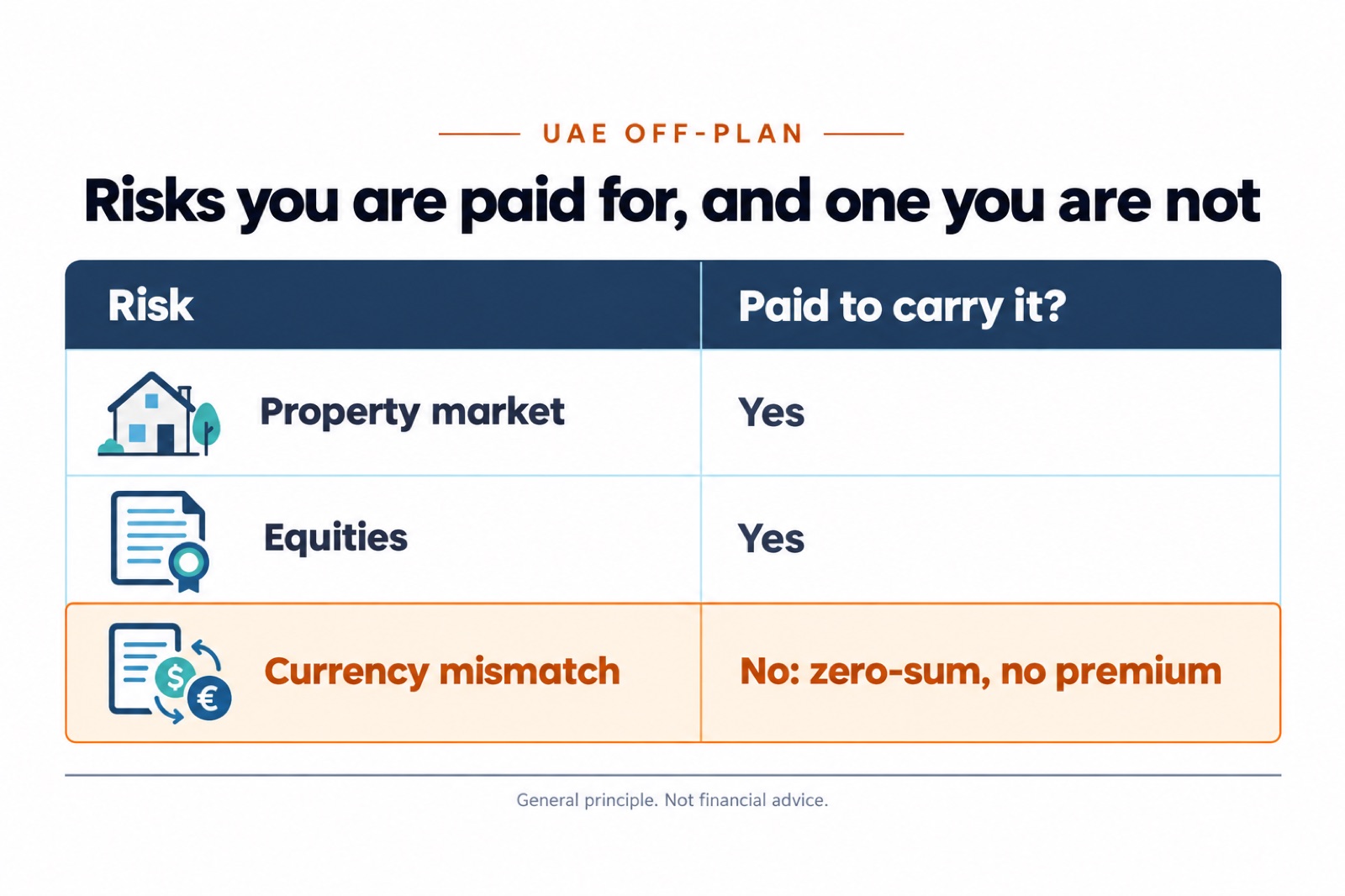
Foreign exchange has no risk premium.
When you take property risk, you are being paid to take it. You accept that the market might soften, that handover might slip, that the building might underperform, and in exchange you have an expected long-run return. Same with equities. The volatility is the entry fee and the return is what you bought with it.
Currencies do not work like that. They trade against each other in a zero-sum relationship. One gains exactly as another loses. There is no productive asset underneath the pair generating a premium for anyone. Nobody is paid, over the long run, for holding sterling instead of dirhams or dirhams instead of sterling.
So an unexamined currency mismatch is the one thing in your entire financial position that has volatility and no expected return attached to it.
That distinction did something to how I think about it. A property risk you took on purpose is a decision, and you can argue for it. A currency mismatch you took by accident is not a position at all. It is a leak. And a leak is worth closing regardless of what you think markets are going to do, which is a much easier conversation than the one where somebody has to have a view on the pound.
A number I will not repeat, and why
There is a version of this topic circulating that I want to push back on, because it is aimed directly at the buyers I work with.
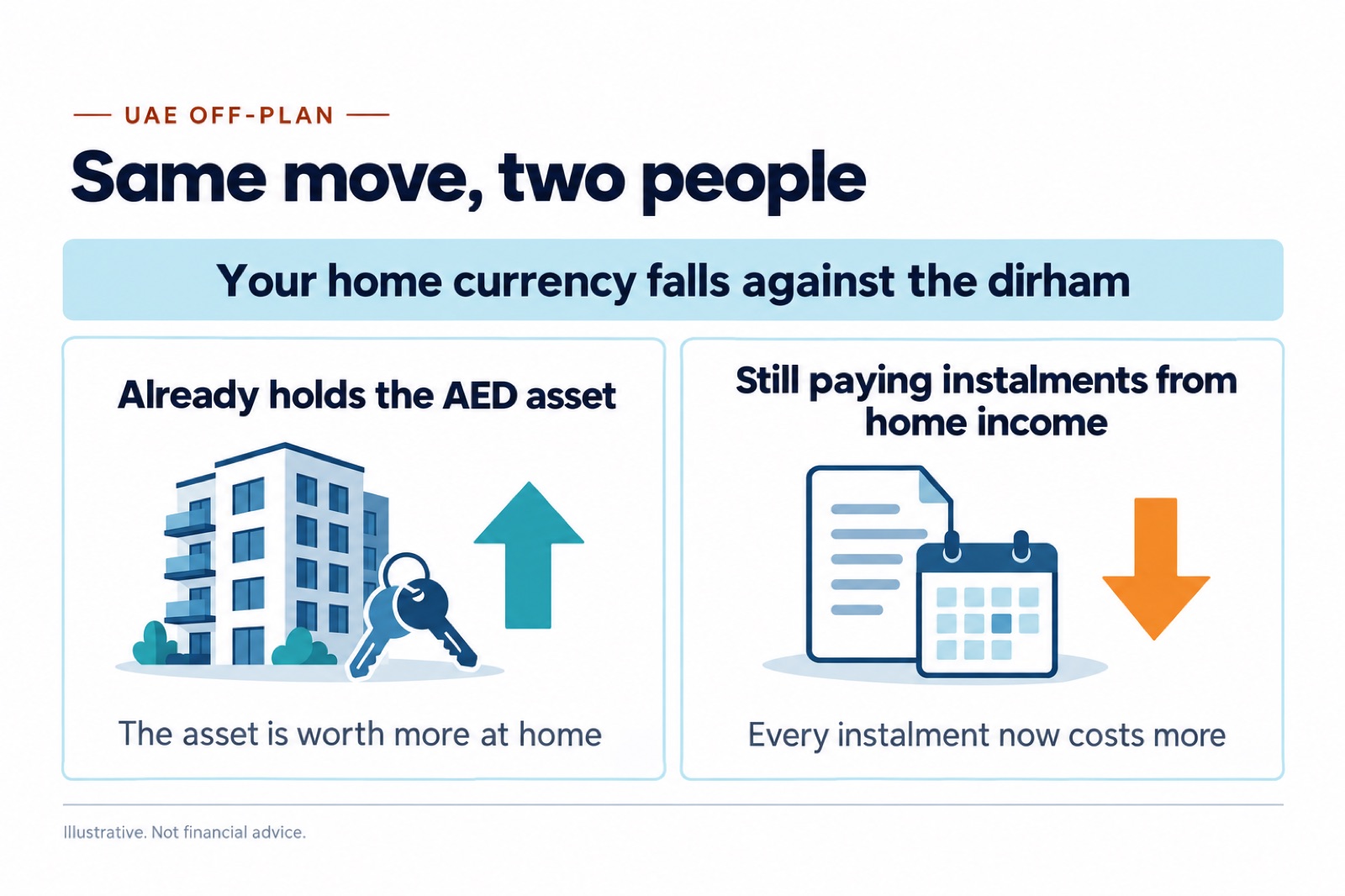
It goes like this. The Pakistani rupee fell around 57% against the dirham over five years. The Indian rupee around 23%. Therefore anyone holding Dubai property in that period earned a "currency bonus" of 57% or 23% on top of their property return.
Two things wrong with it, and the second is the one that bothers me.
The arithmetic does not invert. A currency falling 57% one way does not produce a 57% gain the other way. Percentage moves are not symmetrical across a reciprocal, and the version being published overstates the effect by a wide margin.
But the real problem is the direction. That gain, such as it is, belongs to somebody who already owned the dirham asset before the move. For somebody converting home earnings into dirhams to fund instalments across those same five years, the identical movement made every payment progressively more expensive.
Same event. Opposite sign. Entirely depends which side of the purchase you were standing on.
And the people reading that content are, overwhelmingly, prospective buyers. Which means the most widely circulated framing on this topic describes an outcome the reader did not have, and quietly presents their cost as their gain.
I am not going to name where I found it. It is in enough places that naming one would be arbitrary, and one of them was the AI summary of my own research, which is its own lesson about checking the thing that summarised your sources for you.
The exercise I now do with every overseas buyer
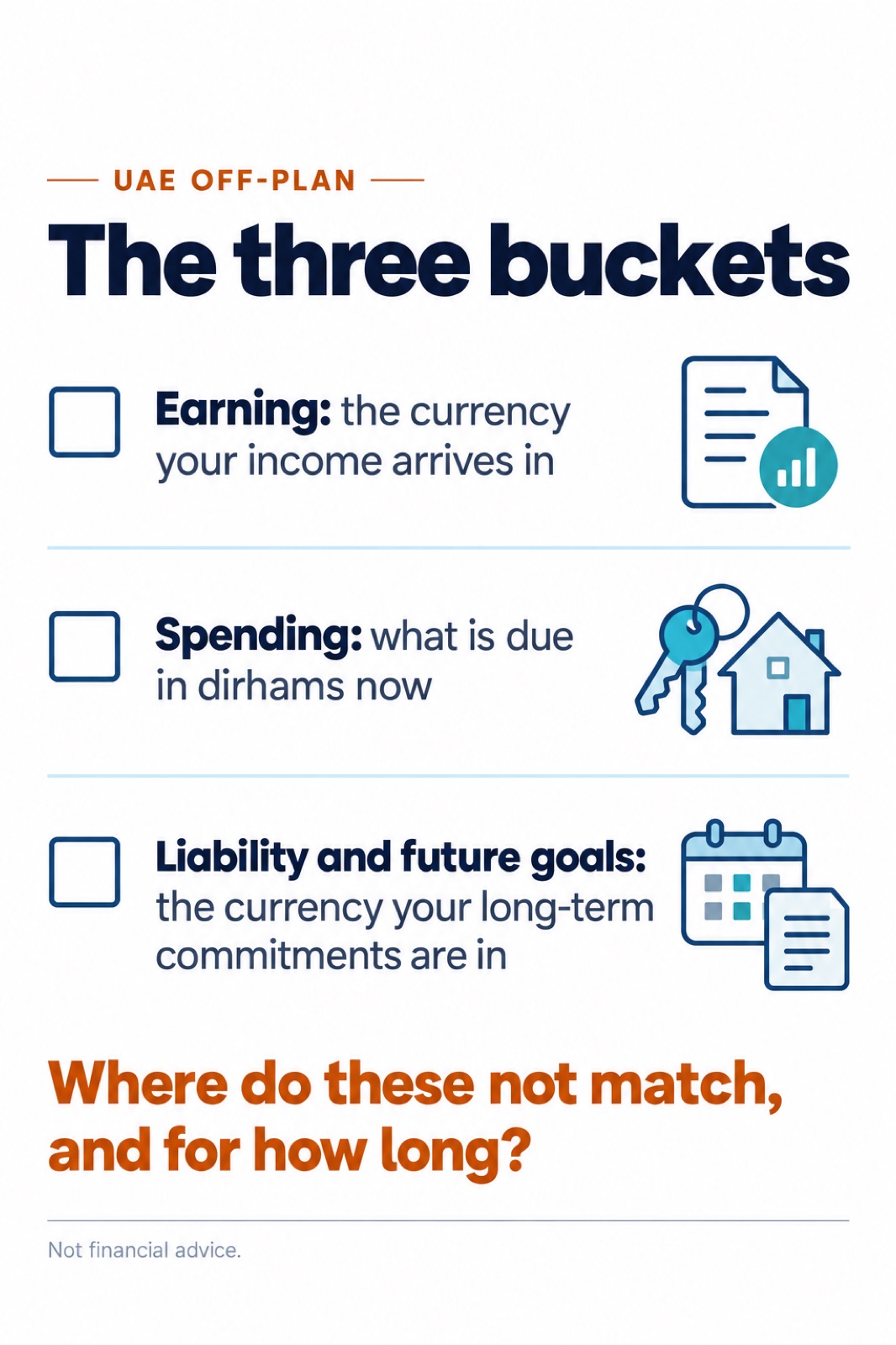
Three buckets. Twenty minutes. No adviser, no software, no permission needed.
What currency does your income actually arrive in. Not where you live. Not where the company is registered. What hits your account.
What is due in dirhams right now. Rent, school fees, service charge, instalments.
What currency are your long-term commitments in. Retirement somewhere else. University fees abroad. A mortgage still running at home.
Your exposure is the gap between what you receive and what you owe, over the period you owe it. That is arithmetic. It requires no forecast and no opinion about central banks, which is why I like it.
The interesting thing is where the surprise lands. It is almost never in the first two buckets, because people know what they earn and what they pay. It is nearly always in the third, where somebody has spent five years building a dirham asset base to fund a life they fully intend to live in a completely different currency.
That is not a bad decision. It might be a very good one. But it should be a decision, and for most people it is an accident.
Where I stop
I am a broker. I am not licensed to advise on any of this and I am not going to pretend otherwise by dressing up an opinion as information.
So I will tell you the terms so you can ask about them properly. Natural hedging, which is matching what you owe to what you earn. Forward contracts, which fix a rate now for a payment later and are available here out to two years. Staged conversion, which averages rather than bets. Multi-currency accounts. Options.
Every one of those costs money and carries commitments that I have not examined and am not qualified to examine. A fixed-date forward against a construction schedule that slips is a specific trap and I am not the person to walk you through it.
That is a list of words to take to a regulated adviser, not a menu to order from.
The one thing I will be direct about, because it is a cost rather than a risk and it is not advice to point at it: the rate you get is not the rate in the news, and the gap between them is usually bigger than the fee sitting next to it. Banks are reported at two to four per cent above the mid-market rate. Specialists at a fraction of that, though the sources disagree on the fraction, which tells you it is not standardised. On a two million dirham purchase the difference has been put at forty to eighty thousand dirhams.
I am not naming providers. A lot of the comparison content on this is written by the providers being compared, and at least one of the sources in my research was a company's own page explaining why it beats its competitors. You do not need a provider name to run the check. Take a rate you were quoted, take the mid-market rate for that day, work out the gap as a percentage. Do it once and you will know what the whole payment plan has been costing you.

What I think this adds up to
The thing I keep coming back to is that this is not a sophisticated risk. It does not require a model. It requires somebody to write a second column next to a payment plan they already have, and almost nobody does.
If you take one habit from this: whenever a schedule of future payments is put in front of you, ask what currency each payment is in and what currency you will be paying it from. If those differ, you have a position, and you should know the size of it.
And if you take a second: be suspicious of any content that tells you a currency move made you money on a property you were still paying for. Ask who it made money for, and check whether that is you.
Neither of those is expertise. They are just refusing to accept a number because it is being handed to you cheerfully.
Idris Dad writes about off-plan strategy across Dubai, Abu Dhabi and Ras Al Khaimah.
More on how I work with buyers at offplancrypto.com.
Nothing here is financial advice. I am a licensed real estate broker and not a financial adviser.