September 2026
The question I could not answer
A client asked me what happens if his developer does not register his unit.
I gave him the answer I have given a hundred times. There is a deadline, ninety days from signing in Dubai, and if the developer misses it there is a ten thousand dirham fine.
He said: fine paid to who?
To the Land Department.
He said: so what do I get?
And I did not have an answer. I went looking for one and I could not find one. Not in the statutes I could access, not in the law firm briefings, not in any of the guidance written for buyers. The obligation sits on the developer, the penalty runs to the government, and the person whose money is already gone is not a party to any of it.
That is the piece. A fine is a penalty on somebody else. It is not a remedy for you. And I had been describing one as though it were the other for years.

What registration actually is
Worth being precise, because this is the thing buyers understand least and it is not complicated.
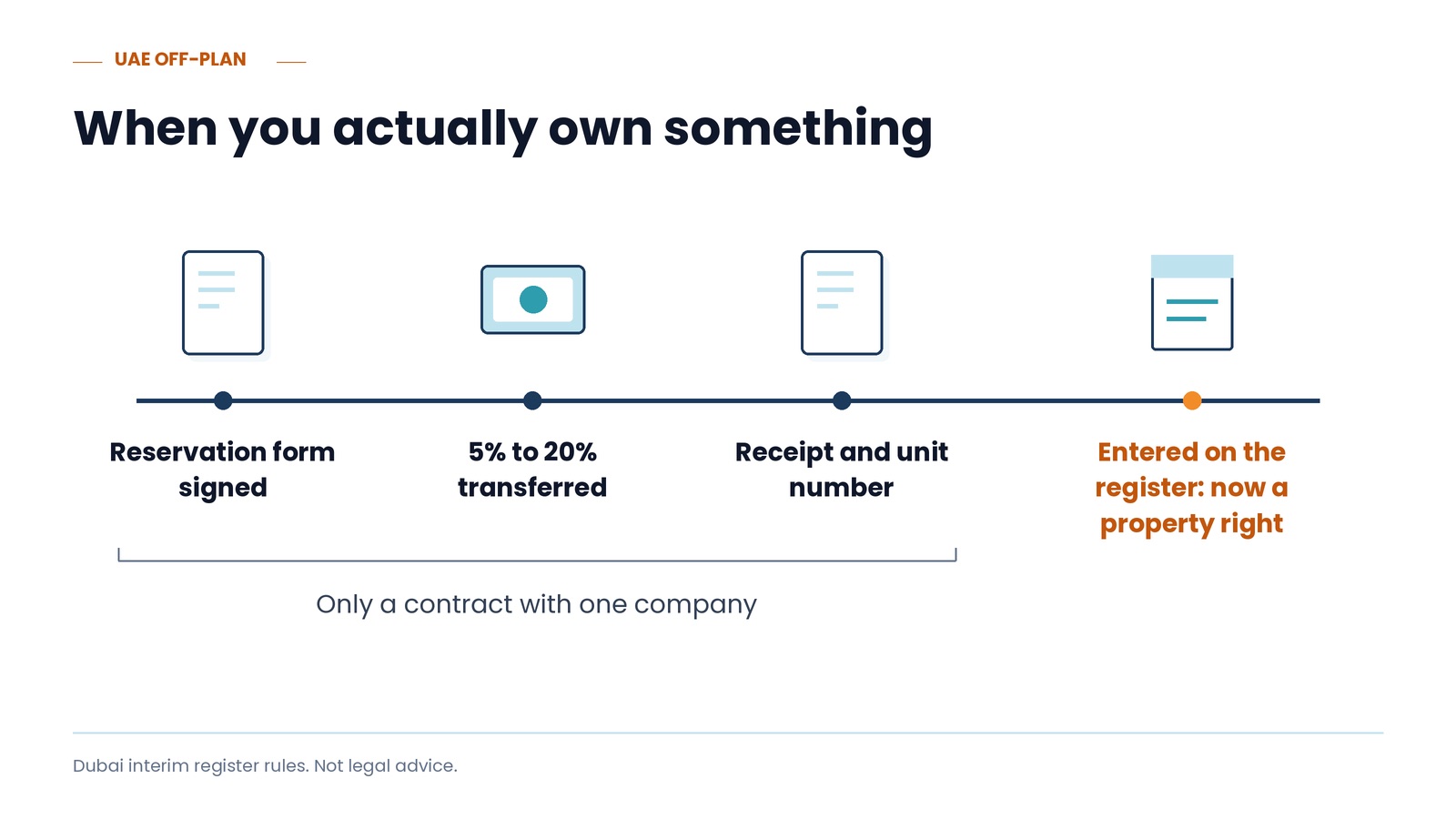
There is a moment in every off-plan purchase when the transaction stops being an arrangement between you and one company and becomes a fact about a piece of land that binds everyone. That moment is registration. It is not the deposit, it is not the SPA, it is not the handover.
Dubai states the position bluntly. An off-plan disposition not entered on the interim register is void as a property disposition. The agreement may survive as a personal contract between the two parties who signed it. So you can still sue. What you do not have is a property right that means anything to a third party.
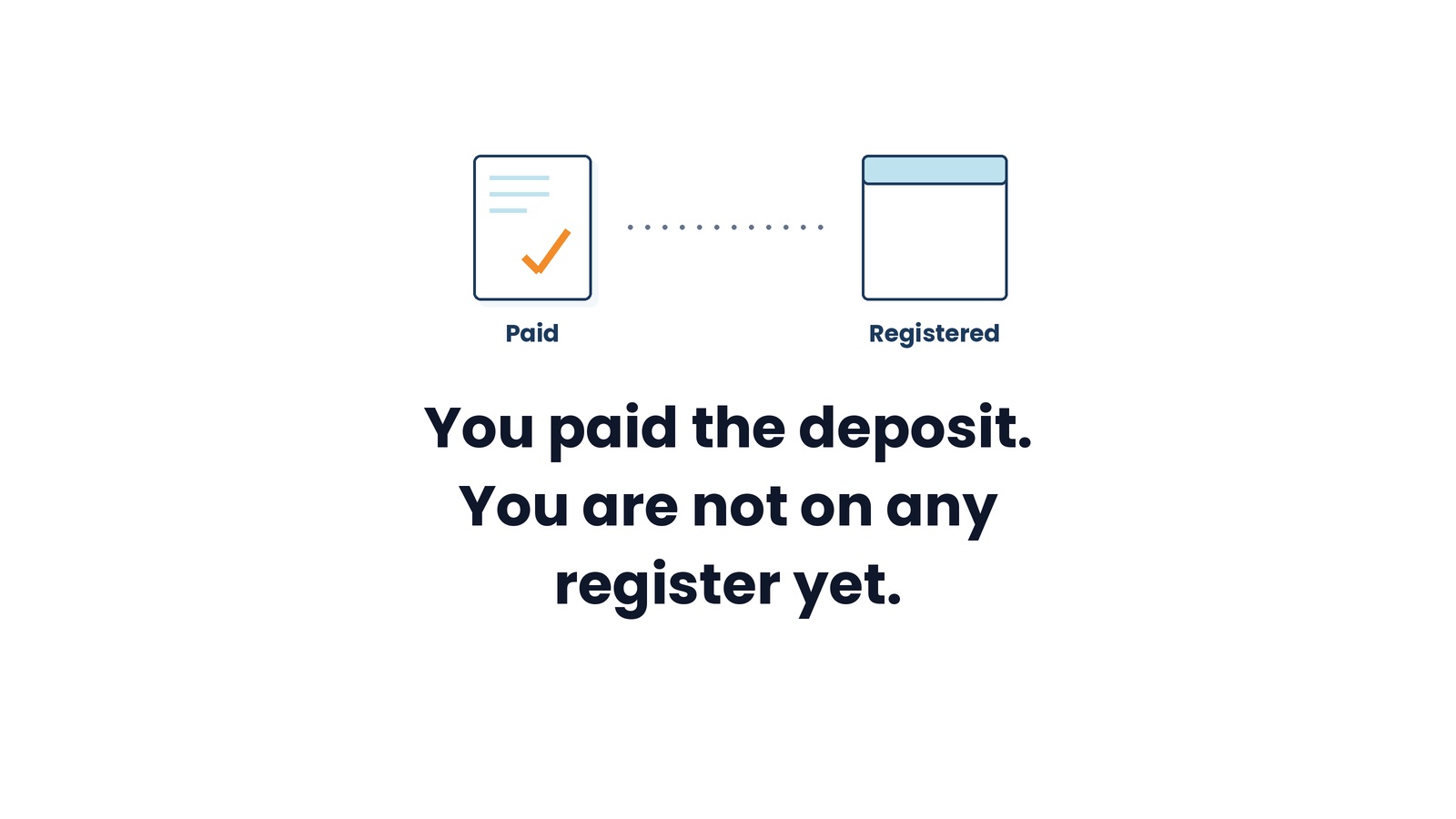
Registered, you have an interest in a unit. Unregistered, you have a claim against a company.
I have sold a great deal of off-plan and I have never once had a buyer ask me to confirm the registration reference in writing.

Three legal systems, not three variations
The second thing this research changed for me is that I had been treating the UAE as one market with local differences. It is not. On this question it is three legal systems.
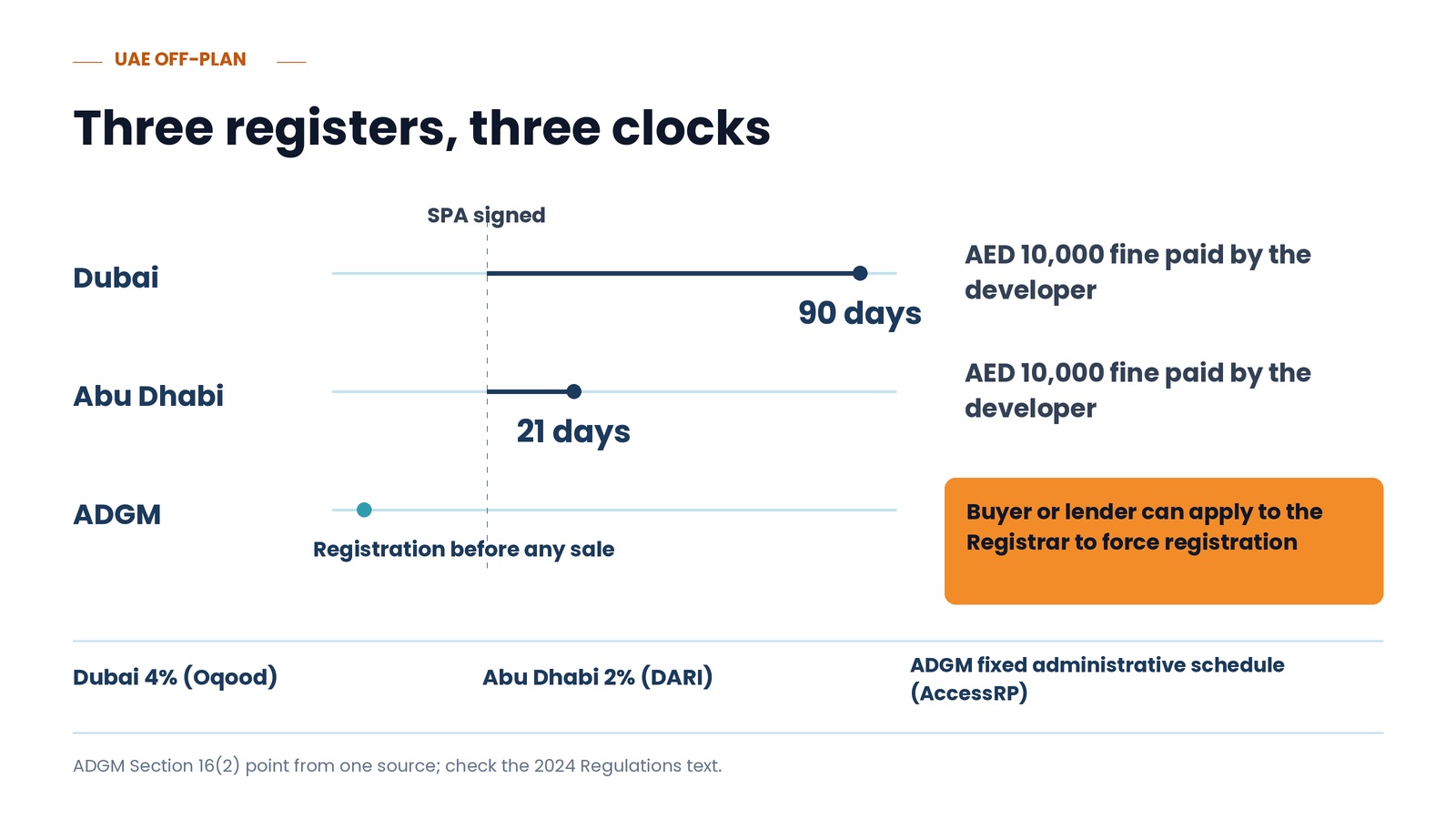
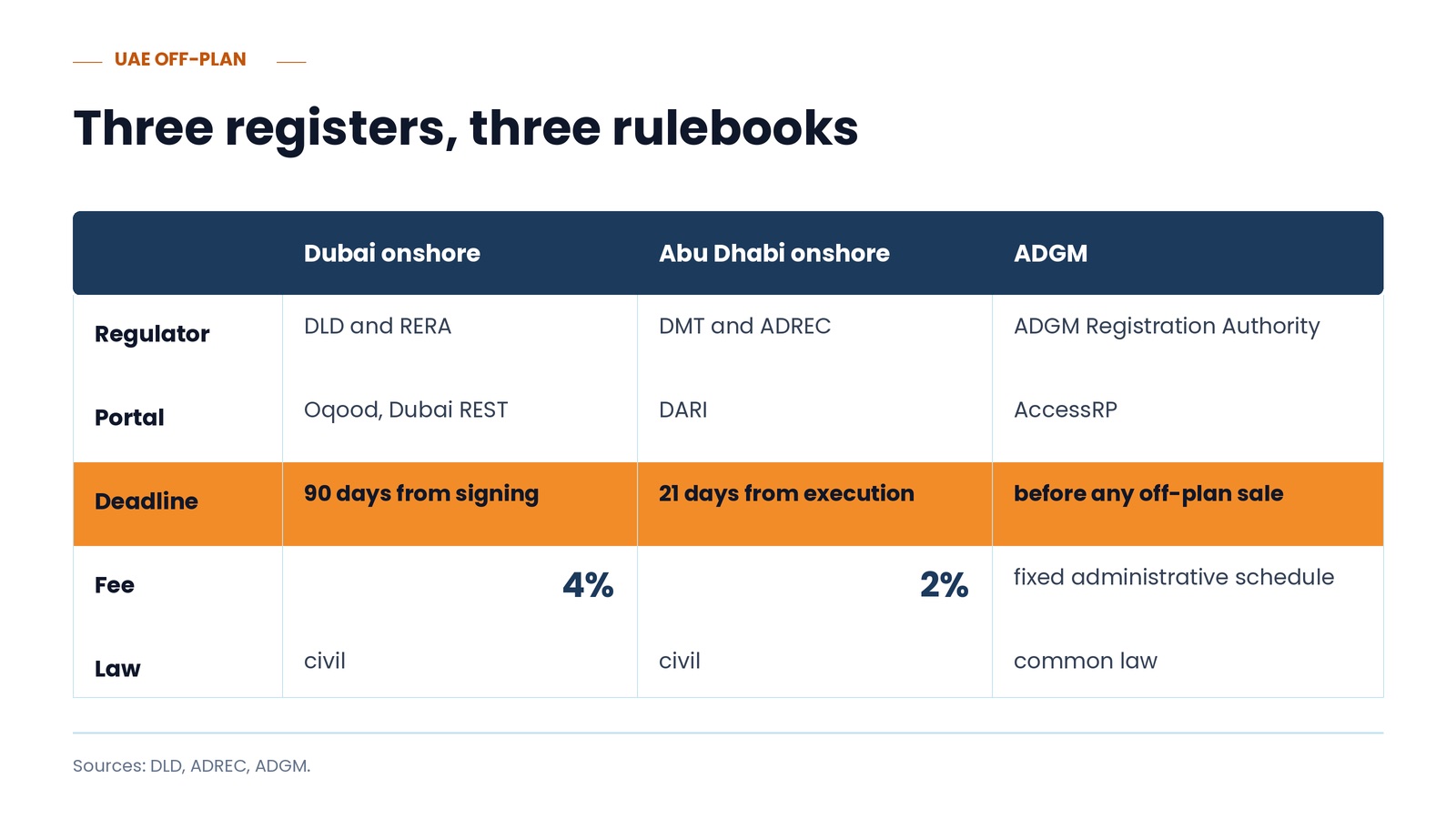
Dubai runs a civil law regime through the Land Department, on a register called Oqood, with a ninety-day deadline and a four per cent transfer fee.
Onshore Abu Dhabi runs a civil law regime through DMT and ADREC, on a platform called DARI, with a twenty-one day deadline and a two per cent fee.
And the Abu Dhabi Global Market runs a common law regime modelled on English principles, with its own registers, its own portal, and its own courts with a specialised property division.
Twenty-one days against ninety is not a detail. It is four times tighter, which means an Abu Dhabi failure is visible far sooner, which in turn means an Abu Dhabi buyer has a much better chance of catching it while it is still fixable.
The thing I did not know, and the reason I wrote this
On 1 January 2025, ADGM's jurisdiction expanded to include Al Reem Island.
I want to sit on that for a second, because of what it means practically rather than legally. Al Reem is not a financial free zone full of law firms. It is ordinary residential stock that ordinary people buy. And overnight, transactions there moved into a common law property regime with different registers, a different portal and different courts.
Which means every guide written about buying on Al Reem Island before 2025, including things I have probably said, describes a system that no longer applies there.
Then I found the clause that made me want to write the article.
Under Section 16(2) of ADGM's Off-Plan Development Regulations 2024, if a developer delays registering an off-plan sales agreement, the purchaser or their mortgage lender can apply directly to the Registrar and force the registration through.
There it is. The answer to my client's question, in the one regime out of three where it exists.
Onshore, a slow developer owes ten thousand dirhams to the government. In ADGM, a slow developer gets overruled by the buyer.
That is not a bigger penalty. It is a categorically different kind of protection, and it is the single clearest example I have seen of what a common law property system does differently.
Where I have to be honest about my own homework
The Section 16(2) point is the most important thing in this article and it is the thing I am least able to stand behind.
It comes from one item in my research. The regulations themselves are published, and they were sitting in the same research folder, and I have not read the section text directly. I am telling you that rather than letting it sit there looking solid, because a fact that carries an article number reads as verified whether or not anybody verified it, and that is exactly how bad information travels in this market.
There is a second one, and it has a better ending.
I found two different law numbers for the same Dubai provision, the one in Article 11 that sets what a developer can retain when a buyer defaults. One body of research said Law No. 19 of 2017. Another said Law No. 19 of 2020. The tiers and the procedure matched in both. Only the number moved.
I refused to pick. I wrote it as "as amended" and left it there, on the basis that I would rather look incomplete than confident and wrong.
Then I went through the next stack of research and it settled the thing. Both laws exist. The 2017 amendment came first. The 2020 amendment replaced it, and it is the one that applies now.
And the difference is not cosmetic. The 2020 version moved the calculation from the completion of your unit to the completion of the whole project, and it added a tier that was not there before: if a project has not started, or RERA has cancelled it, the developer retains nothing and refunds in full through escrow.
So if you read a warning about off-plan default that keys the retention tiers to how finished your specific apartment is, that article is running on a rule that was superseded years ago, and it is not telling you about the tier where you get all your money back.
A law number is the easiest thing in the world to copy from someone who copied it from someone else. The whole reason I caught this is that I refused to copy either one.
The three twenty per cents
One more, because it comes up constantly and it gives people a false sense of safety.
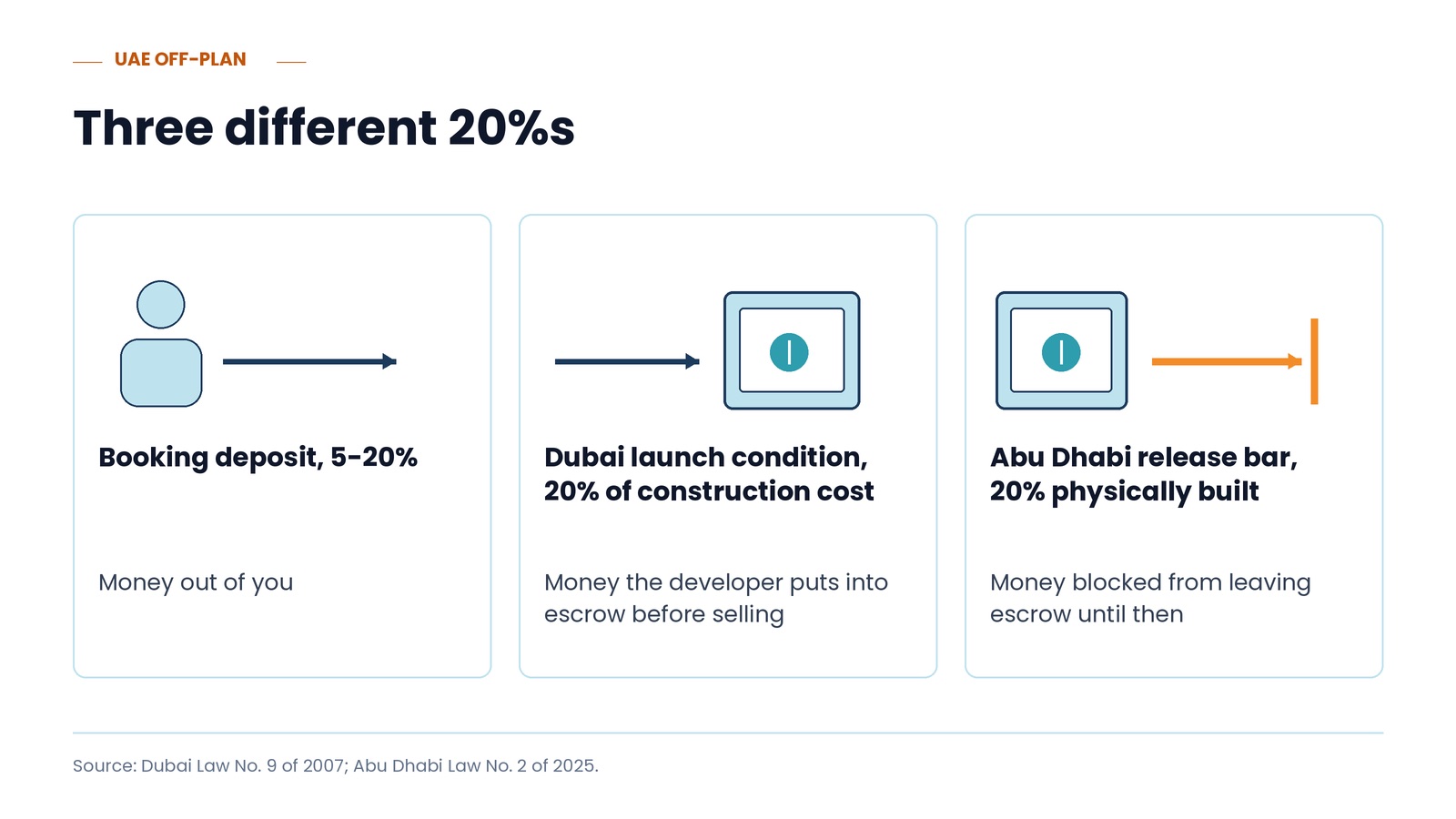
Three separate rules in this area use the number twenty per cent.
The booking deposit is five to twenty per cent of the price. That is money leaving you.
Dubai's launch condition requires a developer to put twenty per cent of estimated construction costs into escrow in cash before marketing anything. That is money the developer has to commit before they are allowed to approach you at all.
Abu Dhabi's release bar stops any escrow money reaching the developer until the project is twenty per cent physically built. That is money the developer cannot take out.
One is your exposure, one is a solvency test at the start, one is a gate during construction. When somebody in this market tells you "there is a twenty per cent rule that protects you", they may be describing a rule that has nothing to do with you.

What I think this adds up to
The thing that bothers me most is how easy the fix is.
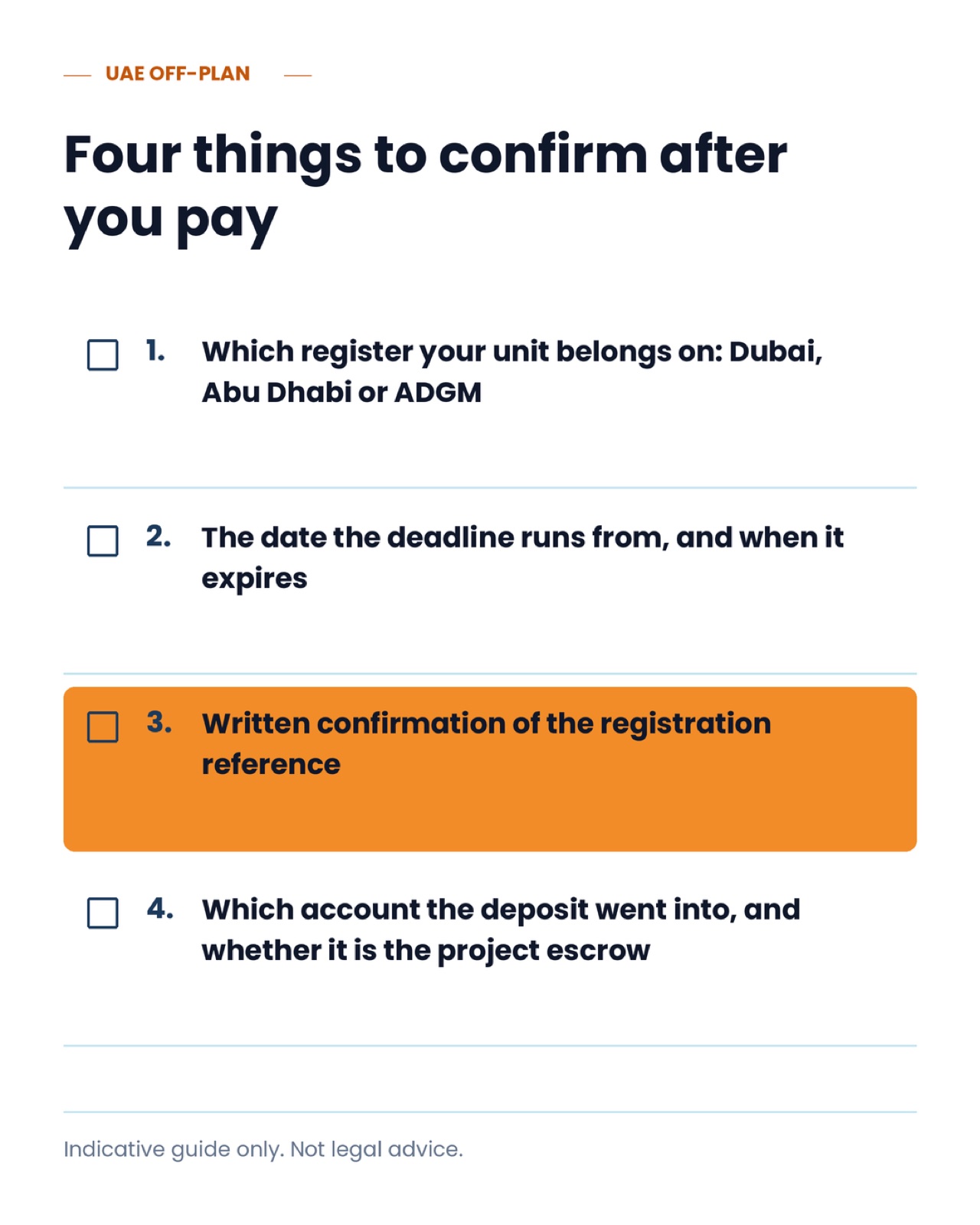
Diarise your own registration deadline on the day you sign. Ninety days or twenty-one days from the date on the SPA in your hand. Then ask for the reference in writing when it passes. That is a calendar entry and an email, and it is more than almost any buyer in this market does.
And a habit worth taking beyond this topic: when someone tells you a rule protects you, ask what it entitles you to do. A great deal of what gets described as buyer protection in this market is an obligation placed on somebody else, enforced by somebody else, for the benefit of somebody else, and the honest way to describe it is not protection at all.
A fine is not a remedy. It took a client asking a simple question for me to notice.
Idris Dad writes about off-plan strategy across Dubai, Abu Dhabi and Ras Al Khaimah.
More on how I work with buyers at offplancrypto.com.
Nothing here is legal advice. I am a licensed real estate broker, not a lawyer.