September 2026
The stat I liked
A market report landed in my inbox this month. Serious-looking. Formulas in it. The kind of document that makes you feel like an analyst rather than an agent.
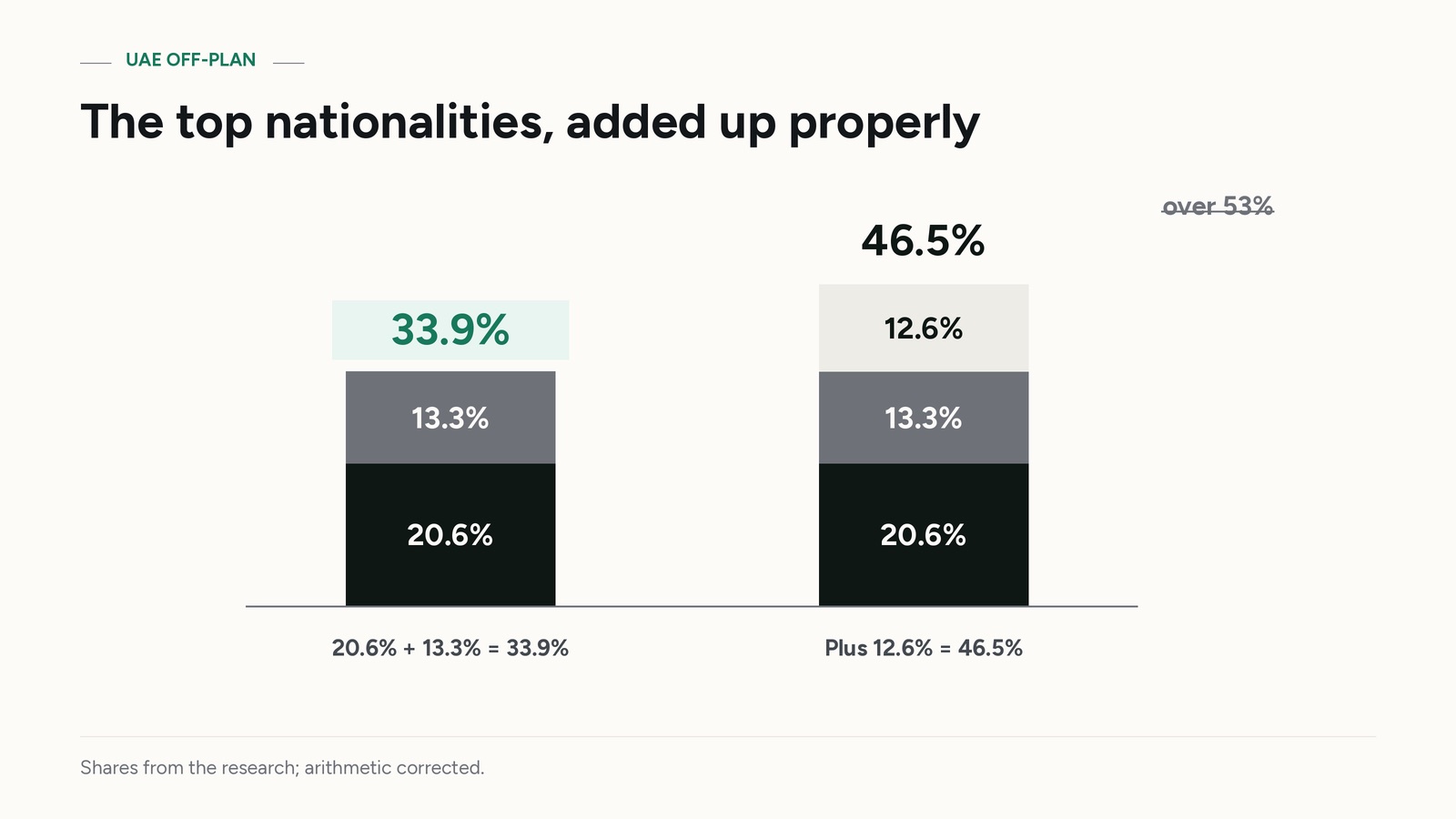
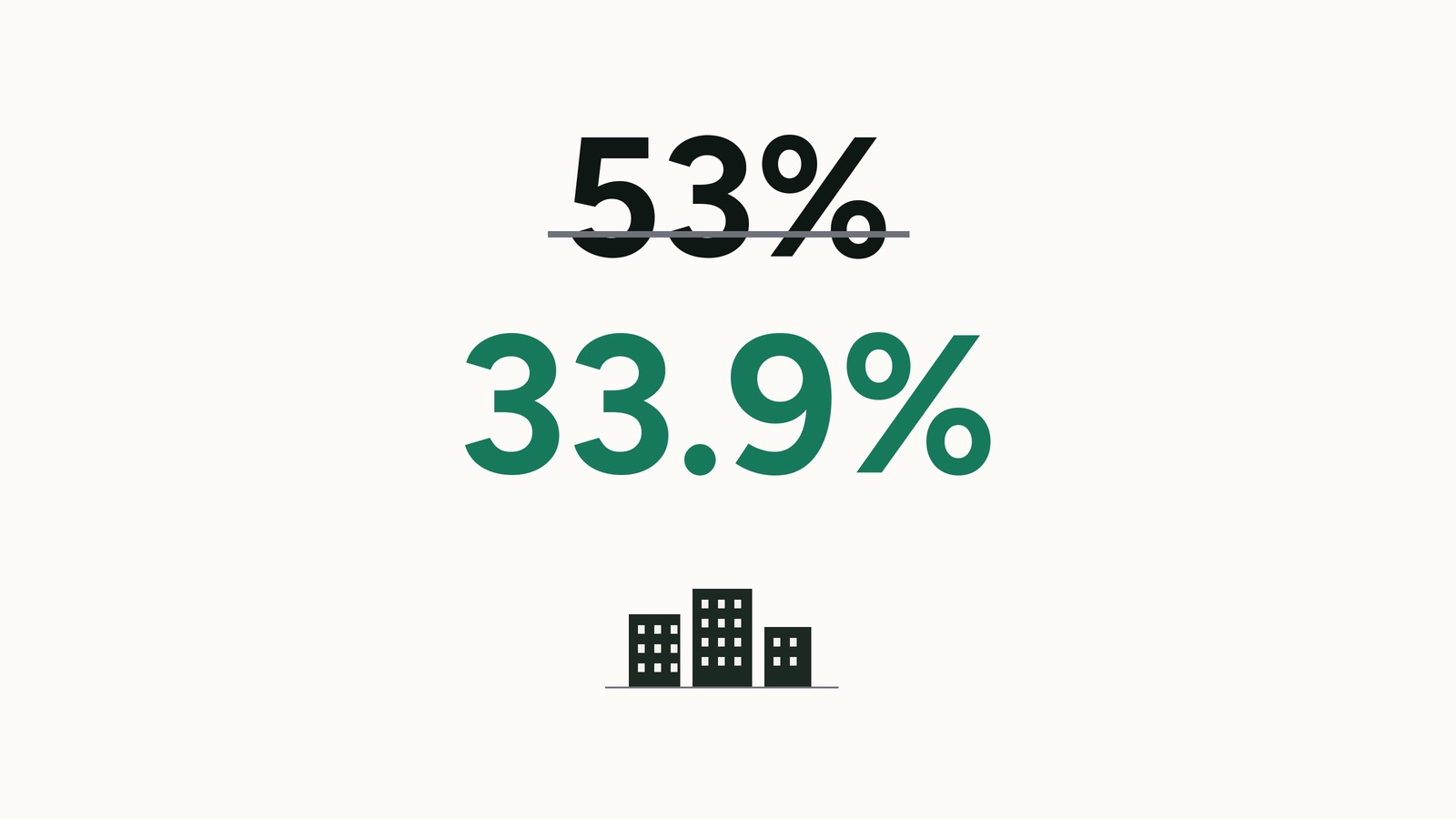
One line stopped me in a good way. It said the top two buyer nationalities in Dubai, at 20.6% and 13.3%, "represent over 53% of overall capital inflows", and that this is a systemic concentration risk.
I thought: that is a useful stat. I will use that.
I had it open in a tab for about a week before I added the two numbers together.
Twenty point six plus thirteen point three is thirty-three point nine.
Not fifty-three. You can add the third-placed nationality at 12.6% and get to 46.5, but the report does not do that. It names two and claims over half.
I want to be precise about why this bothers me, because it is not really about a report.
I did not check it because it flattered me. A stat that says "this market has a hidden risk most people are ignoring" makes the person quoting it sound careful. I am a broker in a market that rewards enthusiasm, and I have spent two years trying to be the one who is not enthusiastic. So a number that made me sound cautious walked straight past the part of my brain that checks numbers.
If that report had said "foreign demand is unstoppable, buy now", I would have had my calculator out inside a minute.

The bigger thing I was doing wrong
The report is a symptom. The thing underneath it is something I have done in client meetings for two years and I have only just seen it.
When somebody gets nervous about an off-plan purchase, the thing I reach for is the inflow number. Look how much foreign capital came in. AED 148 billion in a quarter. Thirty thousand first-time buyers. The money is coming.
It works. It calms people down. And it is an answer to a question they did not ask.
They are not asking whether money is coming into Dubai. They are asking whether their unit, in their building, will find a buyer in the year they need one, at a price that makes the last three years worth it.
The inflow number says nothing about that. Nothing at all. It is a measurement of how much came in, in a period that has already ended, into a market of which their unit is roughly one eighty-six-thousandth.
Here is what does bear on their question, and it was sitting in the same research the whole time.
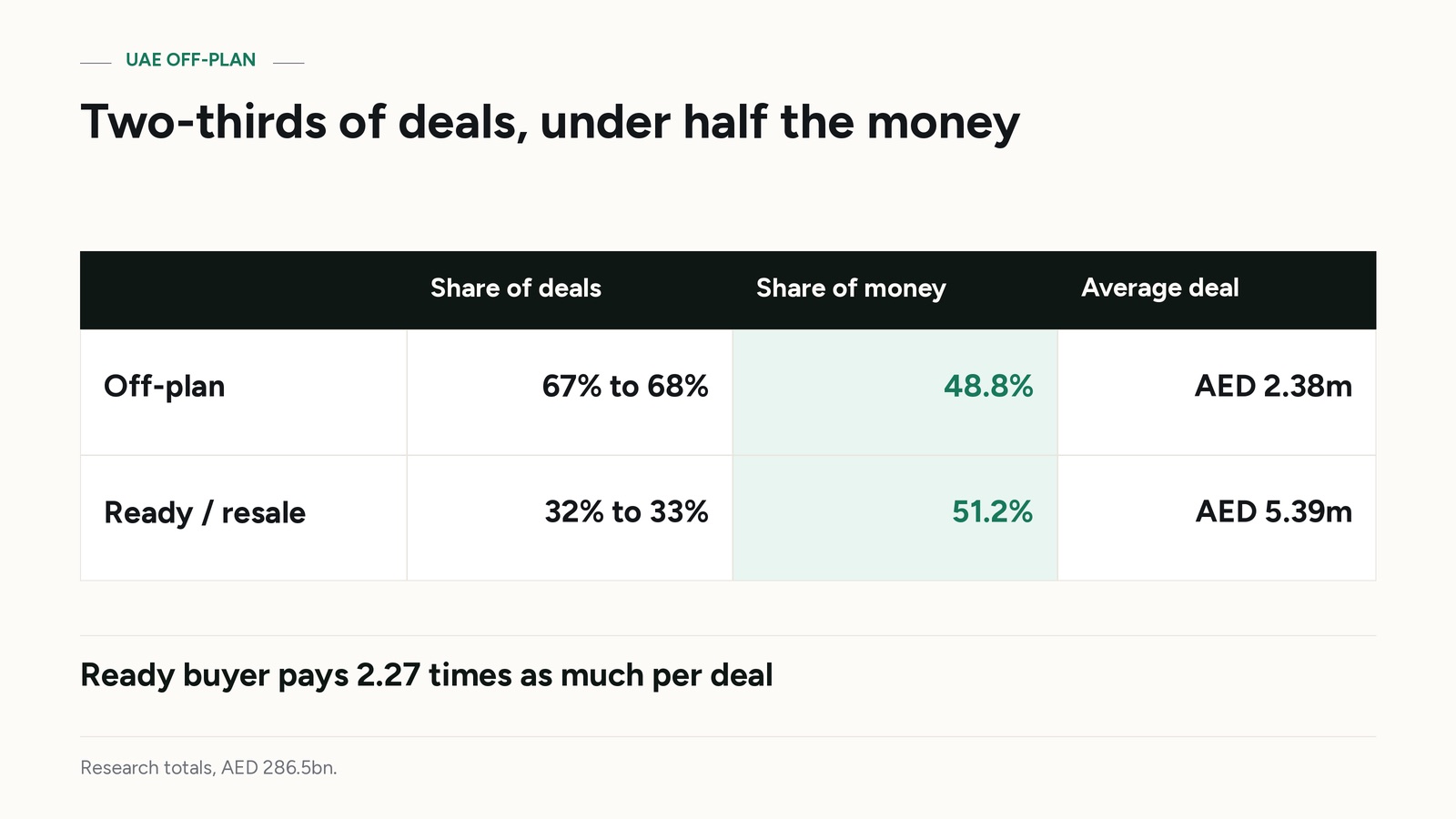
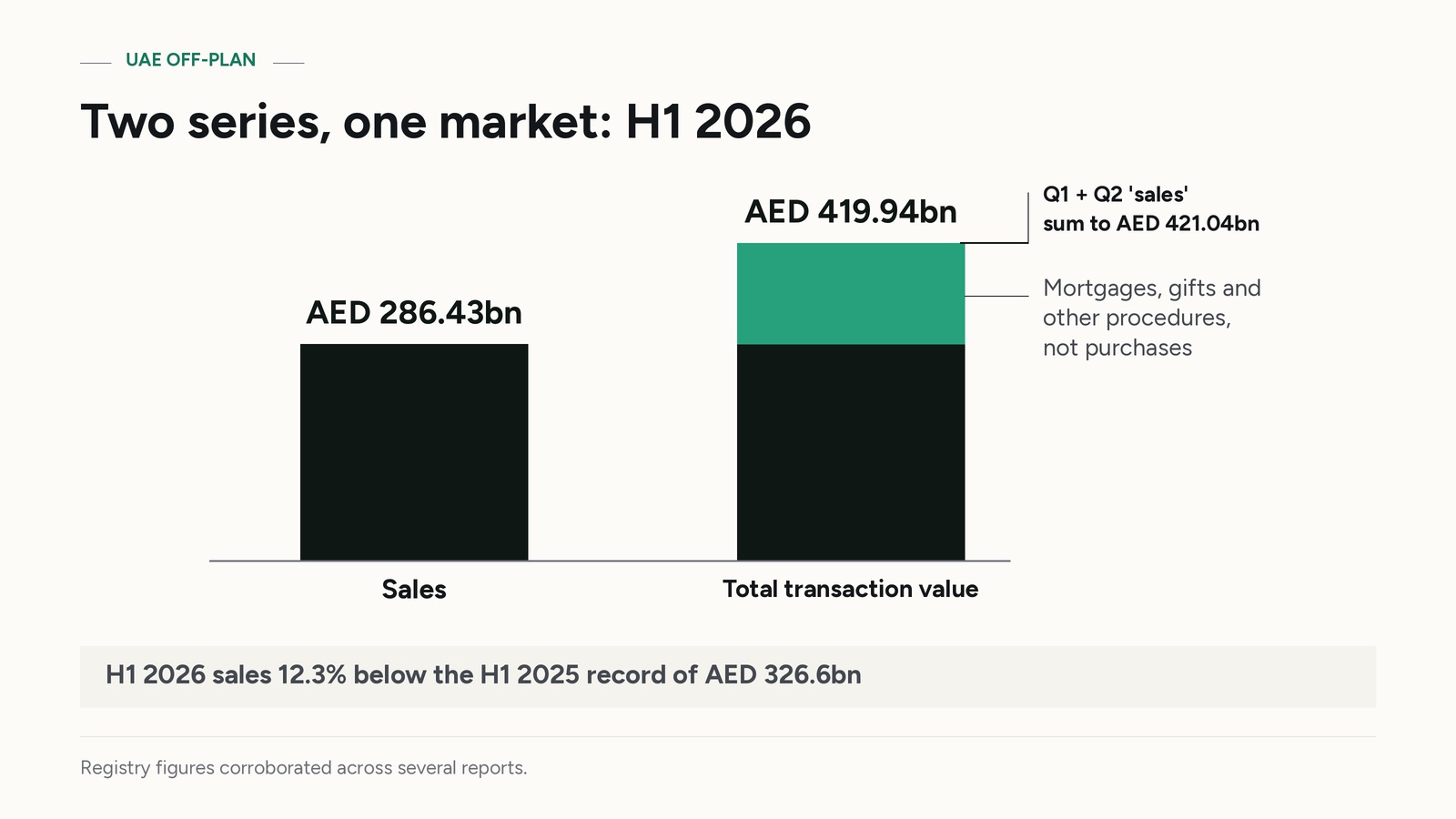
In the first half of 2026, off-plan units took about two-thirds of the transactions in Dubai and under half the money. Completed property took a third of the deals and just over half the money, at 2.27 times the average off-plan ticket.
Read that slowly. The volume is in stock that does not exist. The cash is in stock that does.
So my client, buying off-plan, is planning to sell into a market whose money is currently going somewhere else, against every other unit in the same tower handing over in the same quarter. That is the actual shape of their risk, and I have been answering it with a capital inflow statistic.
The number I never once calculated
There is one useful idea in that report and I will give it credit for it.
Work out what you are paying per square foot over completed resale stock in the same community. Off-plan price, minus resale price, divided by resale price. That is your premium. It is the number that decides whether your capital growth for the next three years has already been spent by the developer.
Simple. An afternoon's work. Registered transactions, same community, same size band.
I have never once run it for a client before they signed.
Not once. I have talked about location and handover and payment plans and service charges and I have never sat down and said, here is what this costs against what the finished thing next door actually sold for last month.
The reason is embarrassing and completely ordinary. By the time somebody is ready to sign, they are ready to sign, and producing a number that might stop them is not what the moment wants from you. So the comparison never happens, and it never happens to anybody, which is why nobody notices it is not happening.

And then the number itself came apart
Having decided to take the premium calculation seriously, I ran it on the research's own figures for the community it used.
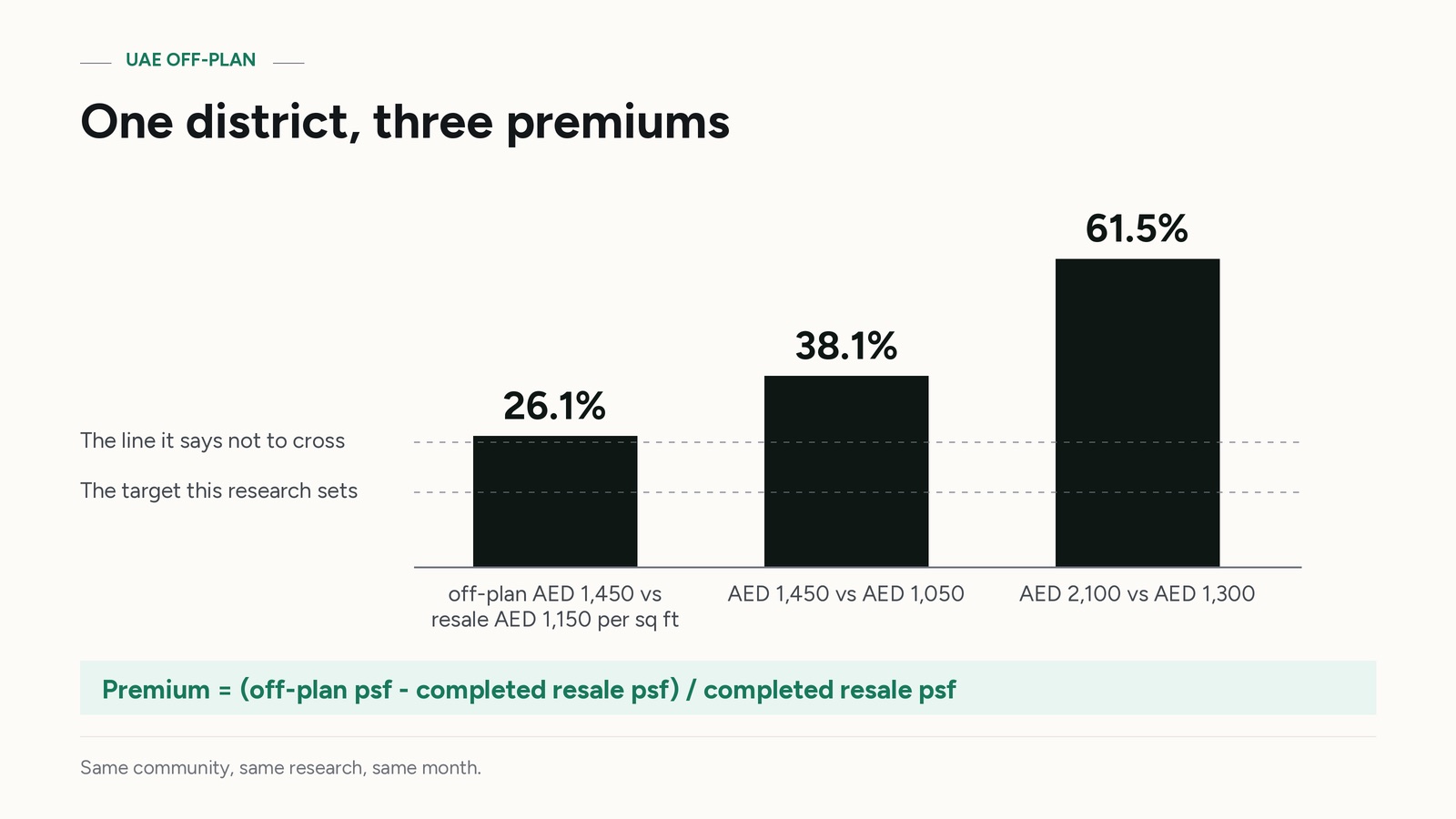
The report gets 26.1%. Off-plan at AED 1,450 per square foot, resale at AED 1,150. The arithmetic is right.
Then I used the other numbers in the same research set, for the same community, in the same month.
AED 1,450 against a resale figure of AED 1,050 from a community guide in the same notebook gives 38.1%.
A project page in the same notebook gives off-plan at AED 2,100 and resale at AED 1,300. That is 61.5%.
Twenty-six per cent, thirty-eight per cent, sixty-two per cent. Same district, same research, same month.
And the report's own rule is that you should target under 15% and treat anything over 25% as a market that has already spent your growth. The district fails on all three readings and the report does not notice, because it only ran one of them.
I have stopped being annoyed at the report. The formula is right and the formula is the gift. What it taught me is that precision and accuracy are different things and only one of them is visible. A number printed to one decimal place looks like work. It might just be one pair of inputs someone happened to pick up first.
The rule I cannot use
The report has three underwriting filters. The first one says no single nationality should be more than 20% of the buyers in a tower.
I spent an hour trying to work out how a buyer would check that. You cannot. Nationality is published at market level. A developer knows its own mix and has no obligation to tell you, and if it tells you, you have no way to verify it.
And the leading nationality is at 20.6% across the whole market, so every tower in Dubai fails a 20% cap on average.
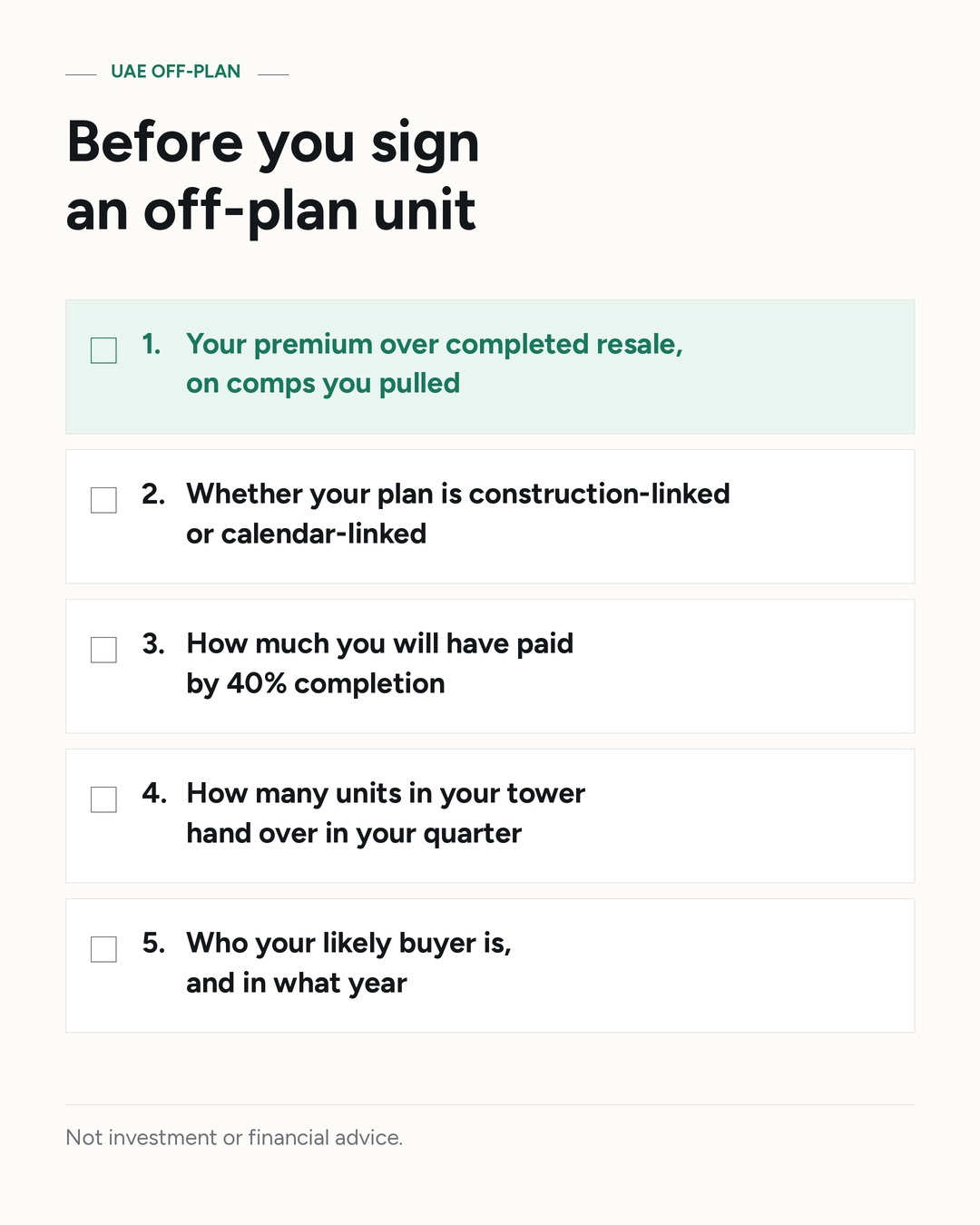
The second filter is better and it changed how I read a payment plan. Do not put in more than half your money before the structure is 40% built. Which is not really a rule about capital. It is a question about whether your plan tracks the building or tracks the calendar, and most buyers have never asked which one they signed.
What I take from it
Three things, and the third one is the one I will still be thinking about next year.
Inflow is not demand for your unit. It is demand for a market. Your unit is a specific thing in a specific building with a specific handover quarter and a specific set of competitors arriving beside it. Nothing in a national capital figure touches any of that.
Run the number before the meeting where they sign, not after. An afternoon of comparables, produced at the wrong moment, is worth more than everything else I do in a transaction. I have started doing it. It is uncomfortable and roughly half the time it changes nothing, which is exactly why it is worth doing the other half of the time.
And check the numbers that make you look good. That is the one that got me. I have built whatever credibility I have on checking claims that this market repeats without checking, and I sat on a false statistic for a week because it made me sound like the careful one in the room.
I did not forward it. But I was going to.
Idris Dad writes about off-plan strategy across Dubai, Abu Dhabi and Ras Al Khaimah.
More on how I work with buyers at offplancrypto.com.
Nothing here is investment or financial advice. I am a licensed real estate broker, not a financial adviser, and I earn commission on property in the market I have just written about. No developer, project or firm is named.