September 2026
A line I had read a thousand times
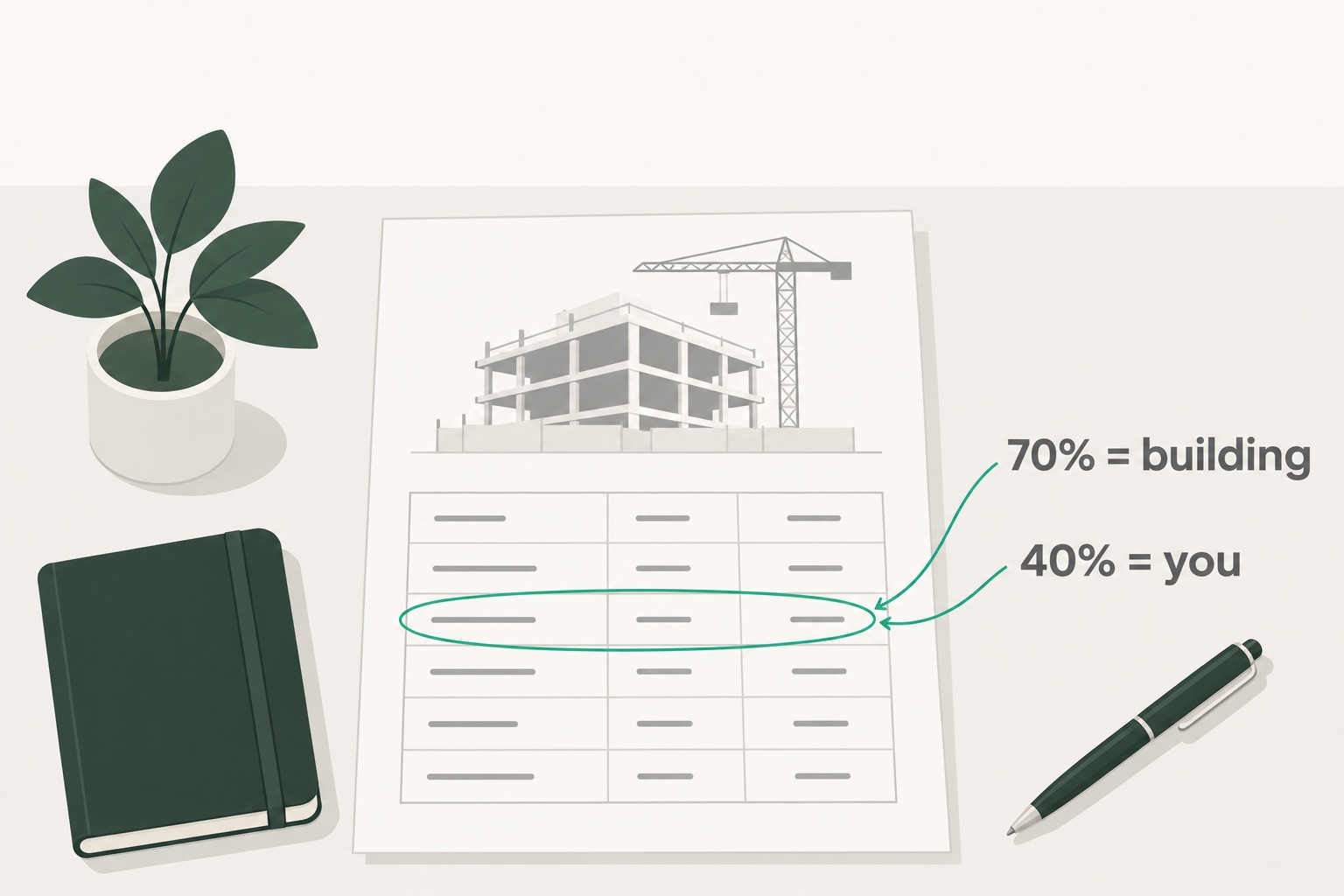
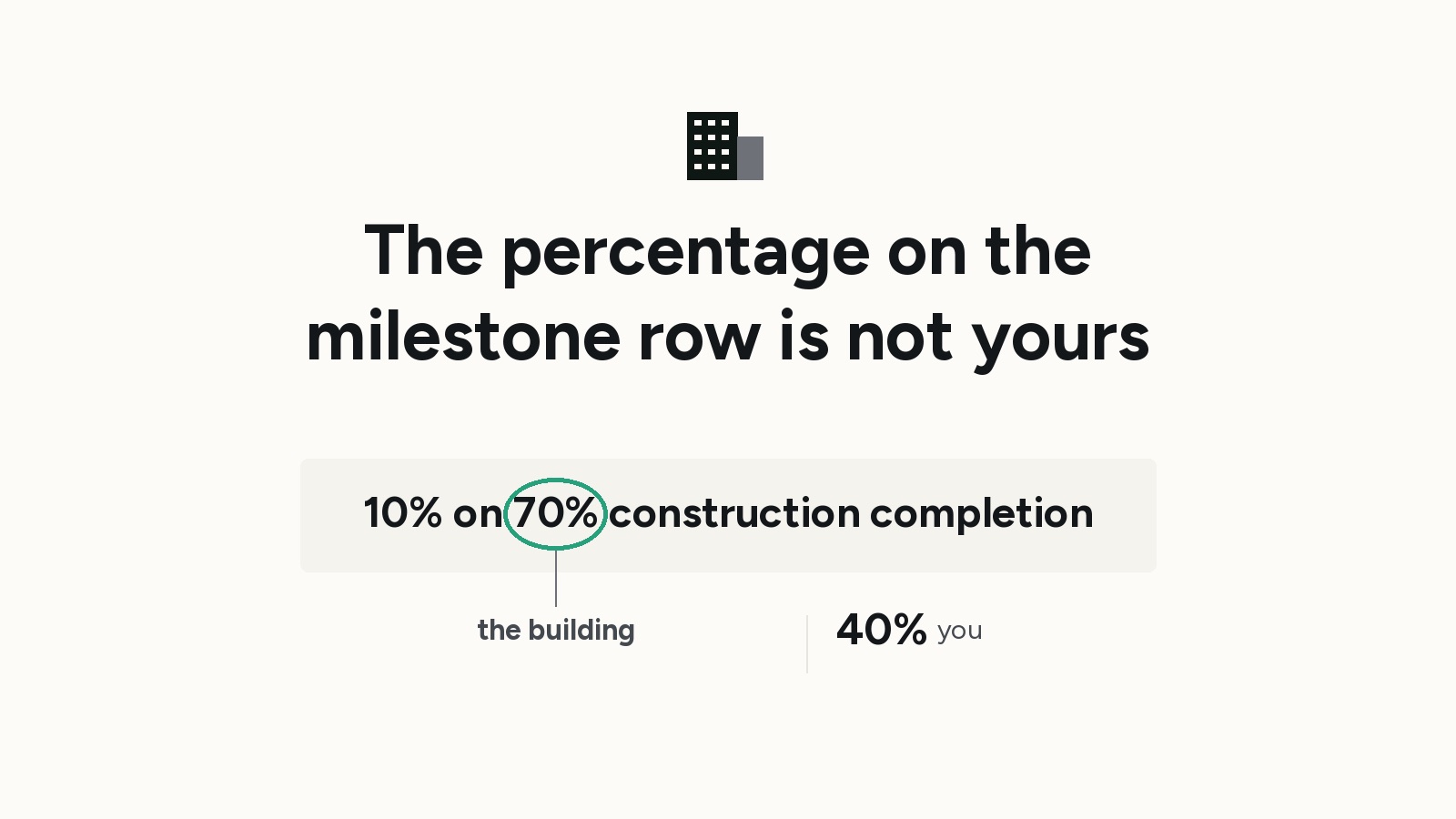
"10% on 70% construction completion."
I have read that line, or one like it, more times than I could count. On schedules I sent to buyers, on schedules buyers sent to me, on schedules I explained across a table.
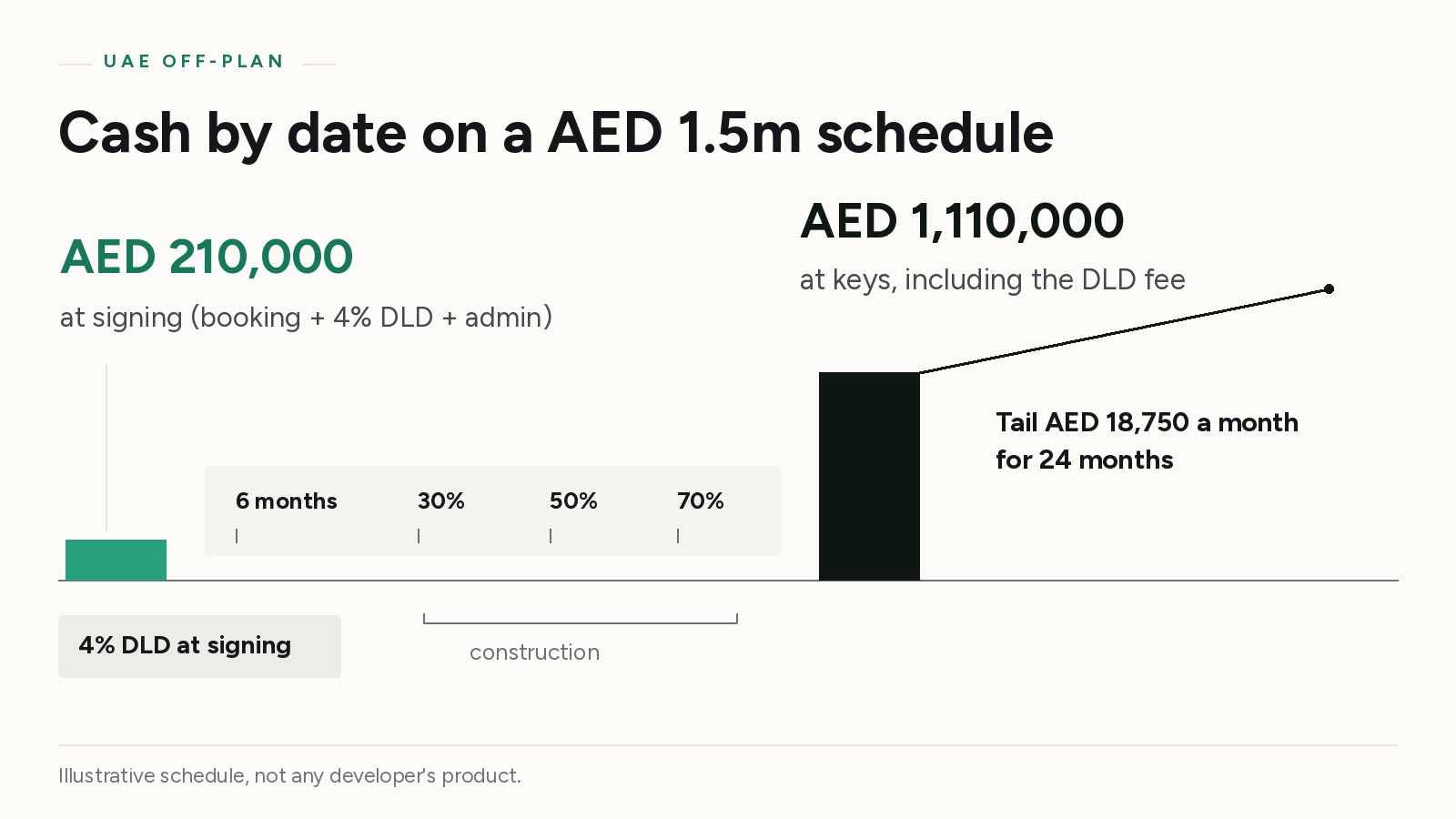
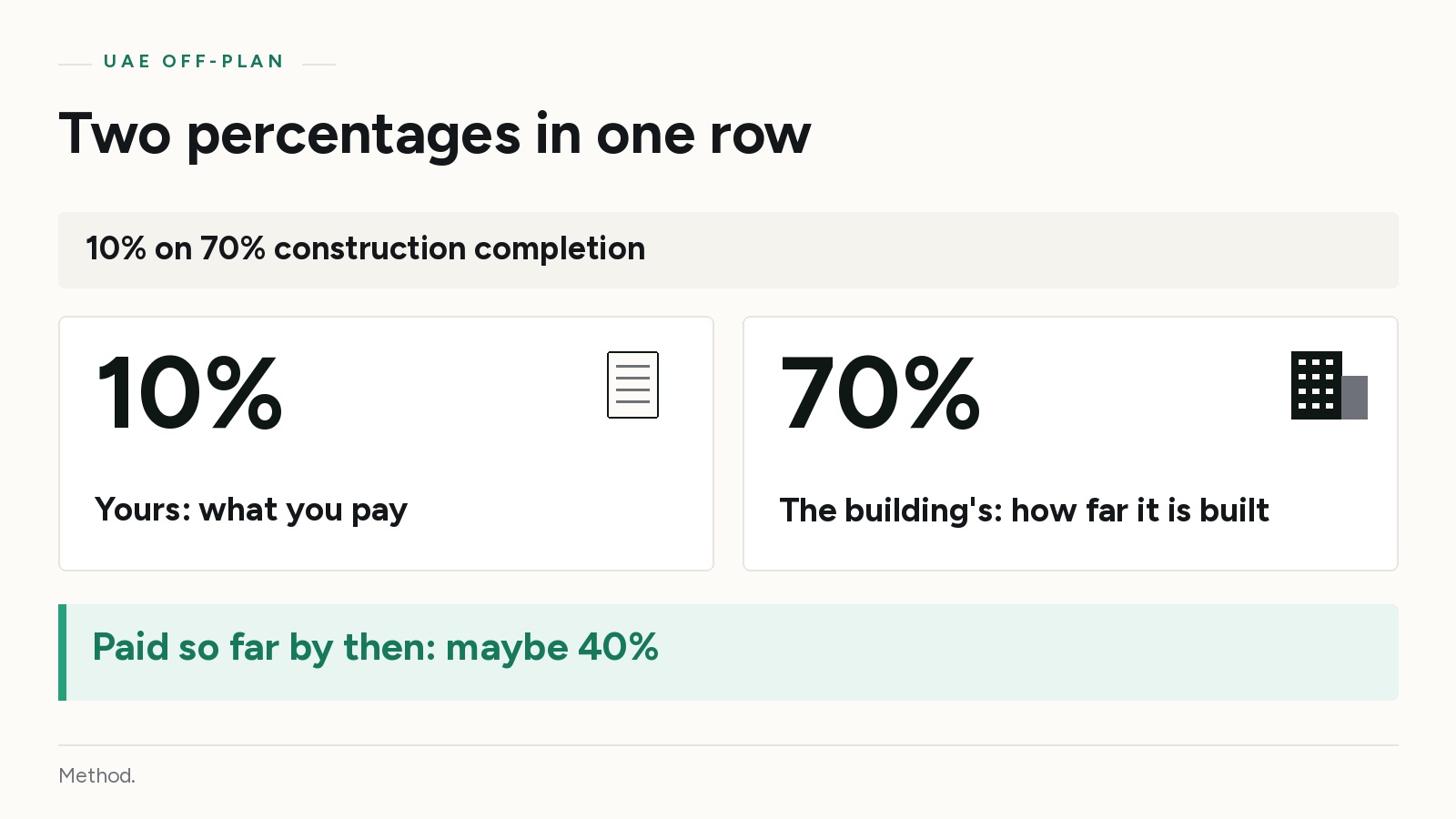
This month I sat down to write about how to read a payment plan, and I built a schedule from scratch to have something to point at. When I wrote the running total next to each row, the one that said 70% came out at 40%. Seventy is how far the building has to get. Forty is how much the buyer has paid when it does.
I knew that. Obviously I knew that. But I had never written the two numbers side by side, and I am fairly sure I have said "once you are at seventy per cent" to a buyer and meant the building while they heard their money.
That is the admission. Not a mistake anyone lost money on, as far as I know. A sloppiness in how I talked about the most important page in the contract.

Why it is not a small thing
Because the law uses one of those numbers and your bank account uses the other.
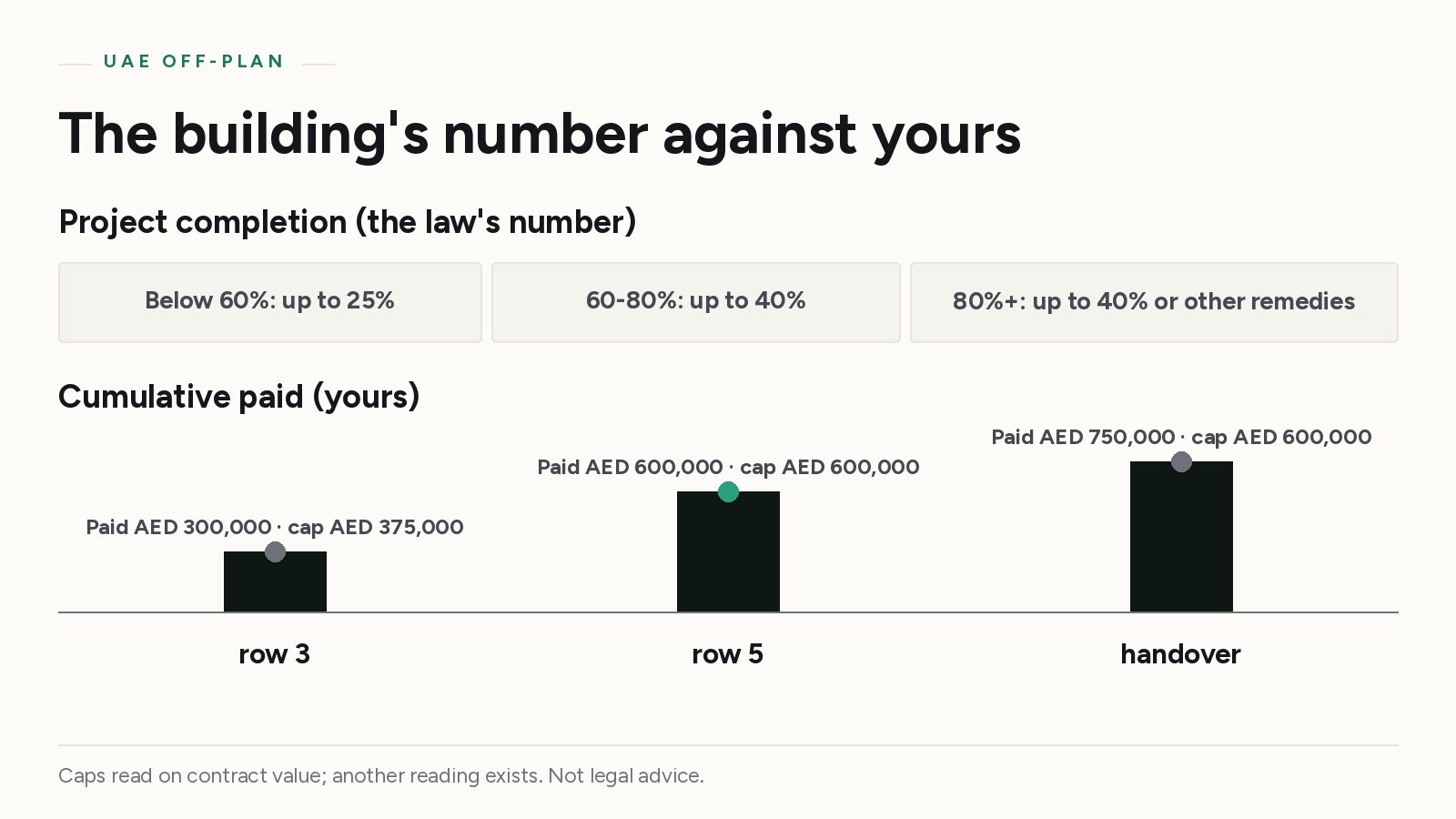
In Dubai, if a buyer stops paying, what the developer can keep depends on how complete the whole project is. Above 80%, the developer has a choice of remedies. Between 60% and 80%, up to 40%. Below 60% with work started, up to 25%. Not started, nothing, full refund. That is Article 11 of the 2008 interim register law as amended in 2020.
Every one of those thresholds is the building's number.
What you stand to lose is measured against yours. On the schedule I built, a buyer who misses the row at 70% construction has paid AED 600,000 on a 1.5 million unit. Forty per cent of contract value is AED 600,000. The building's number put them in the 40% tier; their own number says that is everything they have paid.
I want to be careful here, because there is an open question I have not closed: whether that 40% is measured on the contract price or on what has been paid. If it is what has been paid, the same buyer is looking at AED 240,000, not 600,000. The usual description says contract value. I have not read the statute's own words closely enough to tell you for certain, and I would rather say so than pretend.
The other thing I found
The research I use for these pieces is a mix of legislation, law firm notes and a lot of commercial material. This time it contained two errors that I think a lot of people carry around.
One was a default tier that has not existed since 2020: "if the project has not started, the developer can keep up to 30% of what you paid." The 2020 amendment replaced that with a full refund. It keeps turning up because the older articles still rank.
The other was a mortgage calculation that took 80% of the handover balance rather than 80% of the property's value, and invented a AED 120,000 cash gap out of it. LTV is measured on the property. A 40% balance is a 40% loan.
Neither of those is exotic. Both are the kind of thing that gets repeated from one guide to the next because it sounds right and nobody sits down with a calculator.
The part about my own position
I sell off-plan property, and a lot of it is sold on payment plans. So I have an obvious interest in people liking payment plans.
What I have learned is that the interest is better served by buyers reading the schedule than by buyers skimming the headline. Every plan shape I have seen suits somebody. The cash-light ones suit people with income and patience. The front-loaded ones suit people with capital who want the price. The ones with a tail after handover suit people who have budgeted the tail as a bill, not as something the tenant will cover.
The buyer who gets hurt is almost never the one on the "wrong" plan. It is the one who did not know which row they were most likely to miss, and what that row would cost.
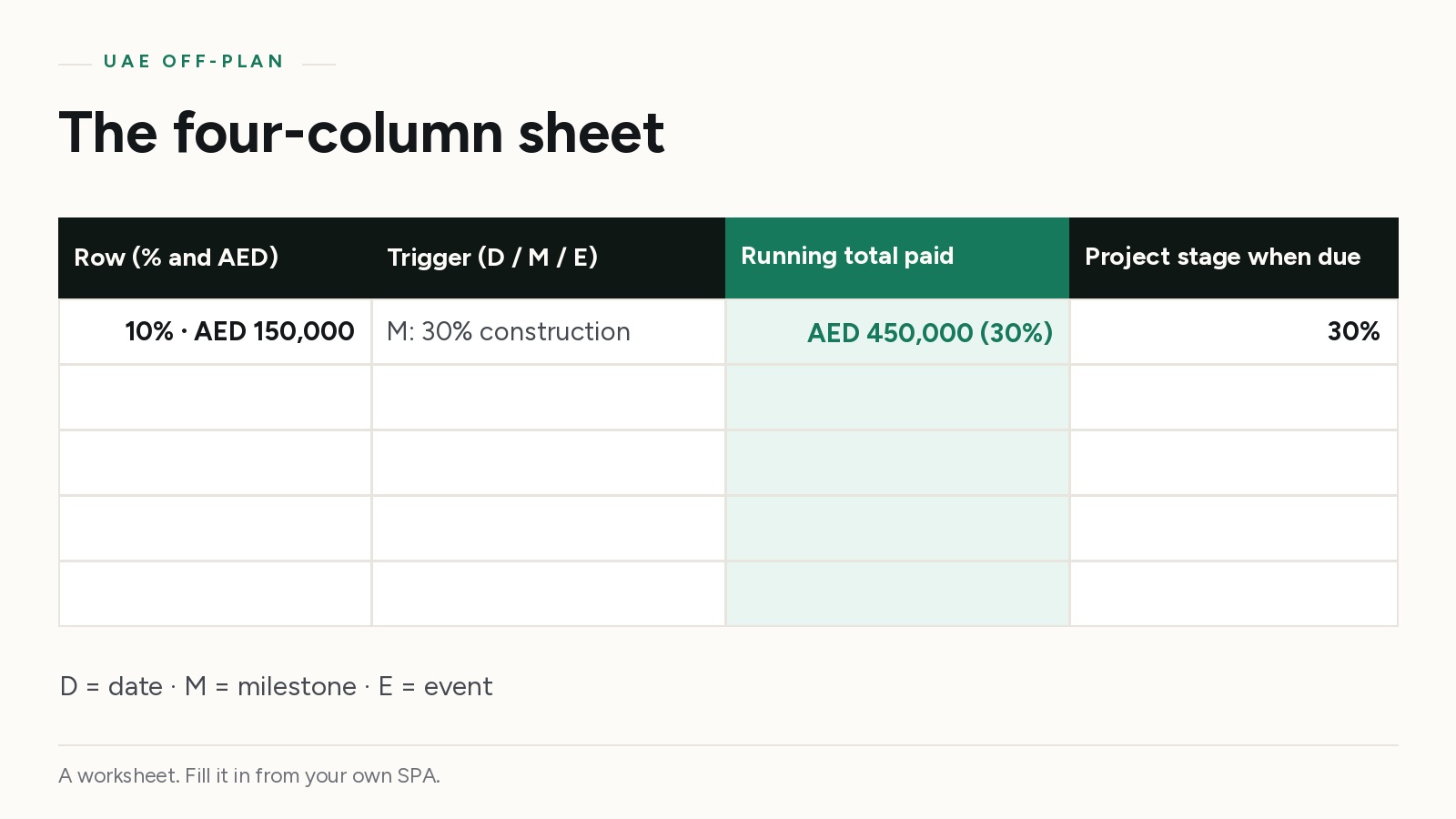
What I do now
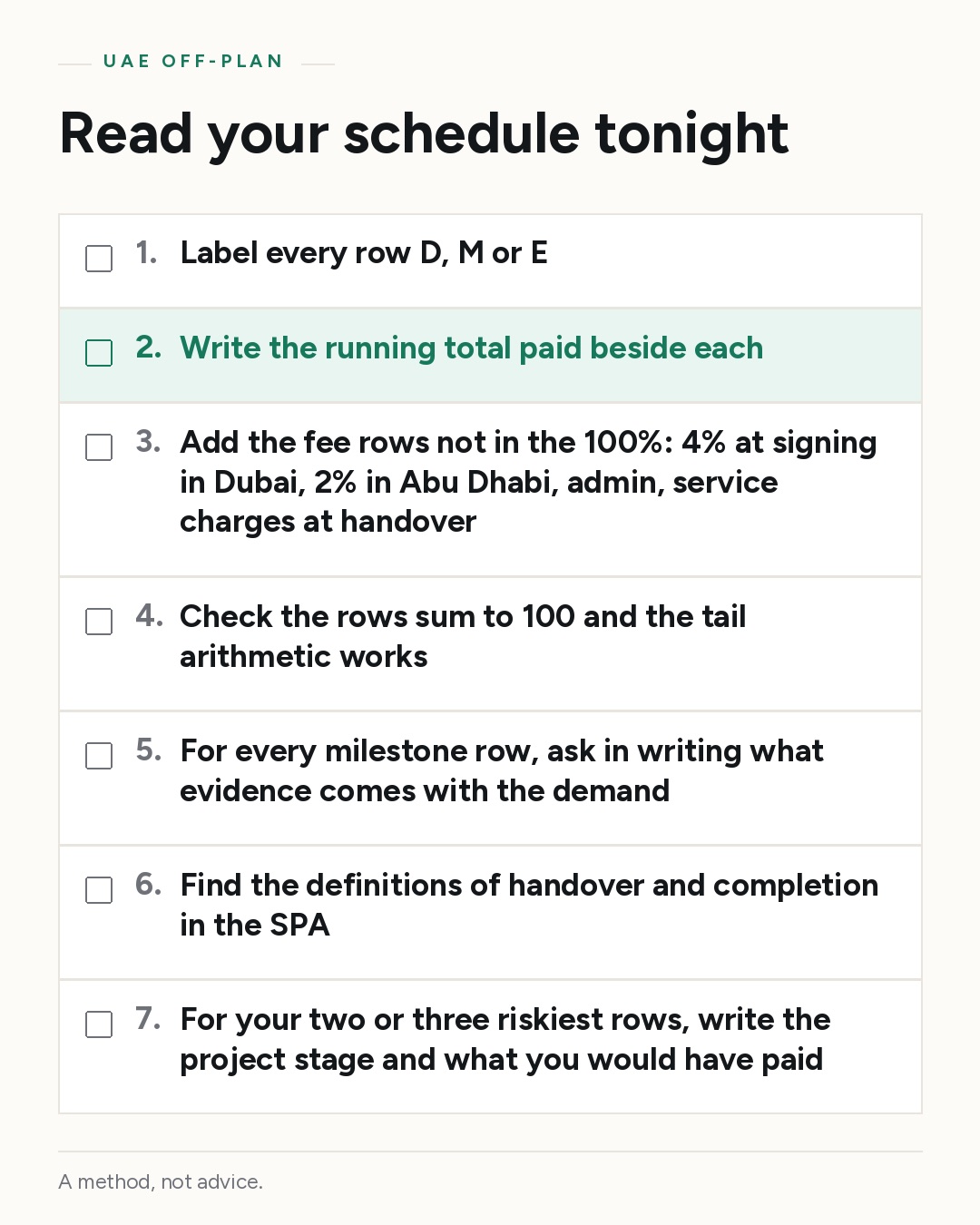
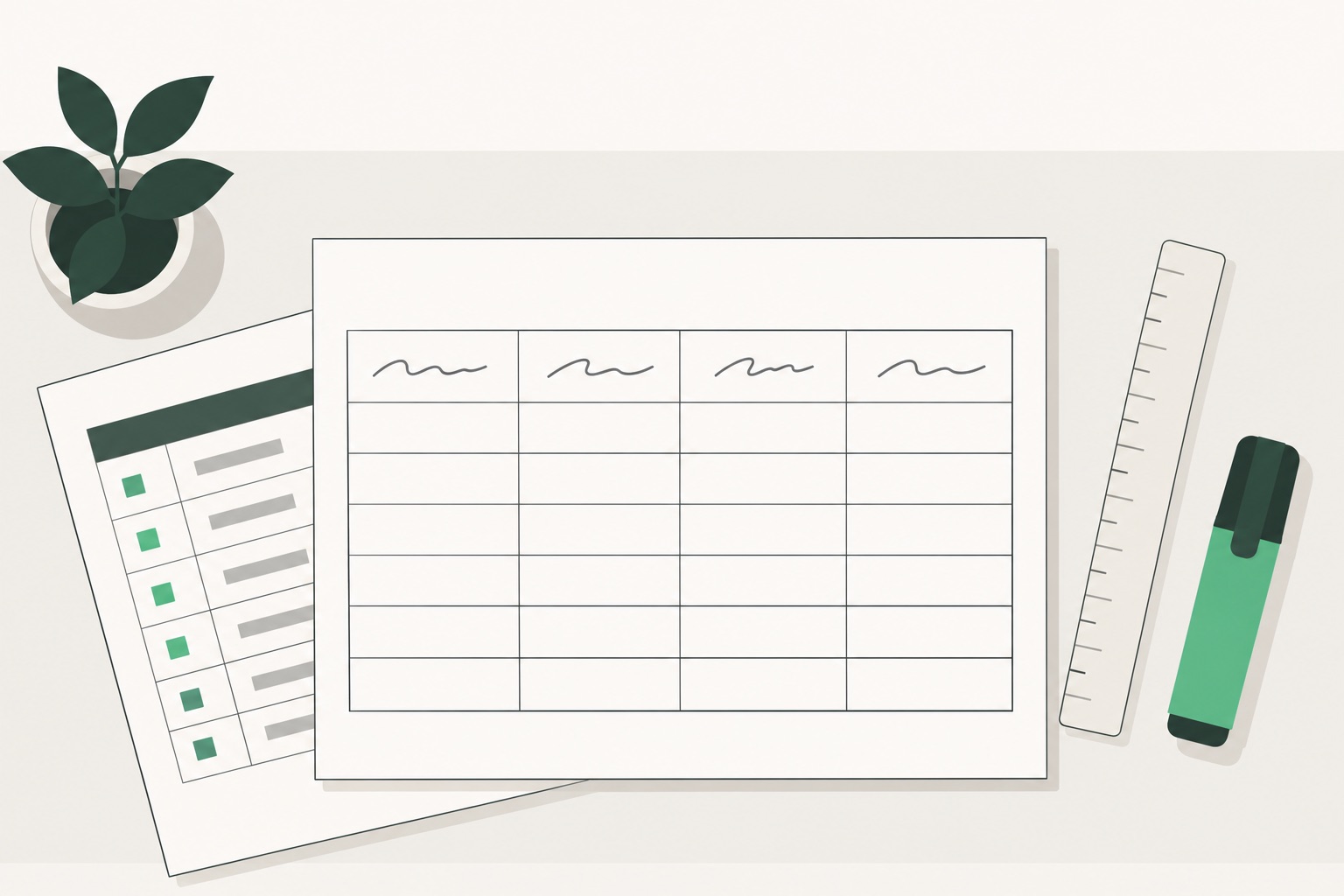
Four columns. The row. The trigger: a date, a milestone or an event like handover. What you will have paid once that row clears. How far the building will be when it falls due.
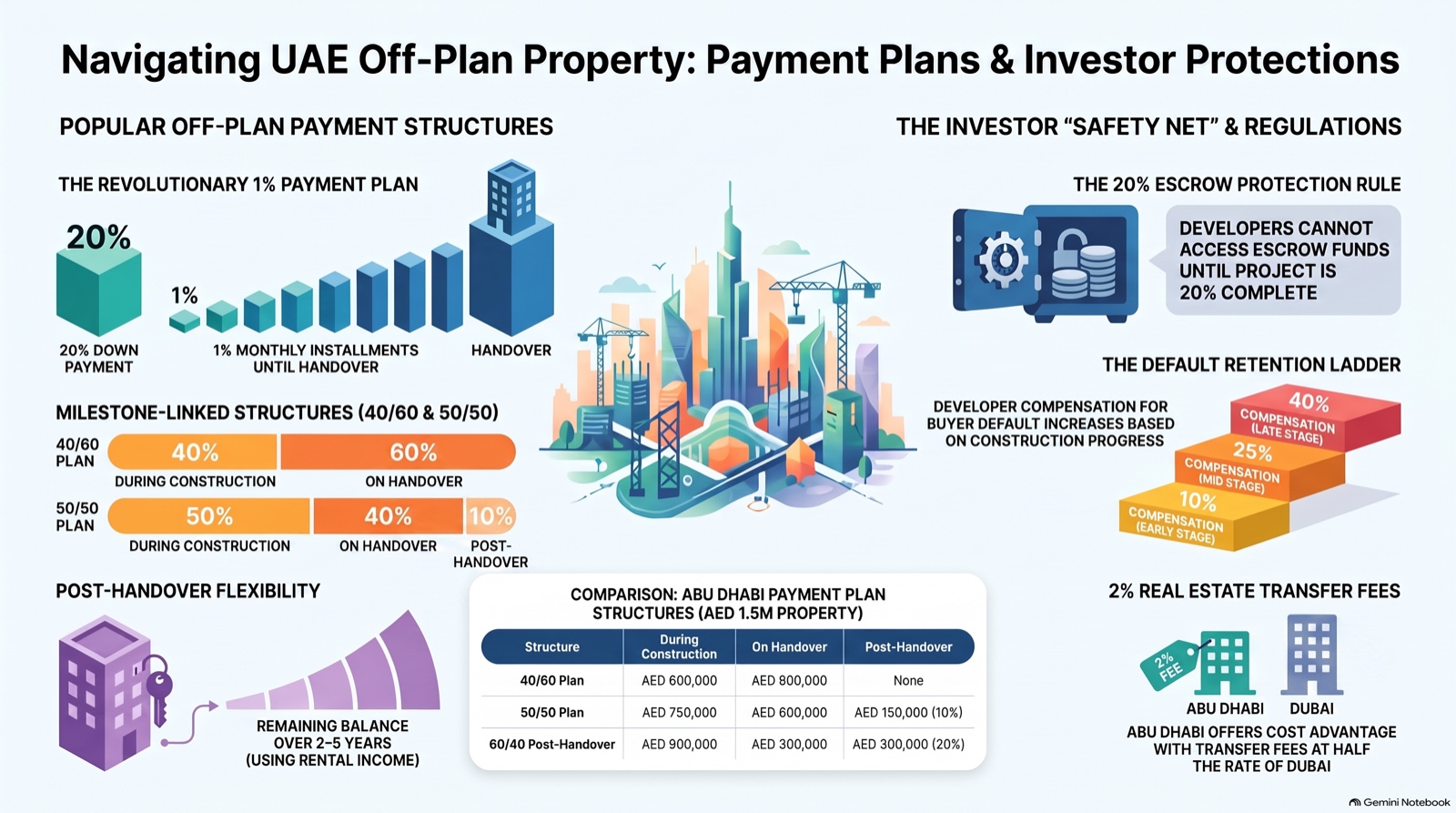
Plus the lines that are not in the hundred per cent: the 4% land department fee at signing in Dubai, 2% in Abu Dhabi, the admin, and whatever service charge lands at keys.
It takes ten minutes. It is the most useful ten minutes in the purchase, and for years I did a shorter version in my head and talked about it loosely.
I am a broker, not a lawyer or a financial adviser, and none of this is advice on your contract. It is a way of reading one. Your lawyer does the rest.
What I take from it
A number with no unit is not information. "Seventy per cent" meant something to me and something else to the person across the table, and neither of us noticed because we never said seventy per cent of what.
And the documents you read most often are the ones you stop reading. I would have told you I knew payment schedules inside out. I did. I just had not written one down properly in years.
Idris Dad writes about off-plan strategy across Dubai, Abu Dhabi and Ras Al Khaimah.
More on how I work with buyers at offplancrypto.com.
Nothing here is legal, mortgage or financial advice. I am a licensed real estate broker, not a lawyer or adviser, and I sell off-plan property including on payment plans. No developer or plan is named or recommended.