September 2026
Six laws and a phone
I spent this week reading Dubai property legislation, which is not a sentence I expected to write about myself a year ago.
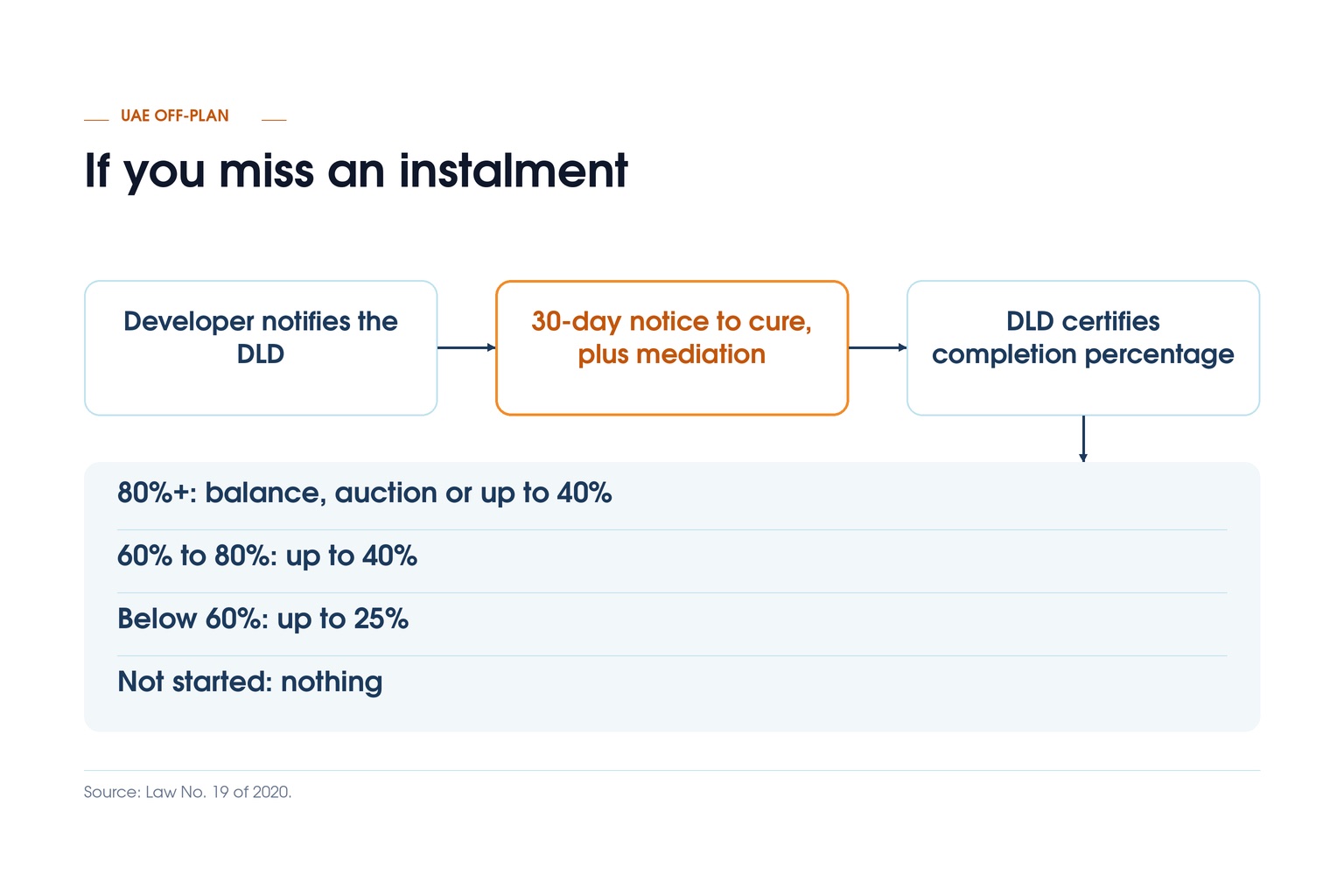
Six statutes. The 2008 law that created the interim register. The 2020 amendment that governs what happens when a buyer defaults. The 2010 implementing bylaw. The 2006 law on completed property. The 2007 escrow law. All of them published on the government's own portal, free, in English, and openly accessible to anybody with a phone.
I mention that because almost every guide to off-plan property in this market, including some I have written, cites nothing. It says "under Dubai law" and moves on. And the whole time, the actual laws have been sitting there.
So this piece cites its sources, and I would encourage you to open them.

Two kinds of claim
Here is the idea the rest of it hangs on, and I had not understood it properly until this week.
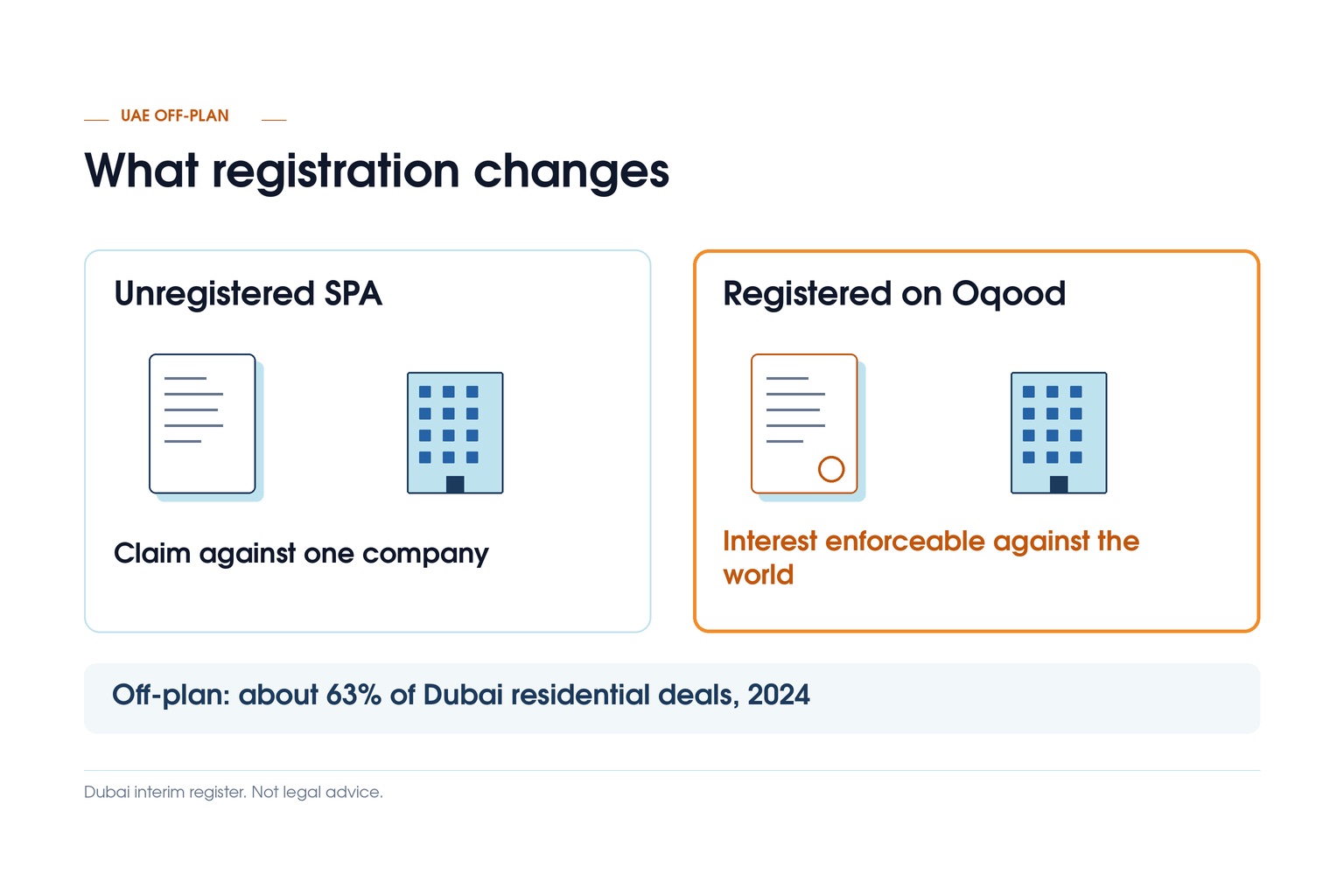
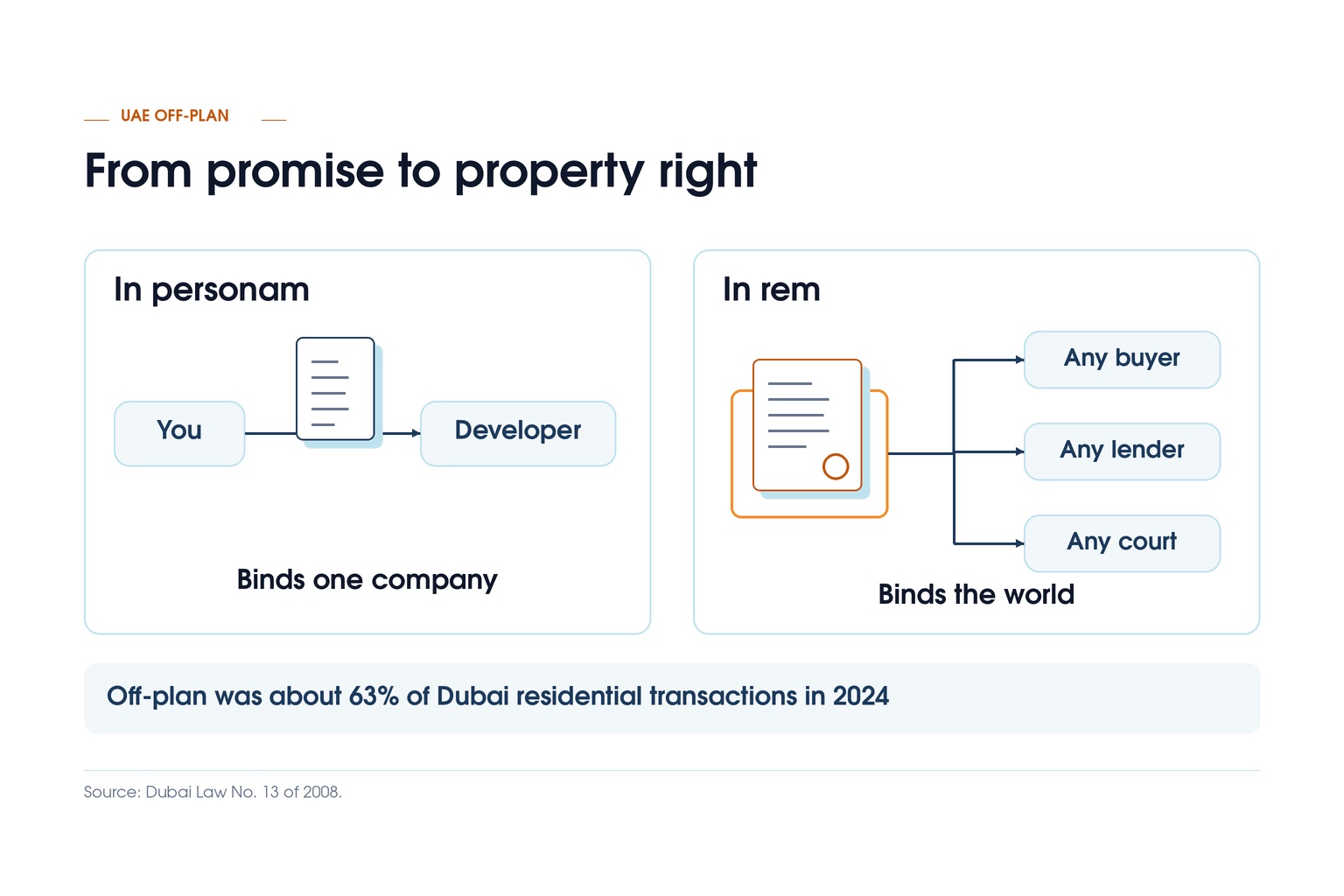
An unregistered sale and purchase agreement gives you a claim against one company. Lawyers call that in personam. A promise. Real, enforceable, and binding on exactly one party.
Register the same agreement on the Oqood system and it becomes something else in kind. A provisional property interest, in rem, enforceable against the world.
Not a stronger version of the same thing. A different category of thing.
I have been explaining Oqood to clients for years as "it protects you", which is true and useless. This is the version I will use from now on: unregistered, you have a promise from a company. Registered, you have a fact about a specific apartment that binds everybody.
What it does not do, which nobody tells you
The part that made me change how I talk to buyers.
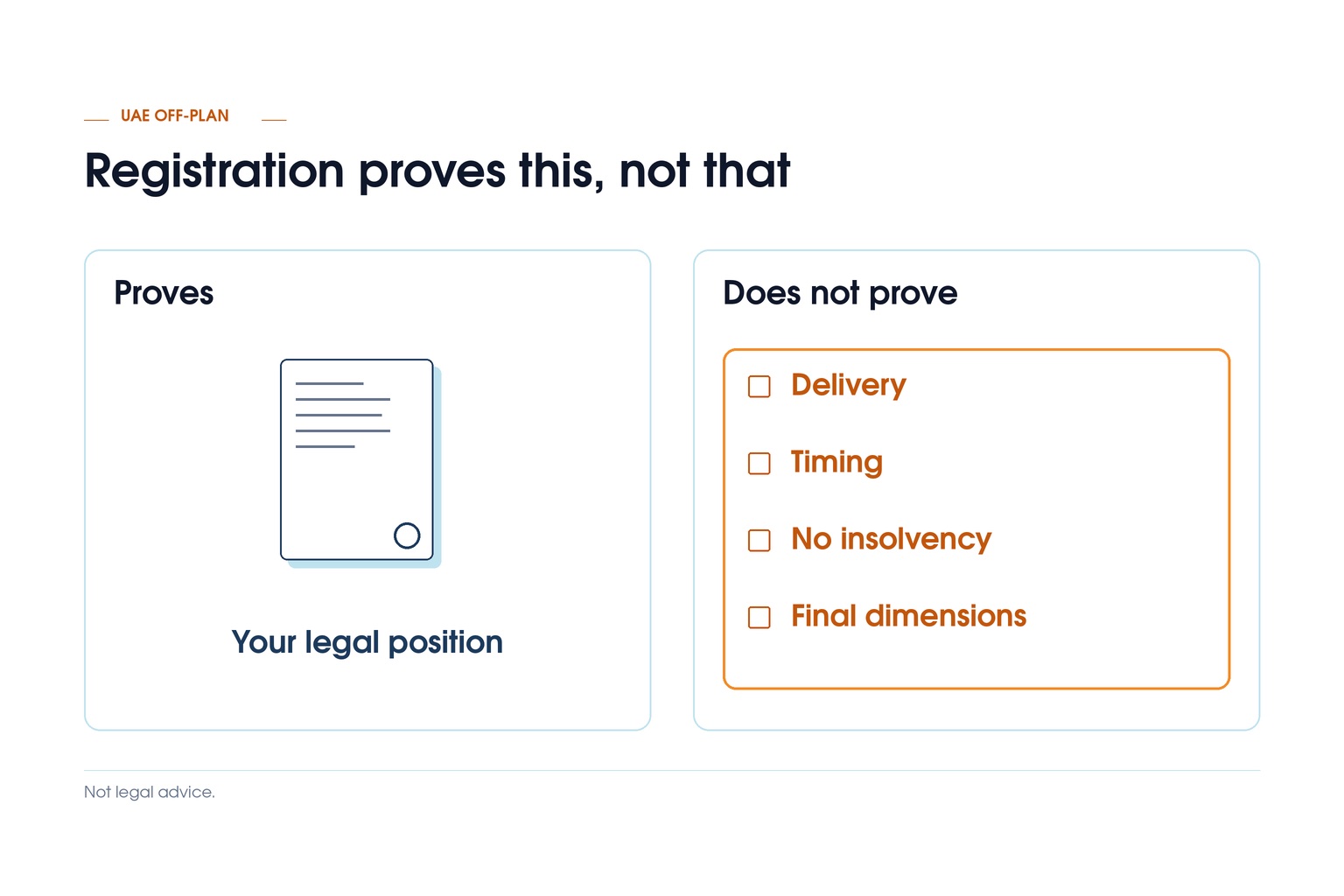
Registration does not guarantee that the building gets finished. It does not guarantee when. It does not stop a developer going under or a project being abandoned. And the dimensions printed on it are provisional until somebody physically measures the unit at handover.
Registration is a statement about your legal position. It is not a statement about the building.
I had been letting people take it as general reassurance, because it feels like general reassurance when you are handed a government certificate. It is not general. It is very precise, it is very good at the things it covers, and it covers none of the things people are actually lying awake about.
Saying that out loud costs me nothing and it is more useful than the version I used to give.

The expensive bit
Now the part worth the whole article, and it caught me completely.
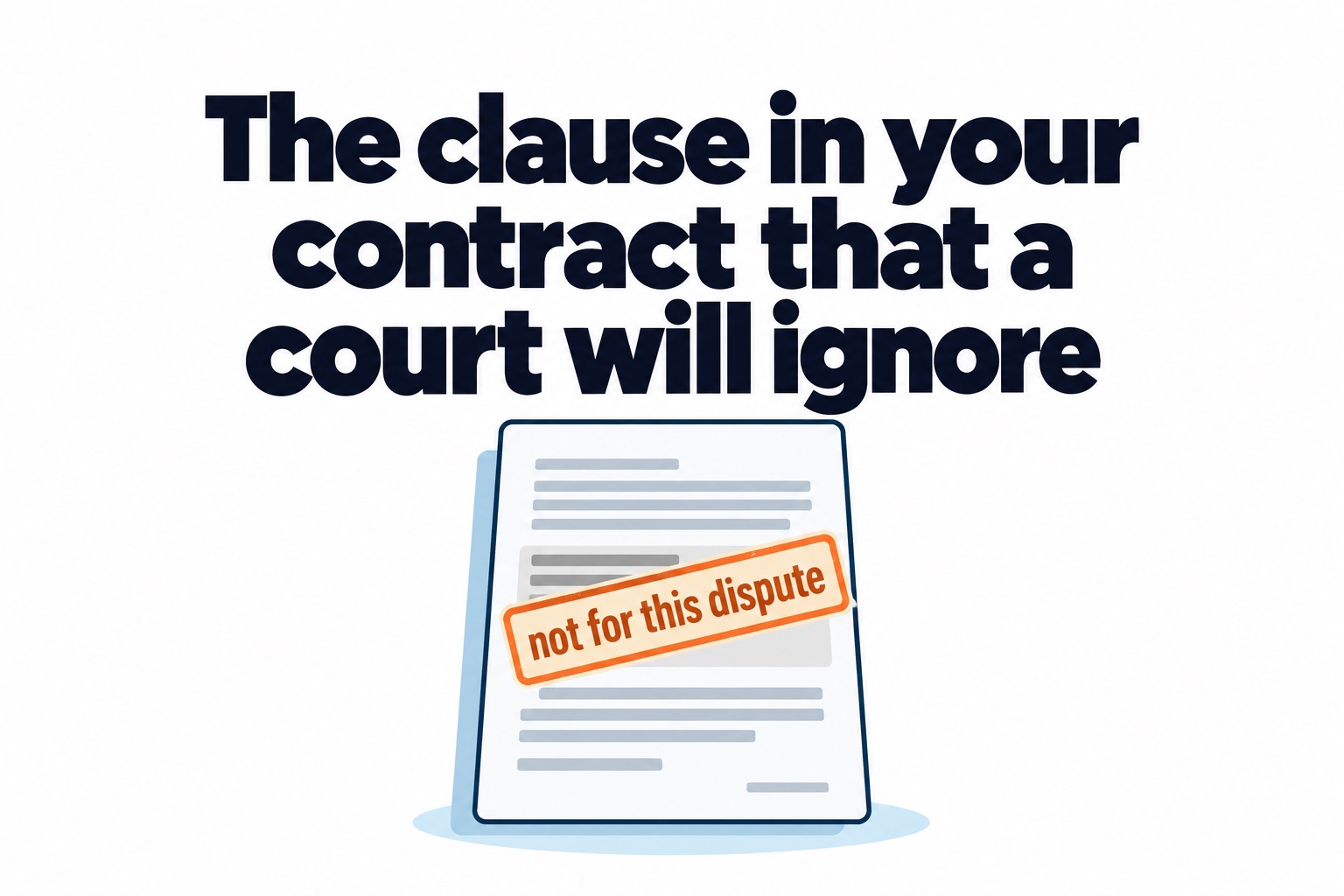
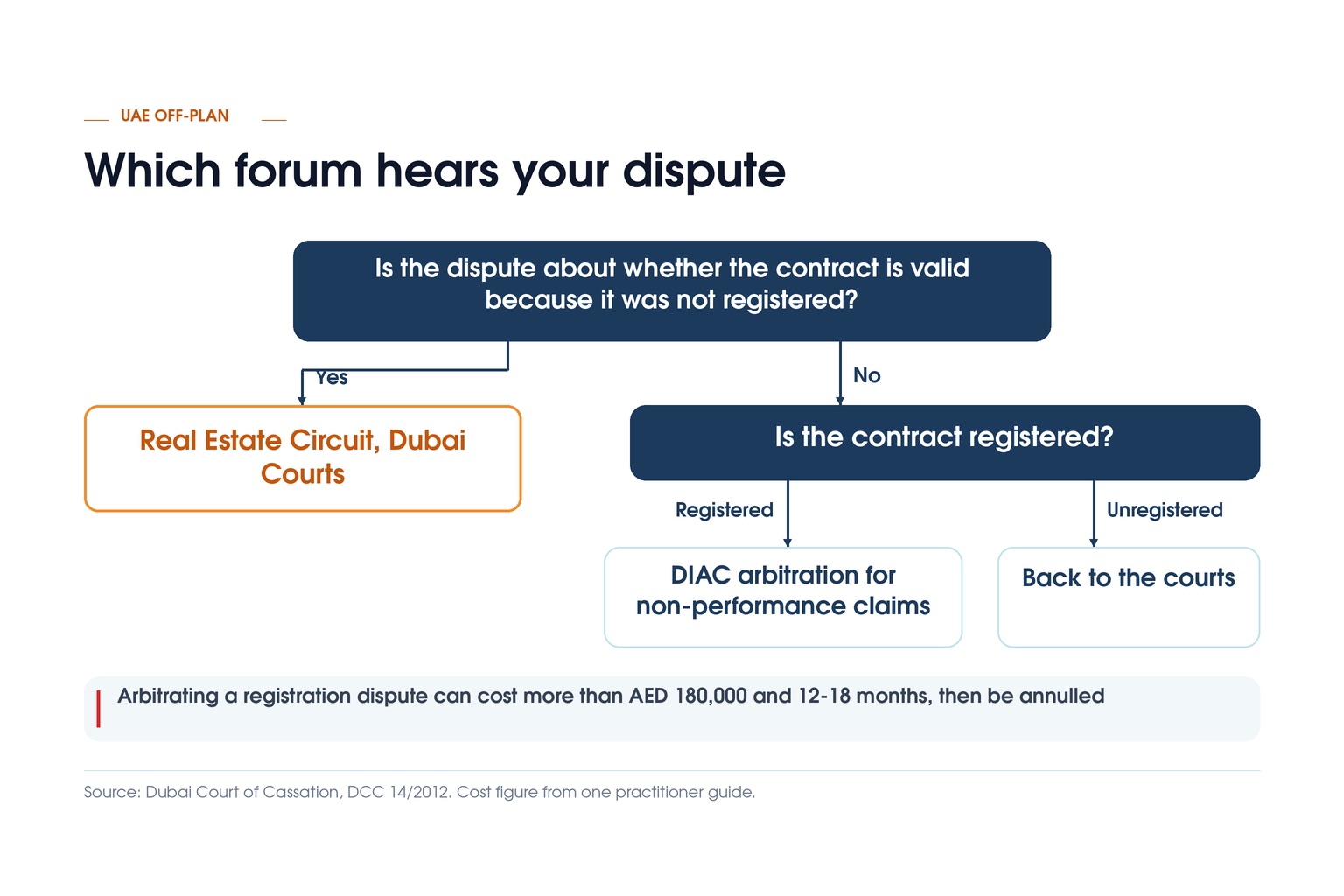
Your off-plan contract almost certainly has an arbitration clause in it, naming DIAC or something like it as the exclusive forum for disputes. Standard. For most disputes it works exactly as you would expect.
It does not work for a dispute about registration.
The Dubai Court of Cassation has held that disputes about real estate registration are matters of public policy. Public policy matters belong to the state exclusively, which means they are not arbitrable. Not because arbitration is bad at them. Because the parties cannot agree to hand a forum a power that forum does not have.
So picture the sequence, because it is the obvious sequence and it is wrong.
A developer does not register your SPA. You want a court, or someone, to say the contract is void because of it. You open your contract. You find the arbitration clause. You file at DIAC.
The tribunal has no power to decide your claim. And if an arbitrator goes ahead and decides it anyway, the onshore courts do not trim the award. They annul the whole thing. There is a Cassation decision from 2014 that did exactly that.
Reported cost of that route: often more than AED 180,000 and twelve to eighteen months, and at the end of it your award is set aside before anybody has considered whether you were right.
I will flag that the cost number comes from one practitioner guide rather than from published data. The mechanism is in the case law. The figure is somebody's estimate, and I would rather tell you that than let a round number do work it has not earned.
The rule, and the half that makes it usable
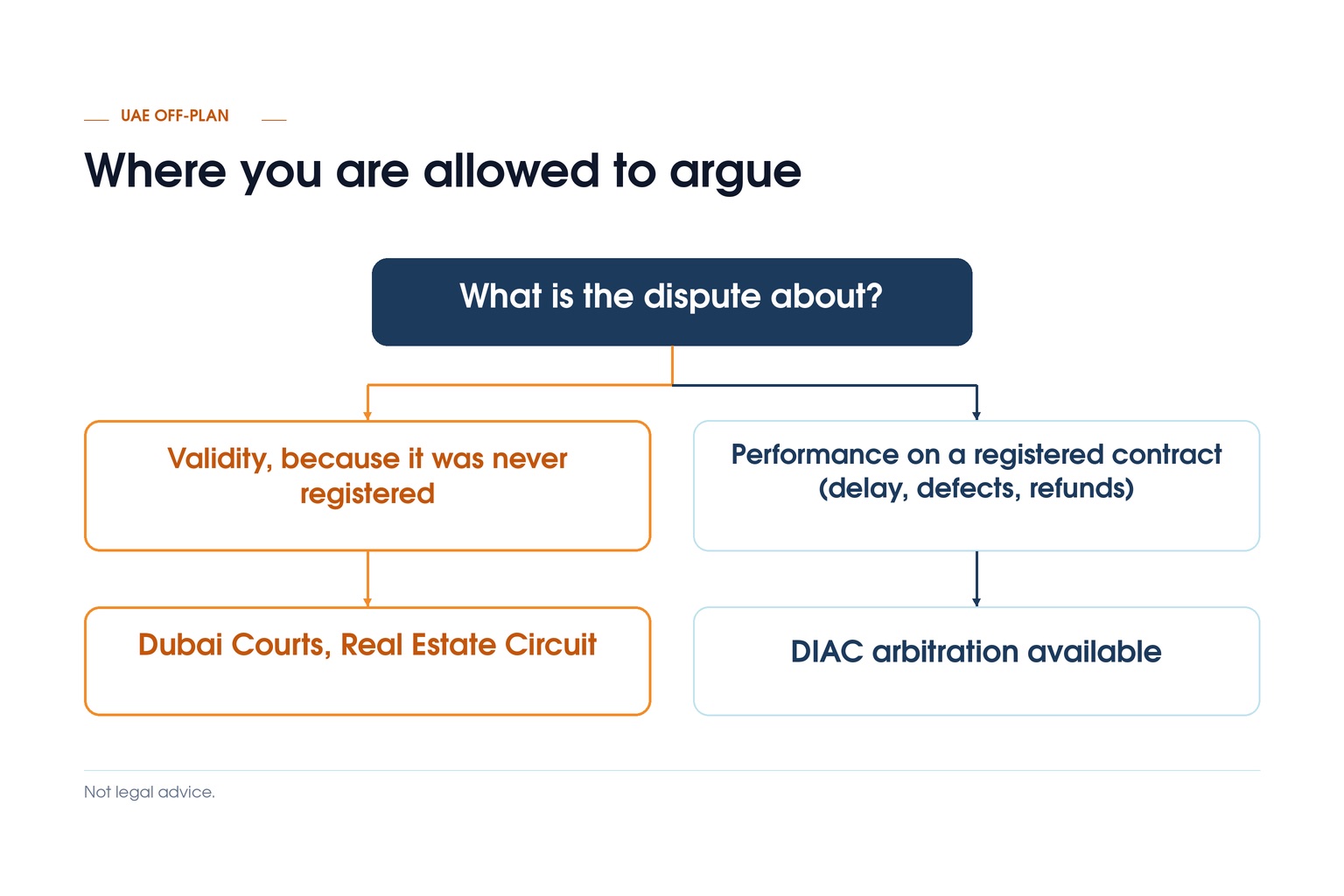
If the dispute is about whether the contract is valid because it was never registered: the arbitration clause does not apply and you go to the Real Estate Circuit of the Dubai Courts.
If the contract is registered and the dispute is about performance, meaning delay, defects, or a refund: arbitration is fully available.
I want to be careful here, because the first half on its own reads like "arbitration is bad for property disputes", and that is not what this says. Most off-plan disputes are performance disputes and arbitration handles them normally. It is one specific category that sits outside, and that category happens to be the one that arises when a developer has not done the very thing this article is about.
Which produces a line I have been turning over all week.
Registration does not only determine how strong your right is. It determines where you are allowed to argue about it.

The thing I now do on every deal
None of the above helps you if the registration never happens and nobody notices for a year.
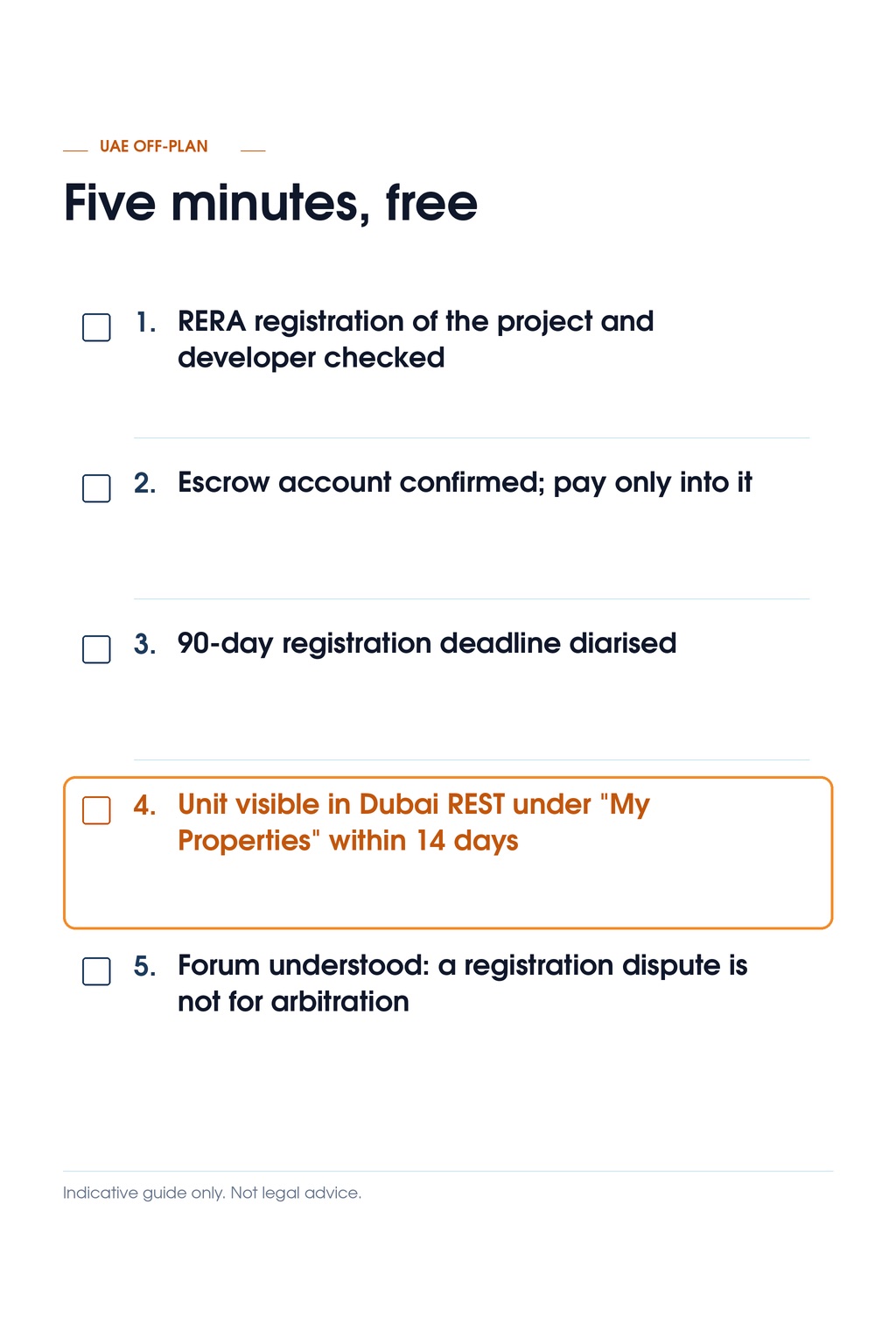
So: open the Dubai REST app. Look under My Properties. Your unit should be there.
If it is not there within fourteen days of signing, ring the developer and ask why.
That is it. That is the whole intervention. It is free, it takes a minute, and it turns a problem that could become a six-figure jurisdictional mess into a phone call made while everybody is still friendly.
I have started doing it for clients as a matter of course, and I have started telling them to do it themselves too, because I would rather they could check without me. An agent whose value depends on the client not being able to look something up is not offering value.
One new thing
Worth knowing because it is recent and almost nothing published has caught it.
From a policy update in February 2026, property registered under Oqood is reported to qualify for a Golden Visa once the certified value reaches AED 2 million, and the previous requirement to have paid fifty per cent upfront has gone.
One source in my research, so treat it as a question to ask rather than a plan to make. But if you had ruled out the visa route because you are only part-way through a payment plan, it is worth asking again.

What I take from the week
Two things, and neither is about property specifically.
The first is that the primary sources were free the entire time. Six statutes, one government portal, no subscription, no gatekeeper. The reason most guides in this market do not cite them is not that they are unavailable. Everybody is summarising everybody else's summary, and the errors compound quietly. I have found two in my own work this month by going back to the instrument.
The second is that a clause in a contract can be completely valid, completely standard, signed by everybody, and still be the wrong place to take your problem. That is not a trick and nobody is hiding it. It is just not in the contract, because a contract tells you what the parties agreed and not what the law will permit.
So the question I would ask before signing anything, and I did not ask it for years: not only what does this say, but what can it not do?
Idris Dad writes about off-plan strategy across Dubai, Abu Dhabi and Ras Al Khaimah.
More on how I work with buyers at offplancrypto.com.
Nothing here is legal advice. I am a licensed real estate broker, not a lawyer. The court decisions are cited by their reported names as public record and I make no comment on any party to them.