I used to assume a will from home, a joint account or a flat in two names would protect my family here. None of them do, and the real rules surprised me.
Three things I believed that were wrong
For years I assumed a few things about owning property here.
I assumed a will made at home would be honored here. I assumed a joint bank account kept working if one name on it died. I assumed my family would pay the same 4% transfer fee on an inherited flat as they would on a sale.
I was wrong on all three. Not a little wrong. Completely wrong.

A will from home doesn't travel on its own
A will made in another country doesn't execute here automatically. It needs probate in the home country first, then attestation, then a certified Arabic translation, then review by a UAE court. None of that happens quickly, and none of it happens without someone doing the work.
Since 1 June 2026, it's also explicit in law. The new Civil Transactions Law states that UAE law governs a foreigner's will as it relates to immovable property in the UAE (Federal Decree-Law No. 25 of 2025, Art. 17). So even once a foreign will clears all that process, UAE law still decides what happens to the property itself.
The accounts freeze before the property question even starts
Here's the part that surprised me most.
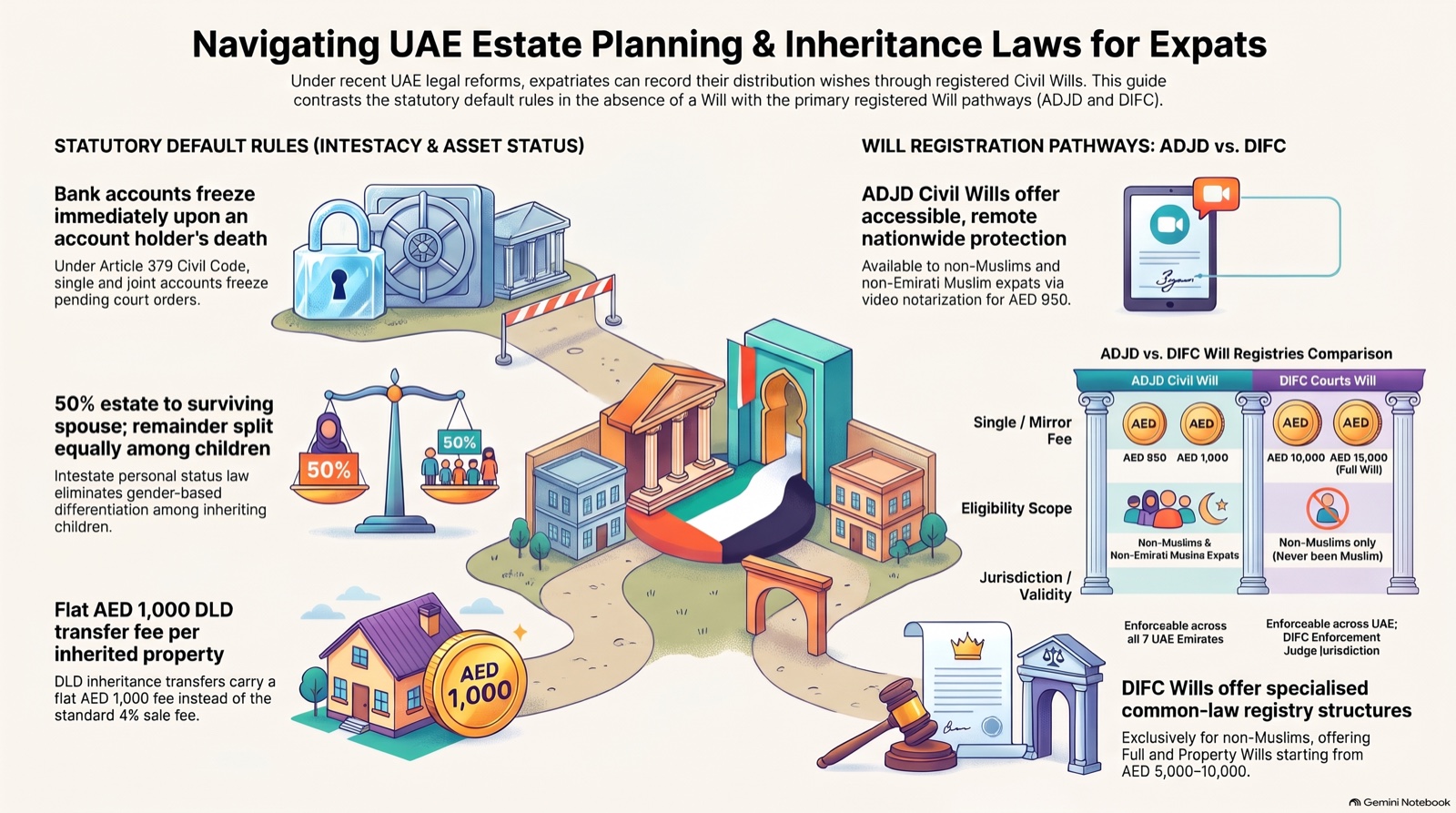
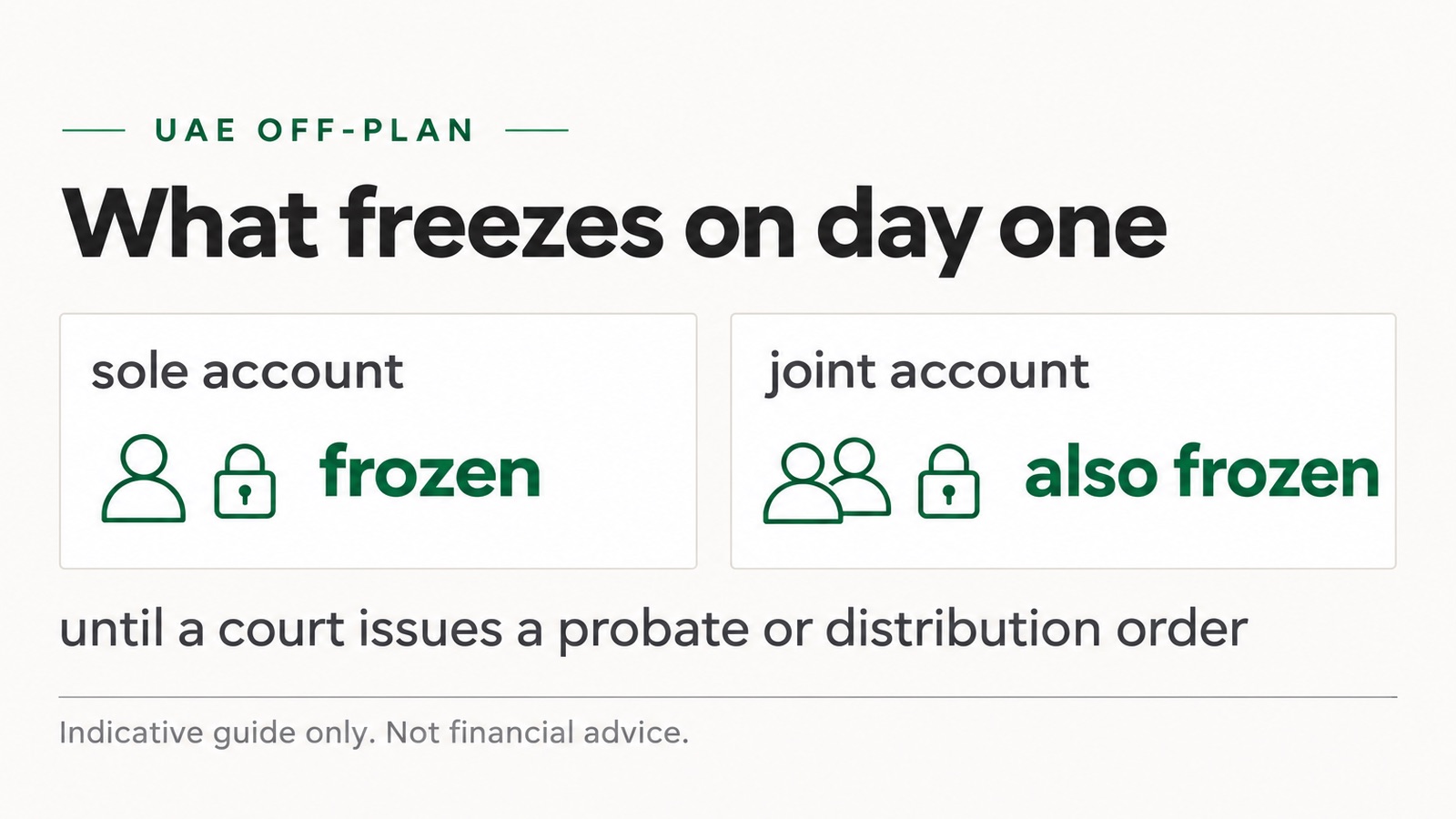
When a bank is told someone has died, it freezes that person's accounts. That includes joint accounts, which catches out people from countries where the surviving holder just carries on using the account. Several law firm sources I've seen cite Article 379 of the Civil Code for this, and they agree on the point. The surviving holder can't touch the account until a court issues a probate grant or distribution order.
If you're part way through an off-plan payment plan, with instalments due and service charges running, and the only liquid household account is frozen, that's not a paperwork delay. That's a real problem, immediately.

The default split, if there's no UAE will
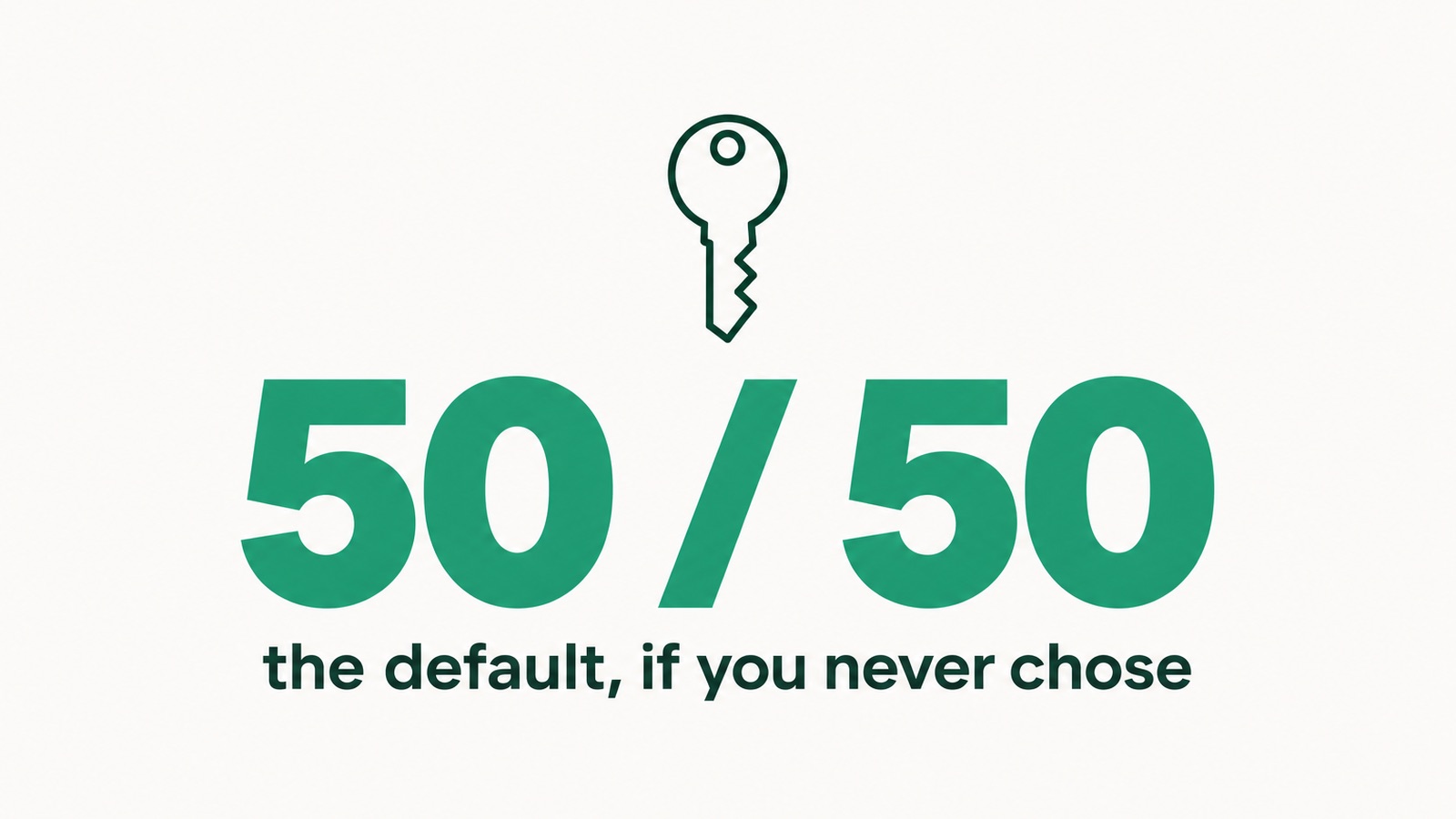
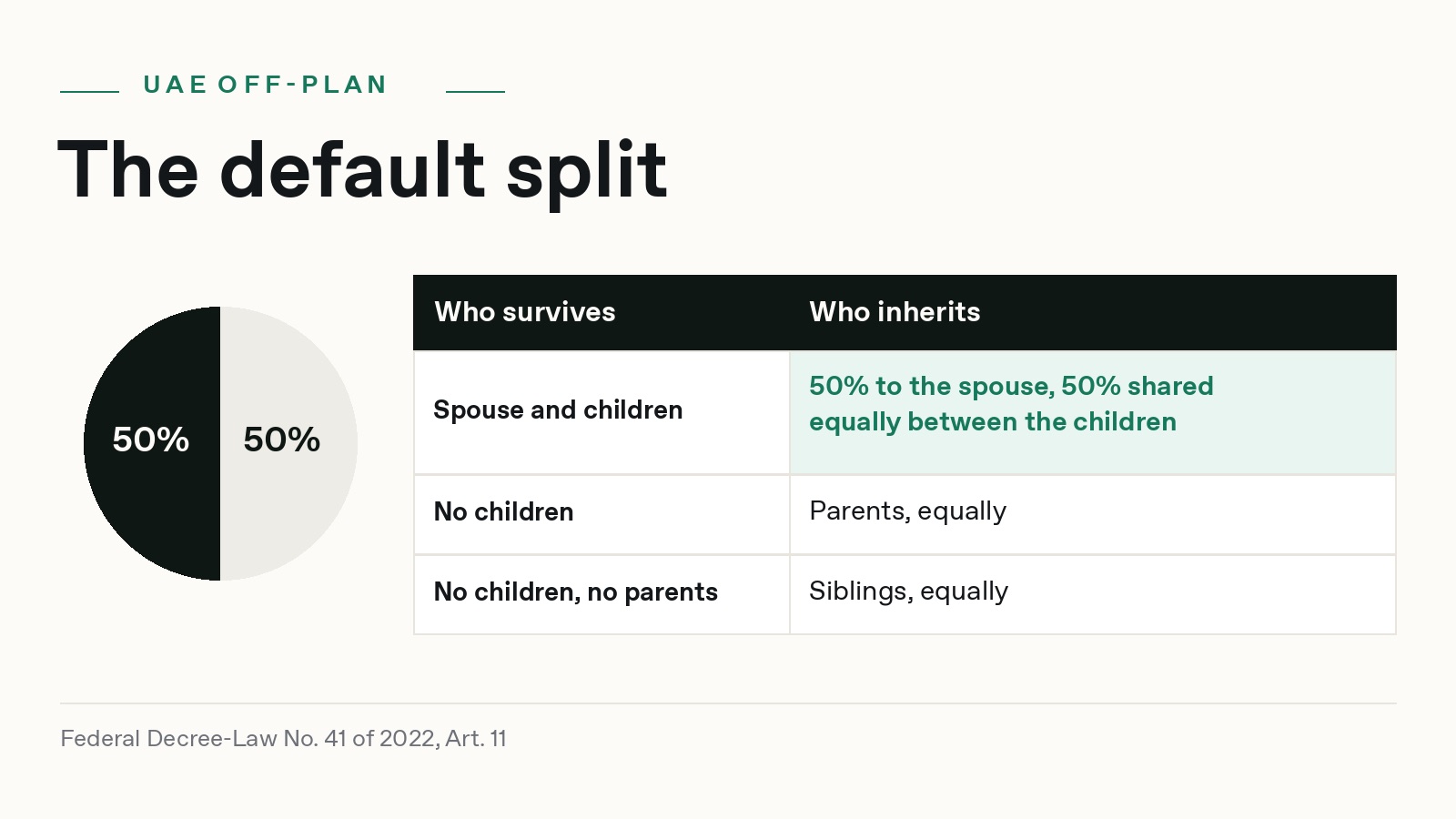
If a non-Muslim owner dies without a will registered in the UAE, the civil personal status law applies a fixed split. It's been in force since 1 February 2023 (Federal Decree-Law No. 41 of 2022, Art. 11):
| Who survives | Who inherits |
|---|---|
| Spouse and children | 50% to the spouse, 50% shared equally between the children |
| No children | Parents, equally |
| No children, no parents | Siblings, equally |
There's no distinction between sons and daughters in that default.
I don't think that split is unreasonable. I just think most people haven't chosen it. If you wanted everything to go to your spouse, or to sit in trust until children are older, or to go to a child from an earlier marriage, the default won't do any of that for you.
For Muslim owners, the Sharia-derived rules in Federal Decree-Law No. 41 of 2024 (Arts. 200 to 250) apply instead, with fixed shares: a wife gets one quarter where there are no children and one eighth where there are, a husband one half or one quarter, and where sons and daughters inherit together a son's share is twice a daughter's. A will can only redirect up to one third of the net estate.
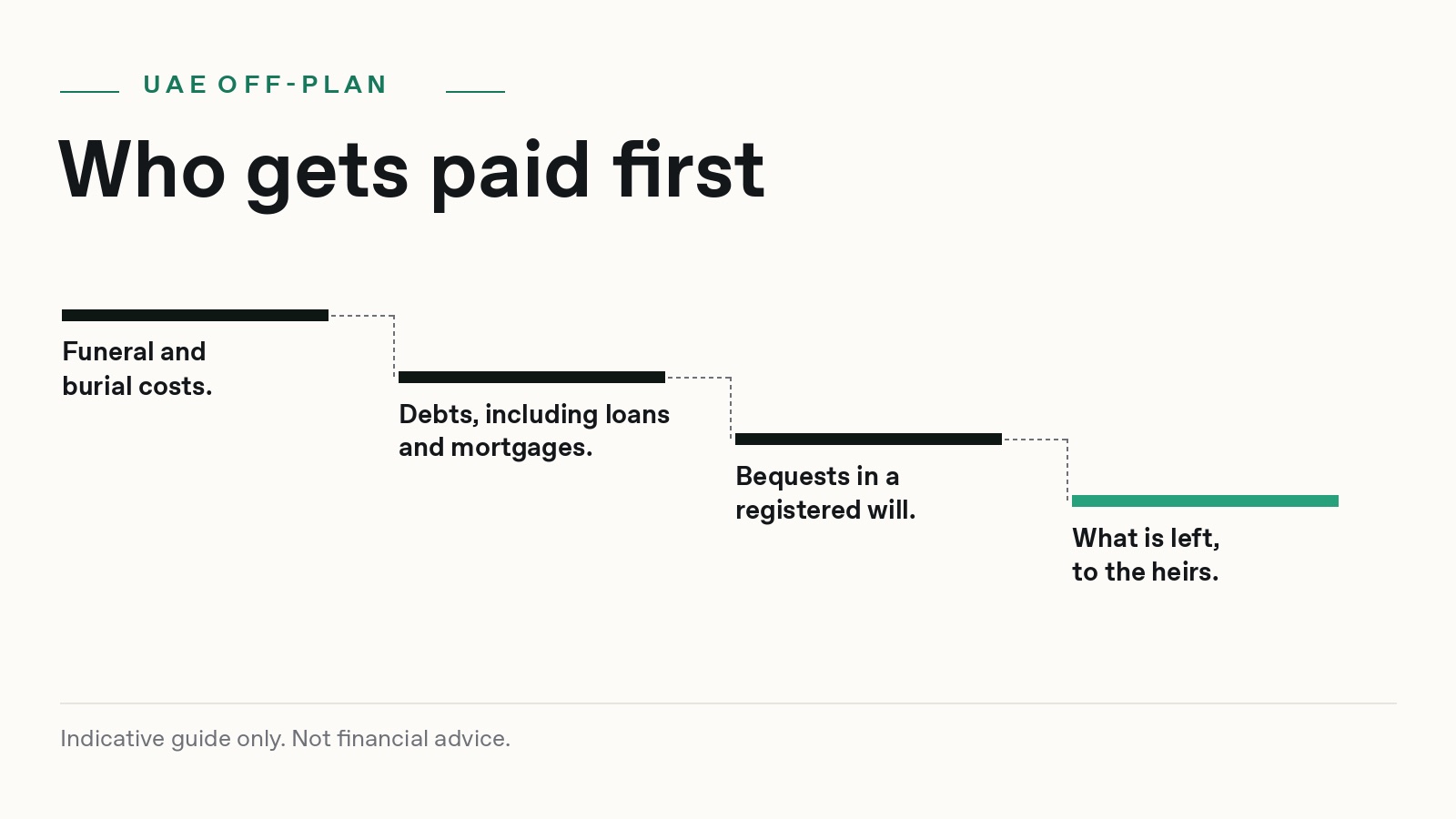
And heirs don't simply receive what's left. Under Article 201 of the 2024 law, the estate pays out in a fixed order: funeral and burial costs first, then debts including loans and mortgages, then bequests from a registered will, and only after that, whatever remains to the heirs. A mortgage on a completed unit gets settled before anyone inherits. What happens to unpaid instalments on an off-plan unit that hasn't handed over yet isn't something I've found a clear answer to. If you're on a long payment plan, that's a question worth putting to a lawyer directly.

What a UAE will actually costs
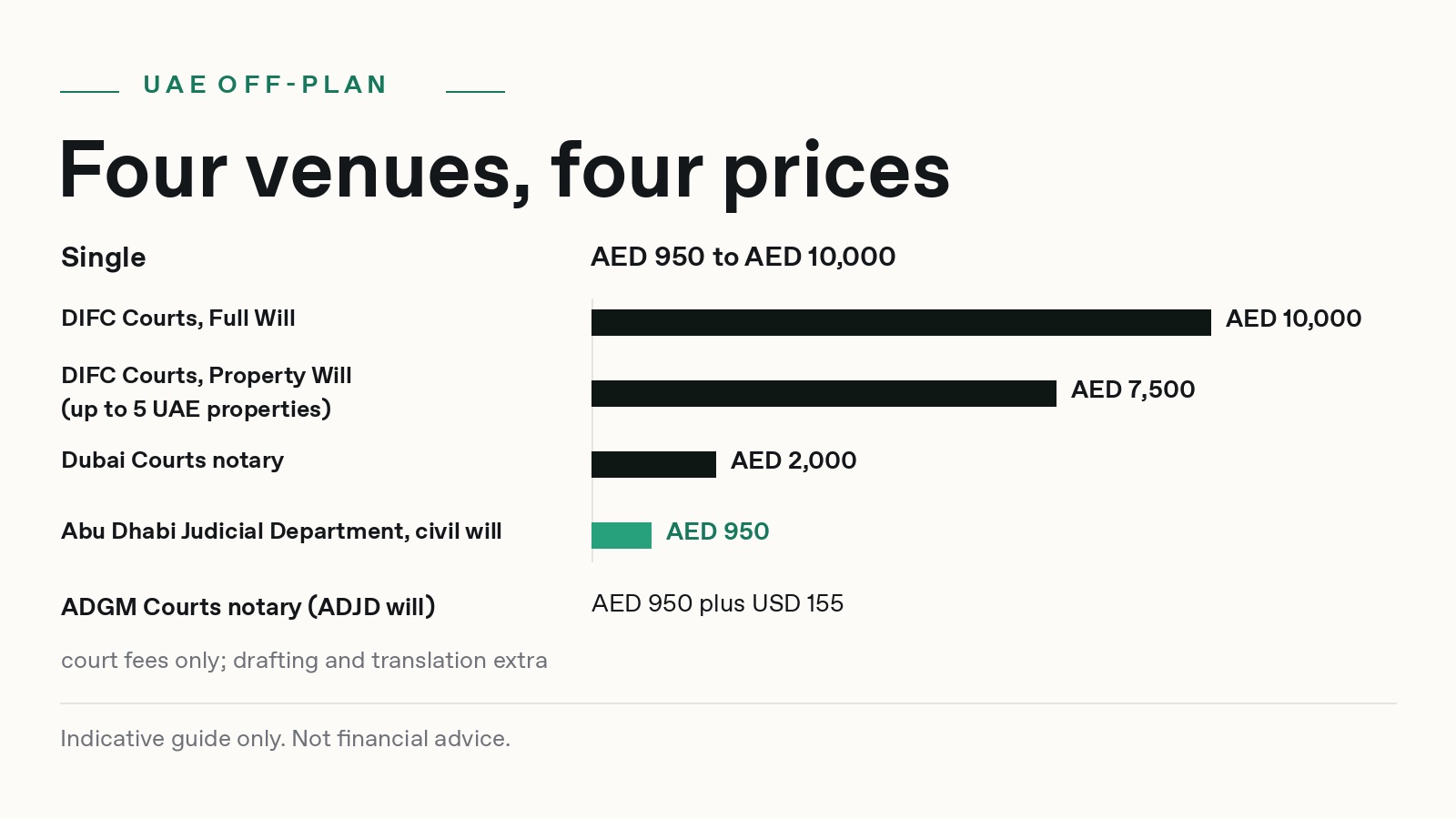
Non-Muslims can register a will here that overrides the default, and there are four routes to do it:
| Venue | Single | Couple (mirror wills) |
|---|---|---|
| DIFC Courts, Full Will | AED 10,000 | AED 15,000 |
| DIFC Courts, Property Will (up to 5 UAE properties) | AED 7,500 | AED 10,000 |
| Abu Dhabi Judicial Department, civil will | AED 950 | AED 1,900 |
| ADGM Courts notary (ADJD will) | AED 950 plus USD 155 | |
| Dubai Courts notary | AED 2,000 (Executive Council Resolution No. 72 of 2025) |
Two things worth knowing about that table. Those are just court fees. Drafting and certified translation cost more on top, and I've seen private drafting quotes from roughly AED 3,000 to AED 6,000. On the DIFC side, when the time actually comes, a grant of probate carries its own application fee of USD 1,500.
There's also a small conflict worth checking before you register. The DIFC Wills Service allows testators from age 18. The federal civil wills framework, and several guides describing it, say 21. If you're registering a will for a young adult, check the venue's own rule rather than trusting a general guide.
The fee people fear that isn't real
Here's the one that cuts the other way.
People assume heirs pay the same 4% Dubai Land Department transfer fee that applies to a sale. They don't. An inheritance title transfer is a flat AED 1,000 per property, plus fixed administrative charges (AED 250 for the title deed, AED 250 for the map, AED 20 in knowledge and innovation fees, and a trustee fee of AED 130 plus VAT).
Before that transfer happens, heirs need the court order or grant, the title deed, IDs, mortgage release letters if any apply, and a developer no-objection certificate confirming service charges are paid. That NOC is quoted at AED 500 to AED 5,000, though that figure comes from a single commercial source, not a regulator.
There's also a lifetime option worth knowing about, separate from inheritance. A gift, or hiba, of Dubai property between first-degree relatives (parents, spouses, children) is charged at 0.125% of the valuation instead of 4%. Siblings, grandchildren and in-laws don't qualify for that rate. A gift happens now, not later, so it's a different decision entirely, and one for a lawyer's conversation rather than a blog post.

What I'd actually tell a friend
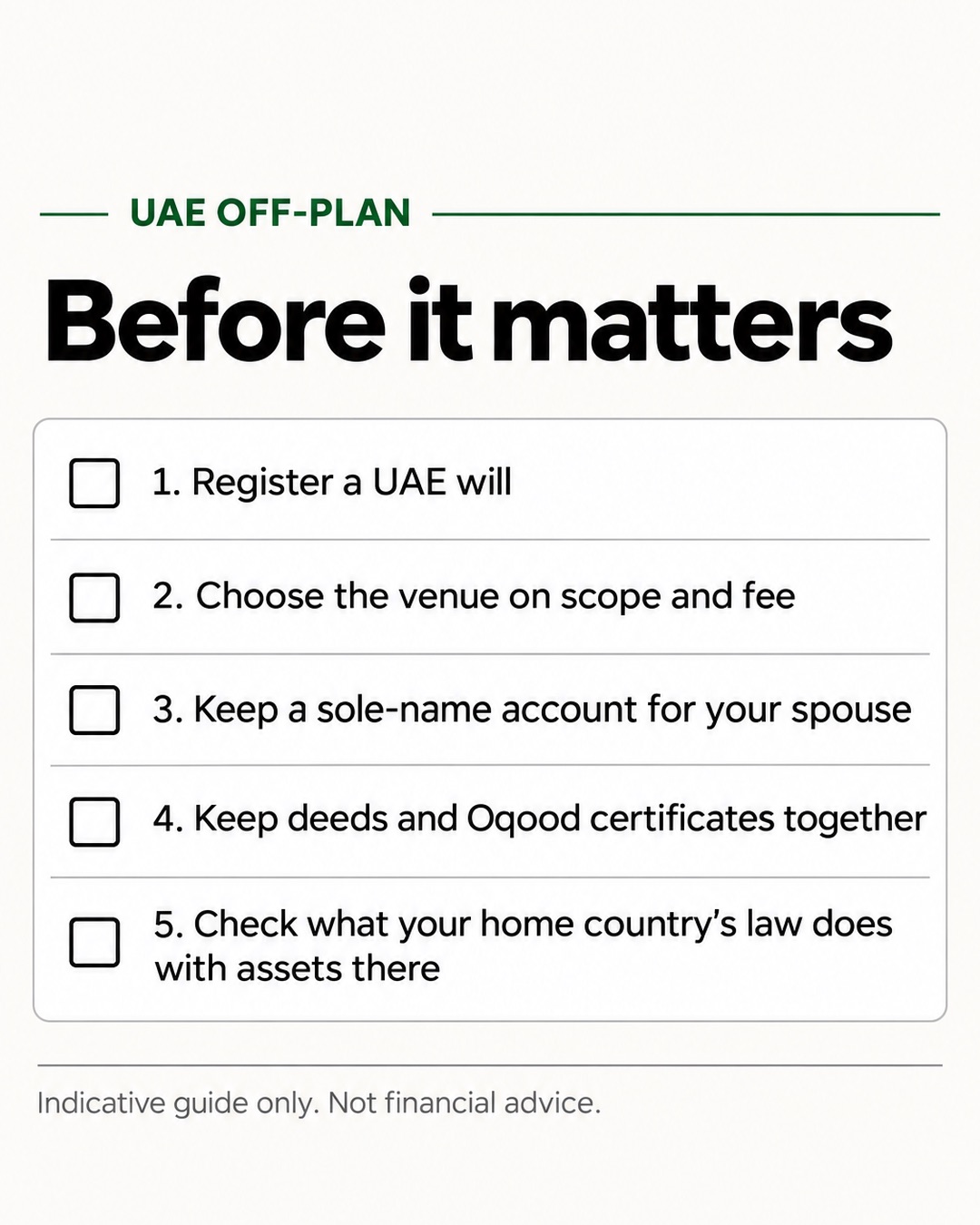
Register a UAE will if you own property here and you're not content with the default split. The DIFC Property Will covers up to five UAE properties. The ADJD civil will is the cheapest court fee by a wide margin.
Don't rely on a joint account doing what you think it does. Keeping a separate sole-name account for a spouse, with a few months of running costs in it, costs nothing to set up and solves a real problem.
Keep the documents in one place: title deeds, Oqood certificates (downloadable from the Dubai REST app), bank statements, and, if you run a business, the trade licence and memorandum of association.
If you own property at home too, remember the rule runs both ways. India, for instance, applies its own law to Indian immovable property regardless of what a UAE will says (Indian Succession Act 1925, s. 5(1)). A UAE will only covers the UAE.
Two things I still don't have good answers for. Nobody publishes how long probate actually takes in the onshore Dubai Courts or the Abu Dhabi family court. The only figure I've seen is "a few weeks" for a straightforward DIFC case. And the UAE itself has no inheritance or gift tax, but your home country might, and I haven't found a source that resolves that for any specific nationality.
The UAE has made a lot of this clearer over the past few years. There's a defined civil default now, real freedom to override it with a registered will, and a transfer fee for heirs that's far lower than people assume.
What it hasn't done is make any of it automatic. The accounts freeze on day one. The default applies to anyone who didn't choose otherwise. And a will made somewhere else has to be proved here before it does anything at all.
I'm a real estate broker, not a lawyer, and I sell off-plan property, so weigh what I've written here accordingly. Where my sources disagreed with each other, I've tried to show both versions rather than pick one.
If something happened to me this year, would my property follow the default, or a will I actually chose? That's the question I keep coming back to.