September 2026

The correction first
A few weeks ago I wrote that banks in the UAE will not underwrite a mortgage on an off-plan property until it is physically complete.
That is wrong.
Banks will underwrite an off-plan unit. They cap the loan at fifty per cent of value, and what they will not do is hand the money over until enough of the building exists to secure it against. Approval and disbursement are two different events and I had collapsed them into one.
I have corrected the original article. I am writing this one because quietly editing a mistake and moving on is the normal thing to do in this market, and I do not think it should be.
Nobody was hurt by it. It was a claim about a technicality, sitting inside a piece about something else. But it is exactly the kind of error that ends up quoted back at somebody by an agent who read it here, and the whole argument I keep making about this market is that people repeat each other's summaries without checking. I do not get to make that argument and then not check my own.
So: correction at the top, before the interesting part.

The number that is not available to you
Here is what I actually learned this week, and it reframes something I have watched buyers get wrong for years.
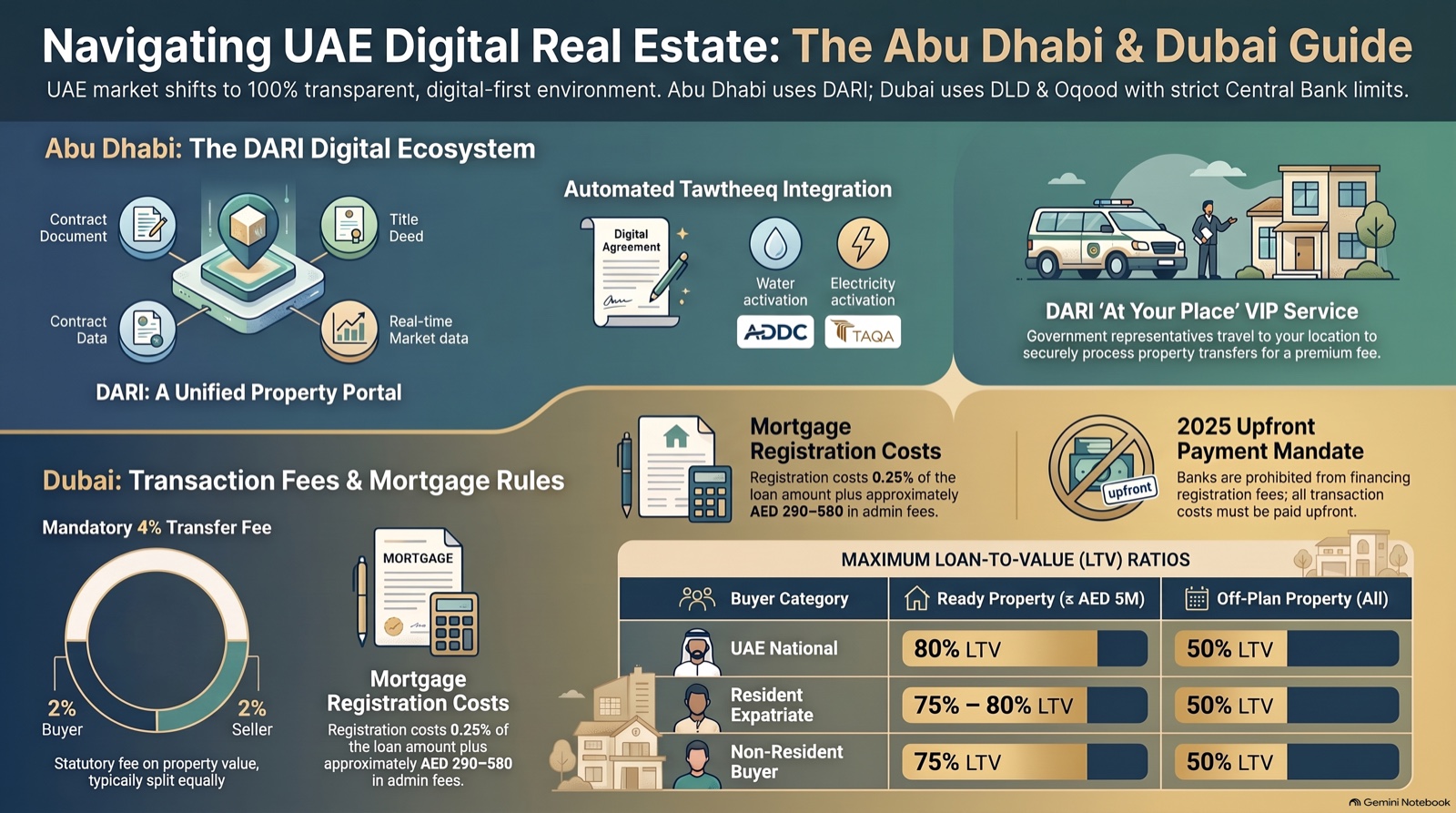
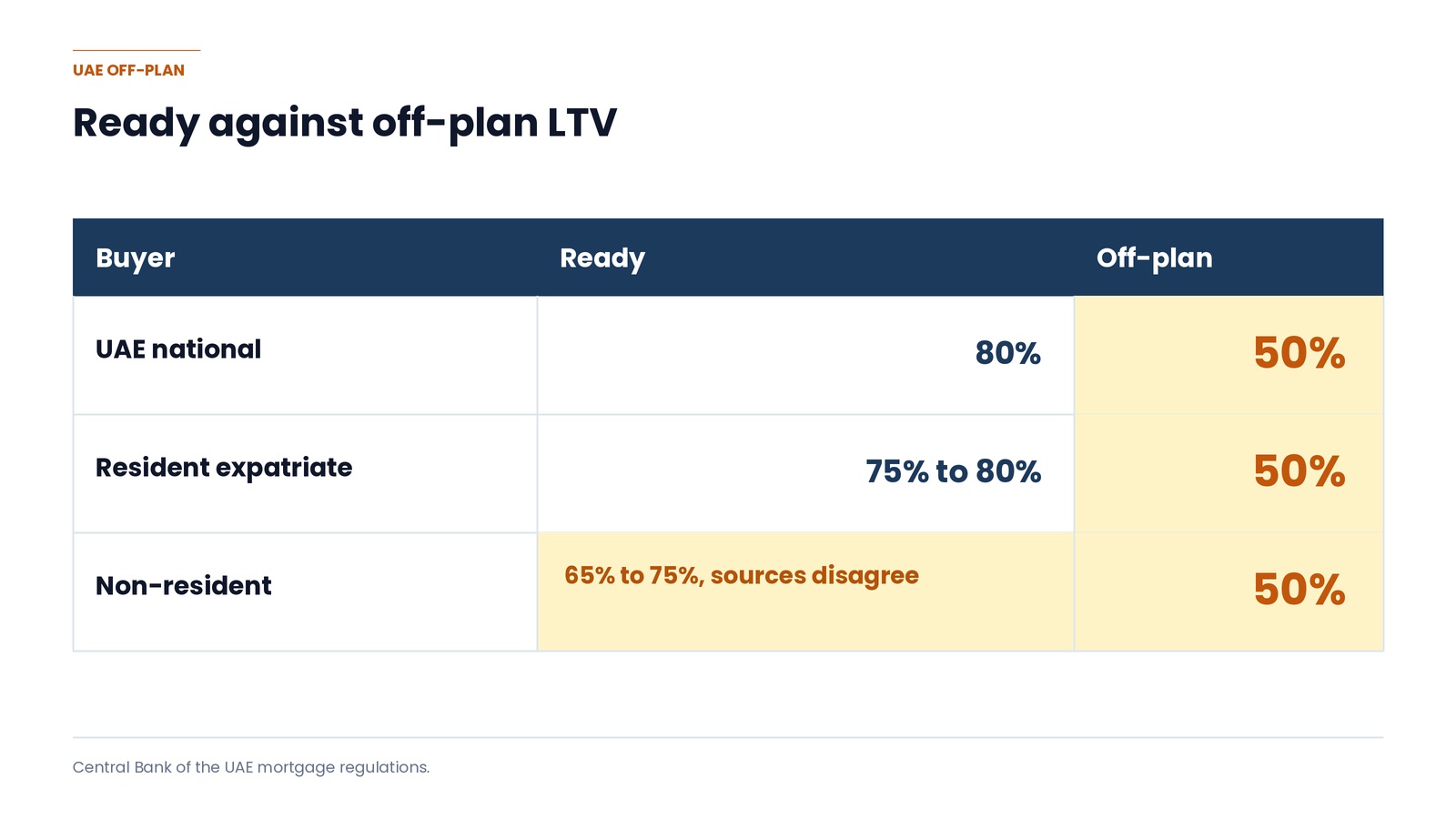
Ask what LTV you can get on Dubai property and you will hear seventy-five or eighty per cent. Those figures are real and current. They are also ready-property figures.
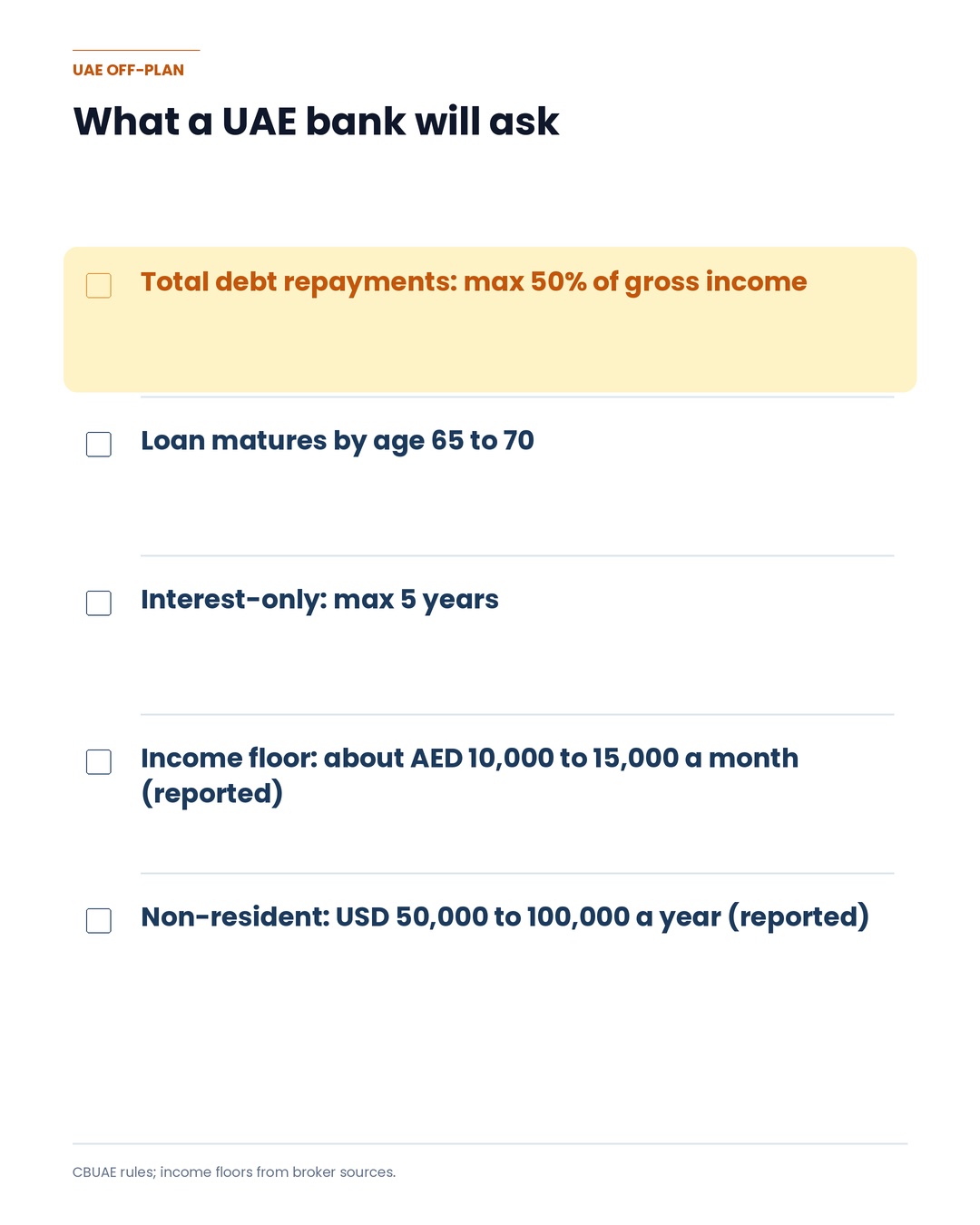
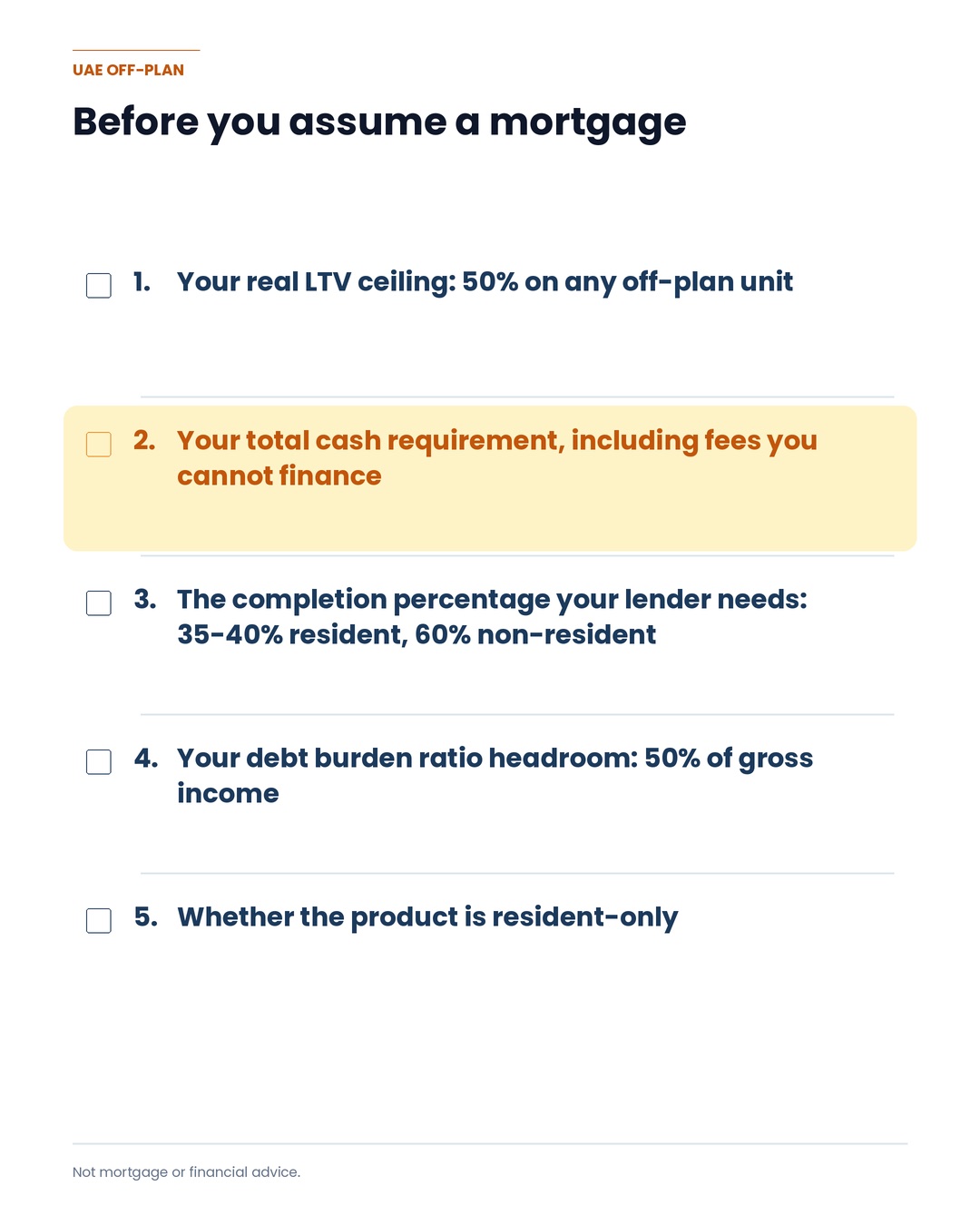
The Central Bank caps off-plan lending at fifty per cent. Not fifty for expats and something else for nationals. Fifty for everybody. UAE nationals, resident expats, non-residents, same number.
I have sat in meetings where a buyer sketched out an eighty per cent mortgage on an off-plan unit and I did not correct it, because I half-thought the difference was a bank-by-bank thing rather than a central bank rule. It is not. It is a hard ceiling and it does not move.
If you are modelling eighty per cent on an off-plan purchase, you are not modelling an aggressive version of your deal. You are modelling a product that does not exist for you.
And fifty per cent does not mean fifty per cent
The part that actually costs money.
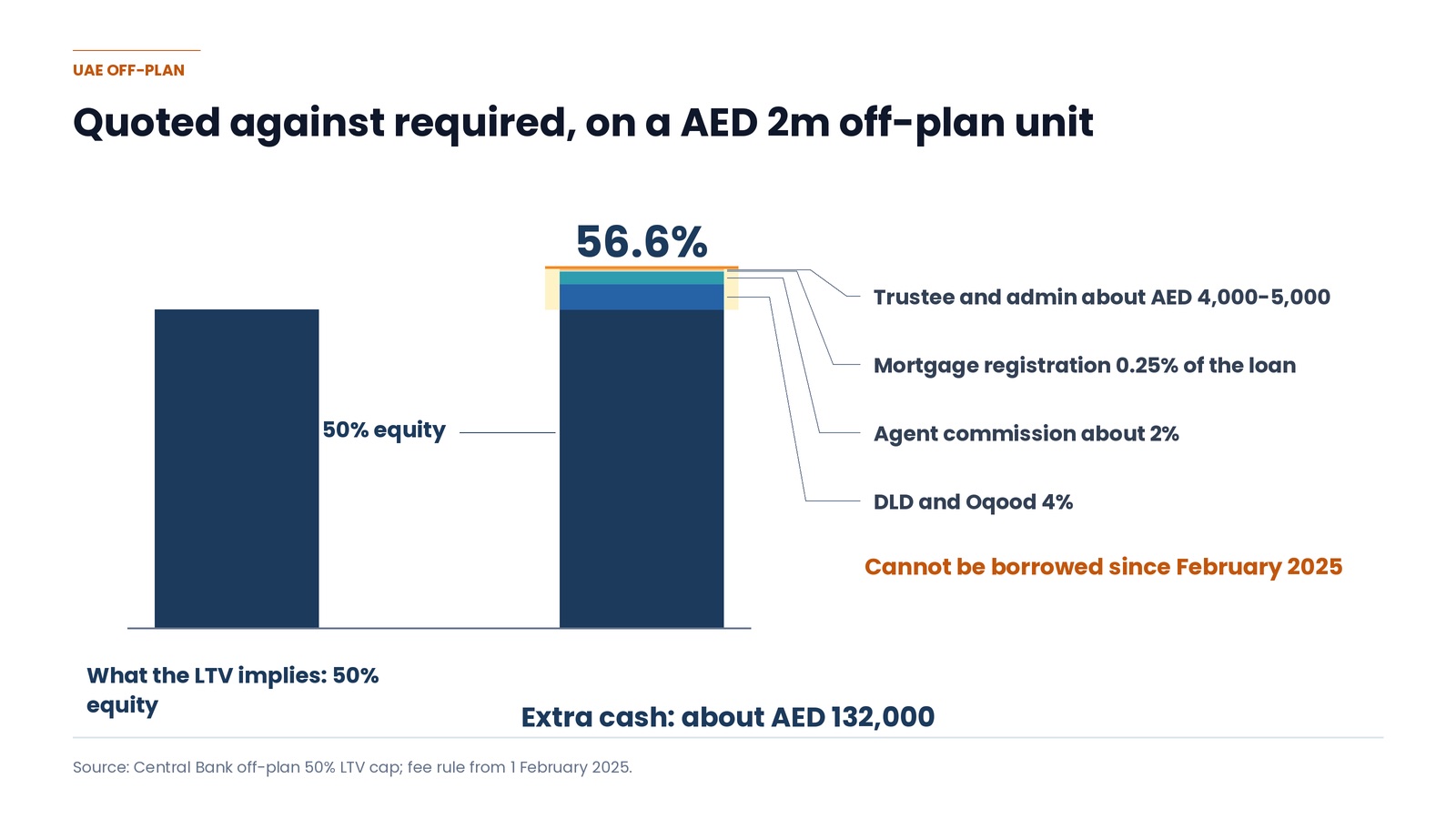
From the first of February 2025, banks are not allowed to finance your transaction fees. The land department fee, the agent commission, the lot. Out of pocket, in cash, and it cannot go into the loan.
Add it up on a two million dirham unit at fifty per cent.
A million of equity. Four per cent to the land department, eighty thousand. Two per cent commission, forty thousand. Mortgage registration at a quarter of a per cent of the loan. Trustee and admin on top.
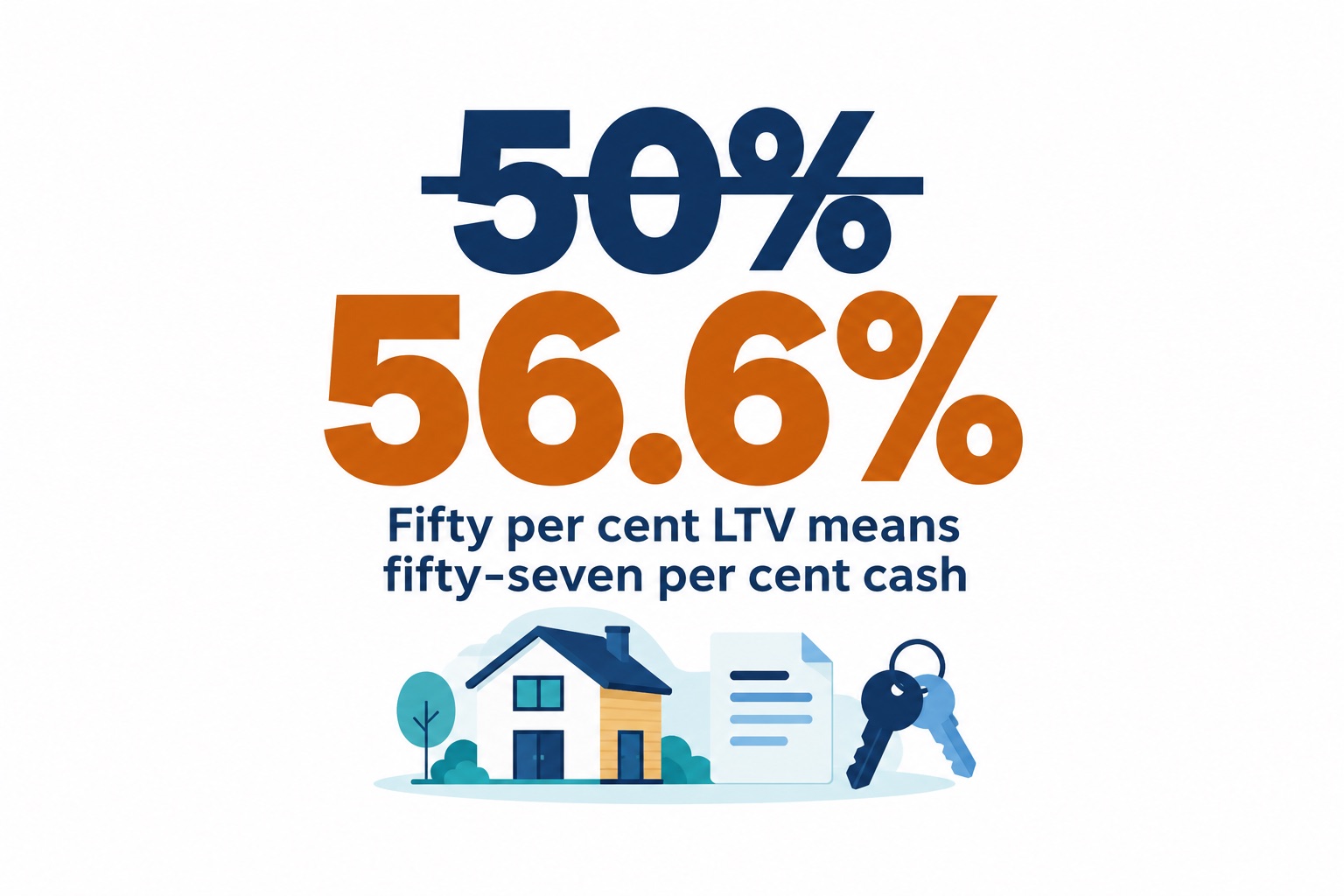
About a million one hundred and thirty-two thousand in cash. Roughly fifty-seven per cent of the purchase price.
Seven points above the number on the term sheet, and it has to be liquid. Not equity in something else, not a facility, cash.
I have had two buyers in the last year get uncomfortably close to the line on exactly this, and in both cases the shortfall was the fees. I assumed it was poor planning. It was a rule change that neither they nor I had absorbed.
When the money actually shows up
The other half of the correction, and it is more useful than the mistake.
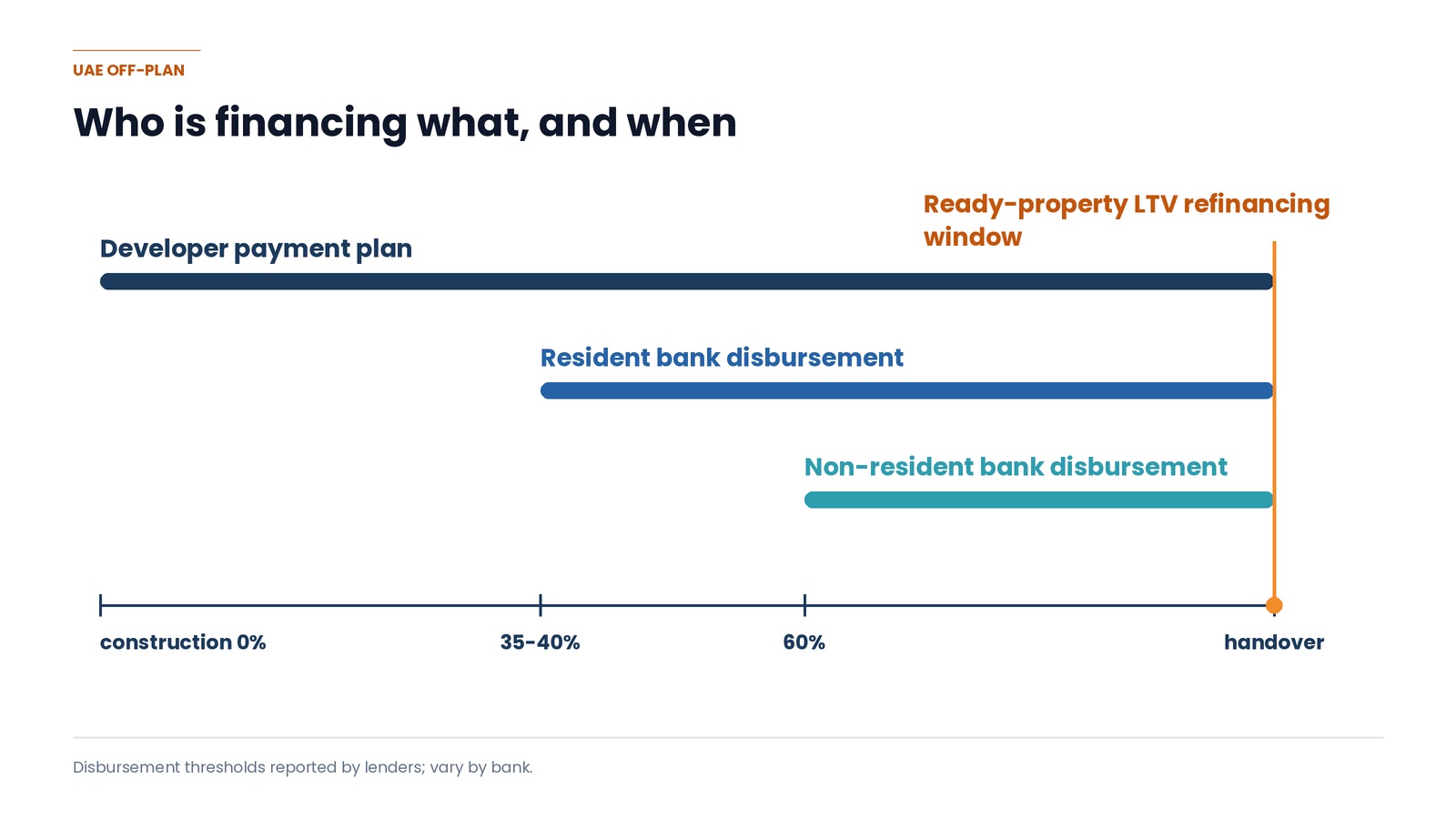
Banks tie the release of off-plan mortgage funds to how much of the building is standing. For residents, most lenders want the project at thirty-five to forty per cent before anything moves. For non-residents, around sixty.
Which means something I had never put into words for a client.
For the first third to two-thirds of construction, the developer's payment plan is your financing. Not an alternative to a mortgage. Your actual financing, for that period, whether you chose it that way or not.
That changes how you should think about the payment plan. It is not a thing you tolerate until the bank arrives. It is the only financing available to you for a long stretch, and the terms of it matter accordingly.
And if somebody is choosing a plan on the assumption they will refinance out of it early: the disbursement rules do not permit that. The bank is not coming until the building comes.
The move, and why I am describing it rather than recommending it
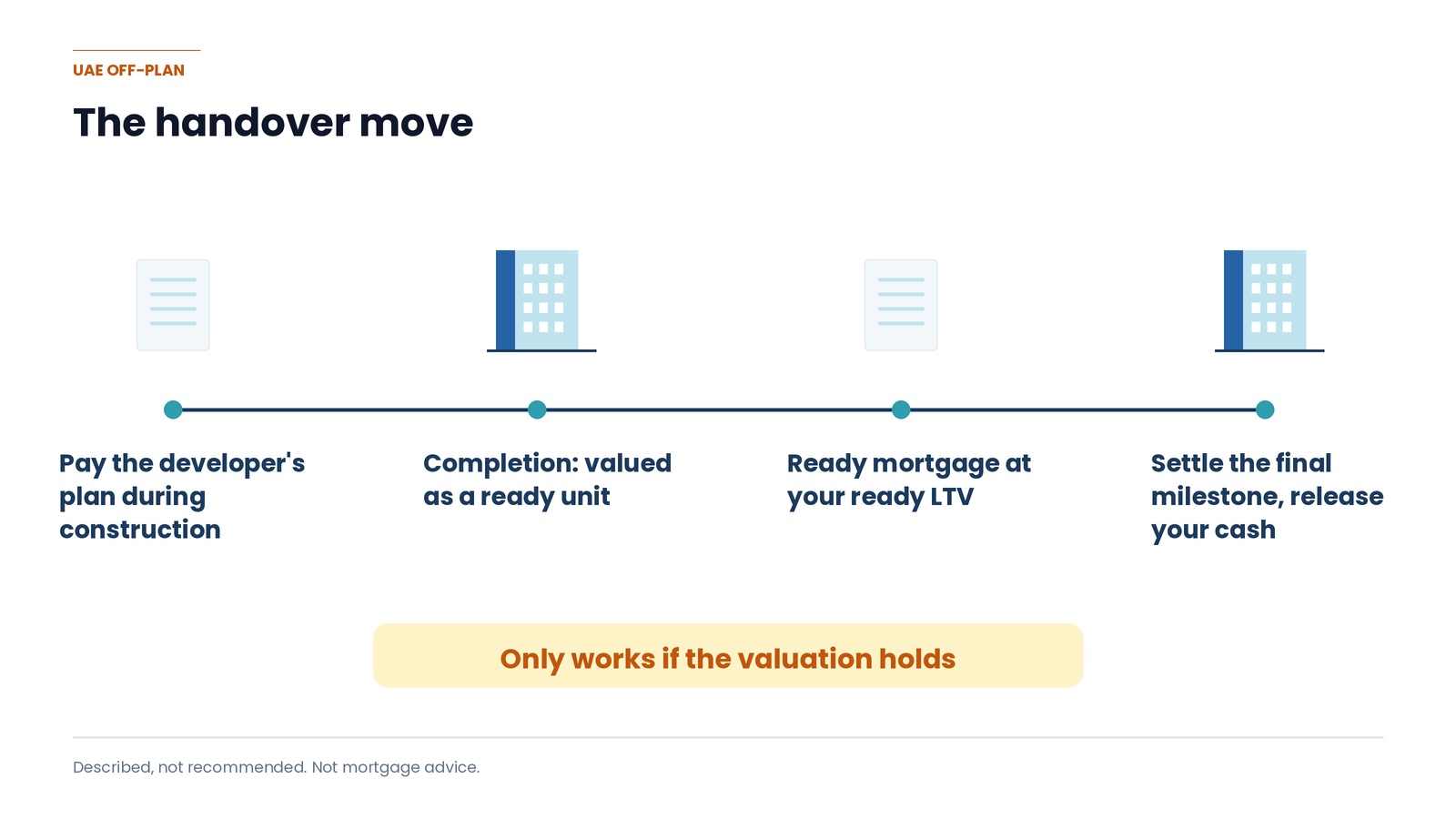
There is a sequence experienced buyers use. Fund construction on the developer plan, let the unit complete, then take a ready-property mortgage at handover at the higher LTV and use it to clear the final milestone, pulling your cash back out.
That is what the rules permit and it is elegant.
Three things about it that the material I read did not say.
The whole thing rests on the valuation. If the completed unit does not appraise at or above what you contracted at, the higher LTV applies to a lower number and the sequence does not close. And units bought on plans carrying a convenience premium are exactly the ones most exposed to that.
The timing advice contradicts itself. Everyone says arrange pre-approval six to twelve months before handover. Everyone also says pre-approval lasts sixty to ninety days. Both cannot be true as stated. What they mean is start the conversation early and take the formal approval late.
And handover slips. Which the sequence does not account for at all.
I am a broker, not a mortgage adviser, so that is a description of a mechanism and not a plan for you. But if somebody walks you through that sequence without mentioning the valuation, they have given you the easy half.

One small thing that has been bothering me for months
Across several articles I have refused to print a figure for the Abu Dhabi property registration fee, because I kept finding two per cent, four per cent and four and a half per cent in different guides and could not tell which was right.
It is two per cent. The source is TAMM, the Abu Dhabi government's own portal, and ADREC's own documentation says the same. There is also a flat e-service fee, and a separate Musataha fee where that applies.
Dubai is four. Abu Dhabi is two.
It took about ten minutes to find once I looked at a government portal instead of at another guide. Which is the second time this month I have written that sentence, and I am starting to think it is the only methodological point I actually have.
What I take from it
Two things.
Approval is not disbursement, and more generally, permission is not delivery. A lot of what gets sold as "you can do this" in property is a statement about eligibility that says nothing about timing. The useful question is not whether something is possible but when the money moves.
And publish your corrections. I found my error because I ran the next topic and it contradicted the last one. That only works if you write things down specifically enough to be contradicted. Vague is safe and useless; specific is exposed and improvable.
I would rather be the person who prints the correction than the one whose earlier article is still quietly wrong.
Idris Dad writes about off-plan strategy across Dubai, Abu Dhabi and Ras Al Khaimah.
More on how I work with buyers at offplancrypto.com.
Nothing here is mortgage or financial advice. I am a licensed real estate broker, not a mortgage adviser, and no bank or product is named.