September 2026
The question
I asked my research tools a question I thought would be easy. What is the most common mistake off-plan buyers make in Dubai?
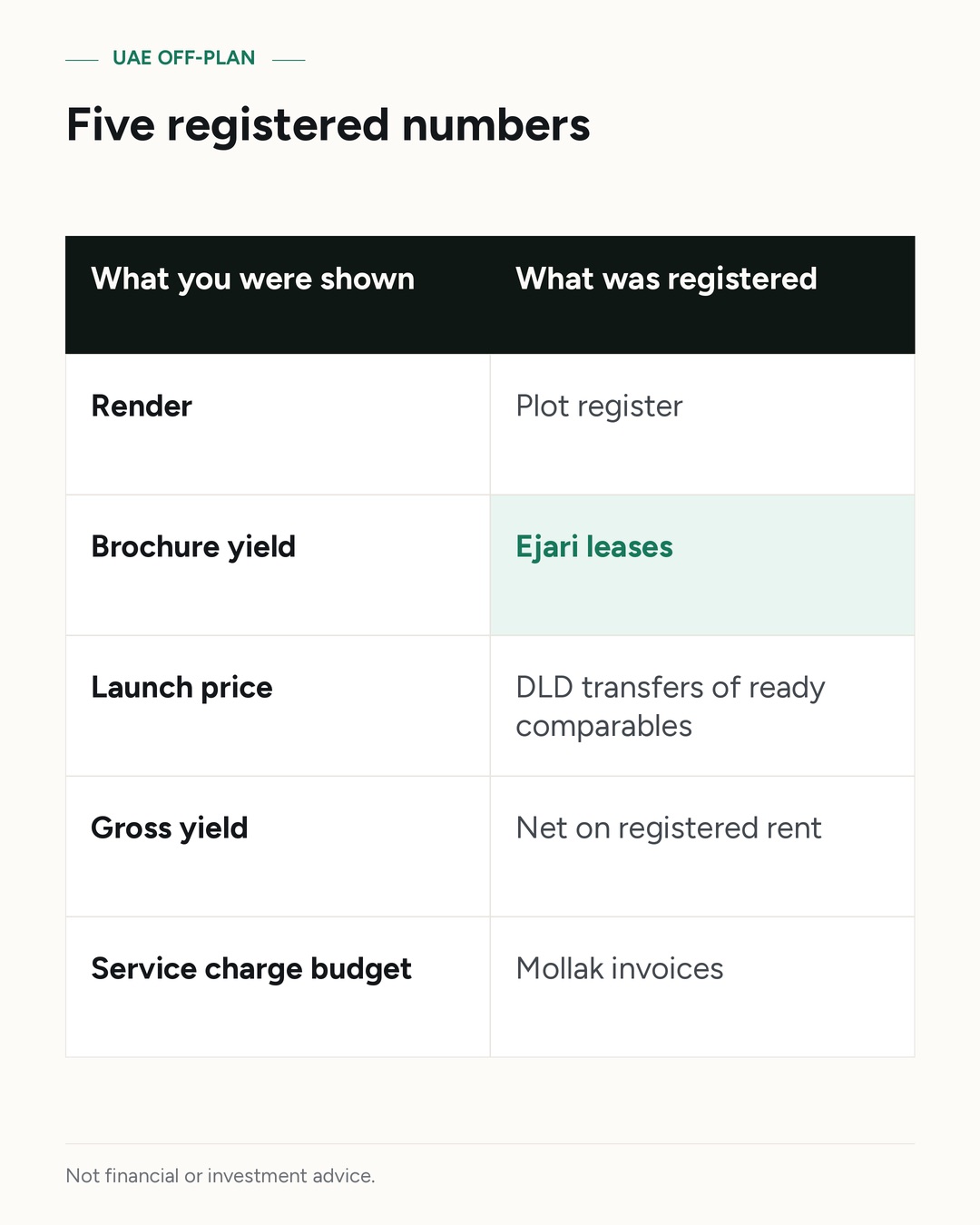
It came back with five. The view that disappears once the next tower goes up. The brochure yield that never turns up. The off-plan premium that never closes. The fringe unit priced like a central one. The service charge nobody put in the spreadsheet.
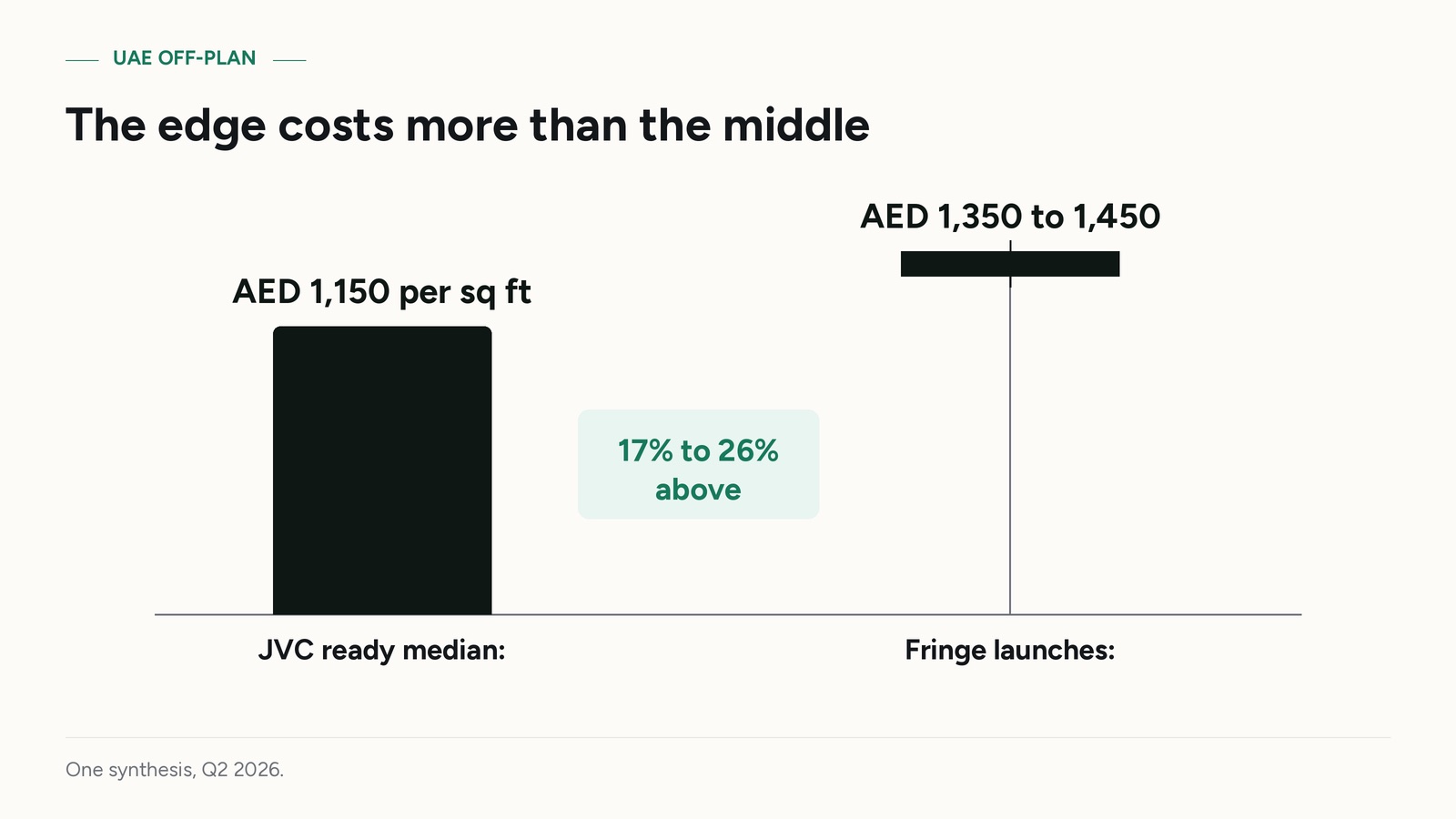
All good. All things I have watched happen. And when I laid them side by side, they turned out to be one thing.
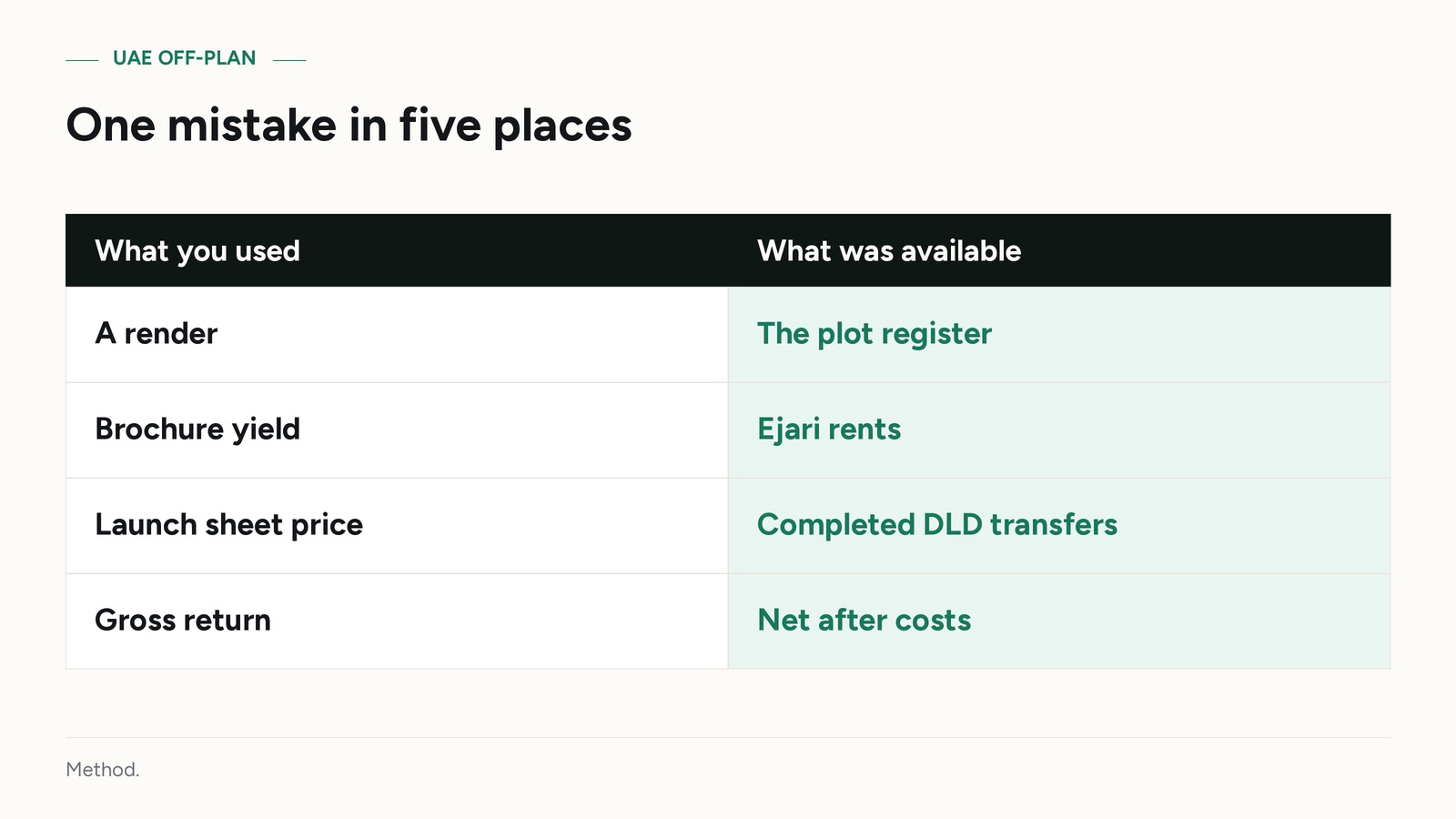
Every one of them is a buyer using a number the seller supplied, when a registered number was sitting there. The render instead of the plot register. The brochure instead of Ejari. The launch sheet instead of the completed transfers. The gross figure instead of the net. The estimate instead of the service charge invoices.
That is the mistake. It is not stupidity and it is mostly not greed. It is a sourcing error. You used the number that was put in front of you.
Then I checked the research
Here is the part I did not expect.
The report that produced those five mistakes leaned, for about half of everything it said, on a single document. That document was not a land department dataset. It was a synthesis my own research tool had generated earlier, and the tool then cited it back to me as a "verified internal grounding source".
Nobody had verified it. It was the tool quoting itself.
So I did what the report told me to do. I checked its numbers against the inputs it gave.
It said the citywide off-plan premium was 27%. The two prices it gave were AED 2,030 and AED 1,691 per square foot. Divide one by the other. It is 20%. The 27% belonged to a different pair of prices from a different document.
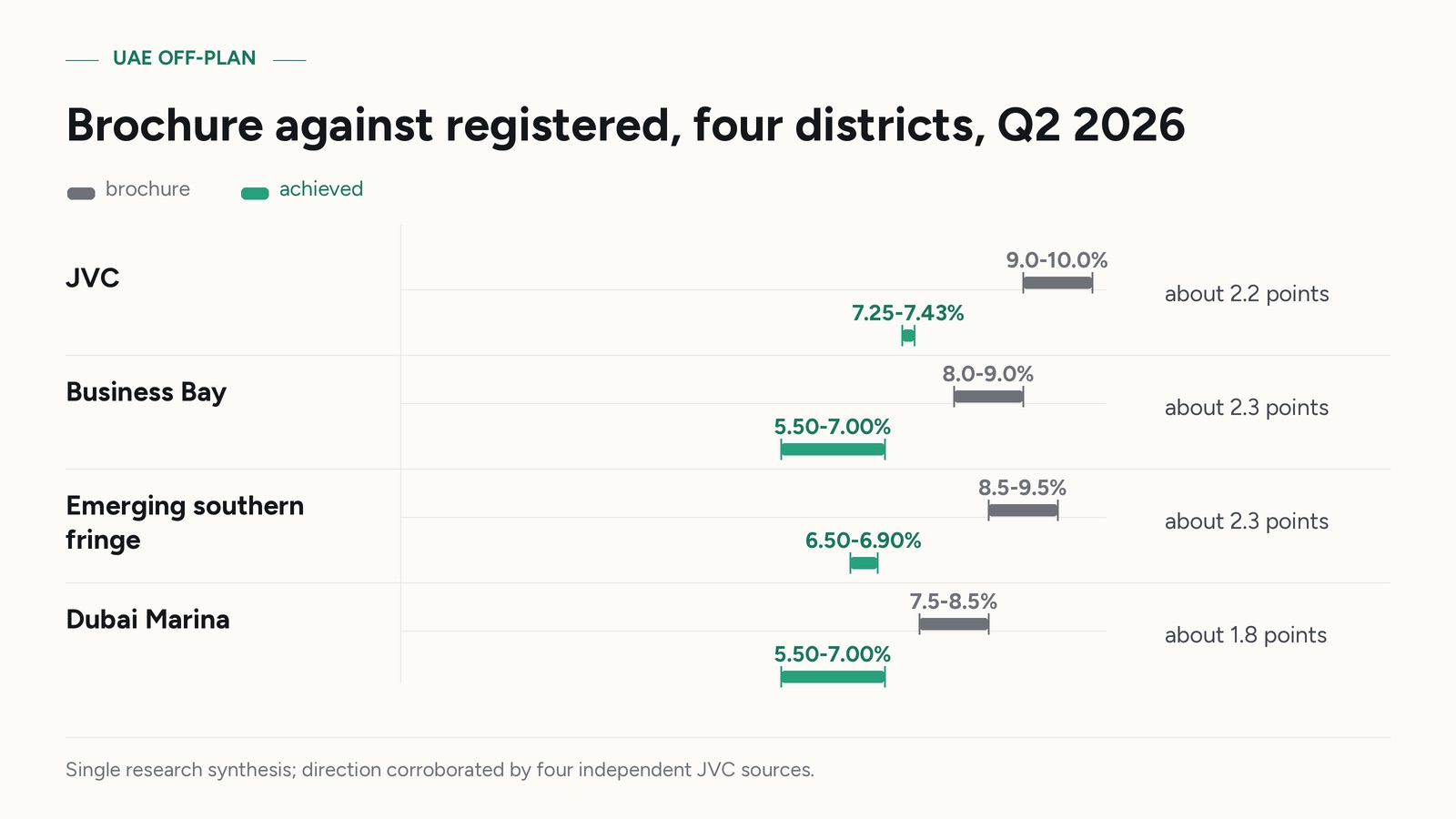
It gave a table of brochure yields against achieved yields in four districts, with the gap in each. I recalculated all four from its own ranges. None of the four gaps it printed fully matched.
It said 67% of off-plan buyers rely on developer projections. Two lines later it said off-plan was 67% of residential sales, from a different source entirely. I cannot prove the first number was borrowed from the second. I also cannot find anywhere else it could have come from.
I very nearly published the 27%. It was in the draft. It looked right, it had a citation beside it, and it came from a tool I use every day.
My research made the exact mistake it was warning me about. It gave me a confident number whose author was, in effect, the seller, and I almost used it because it was the one in front of me.
What survived
Quite a lot, which is the encouraging part.
The direction held up. The brochure yields for JVC in that synthesis ran 9% to 10% gross. Four other sources, none of them the synthesis, put JVC somewhere between about 6.6% and 7.9%. Not one reaches 9%. The only place a JVC unit yields 9% to 10% is the brochure column.
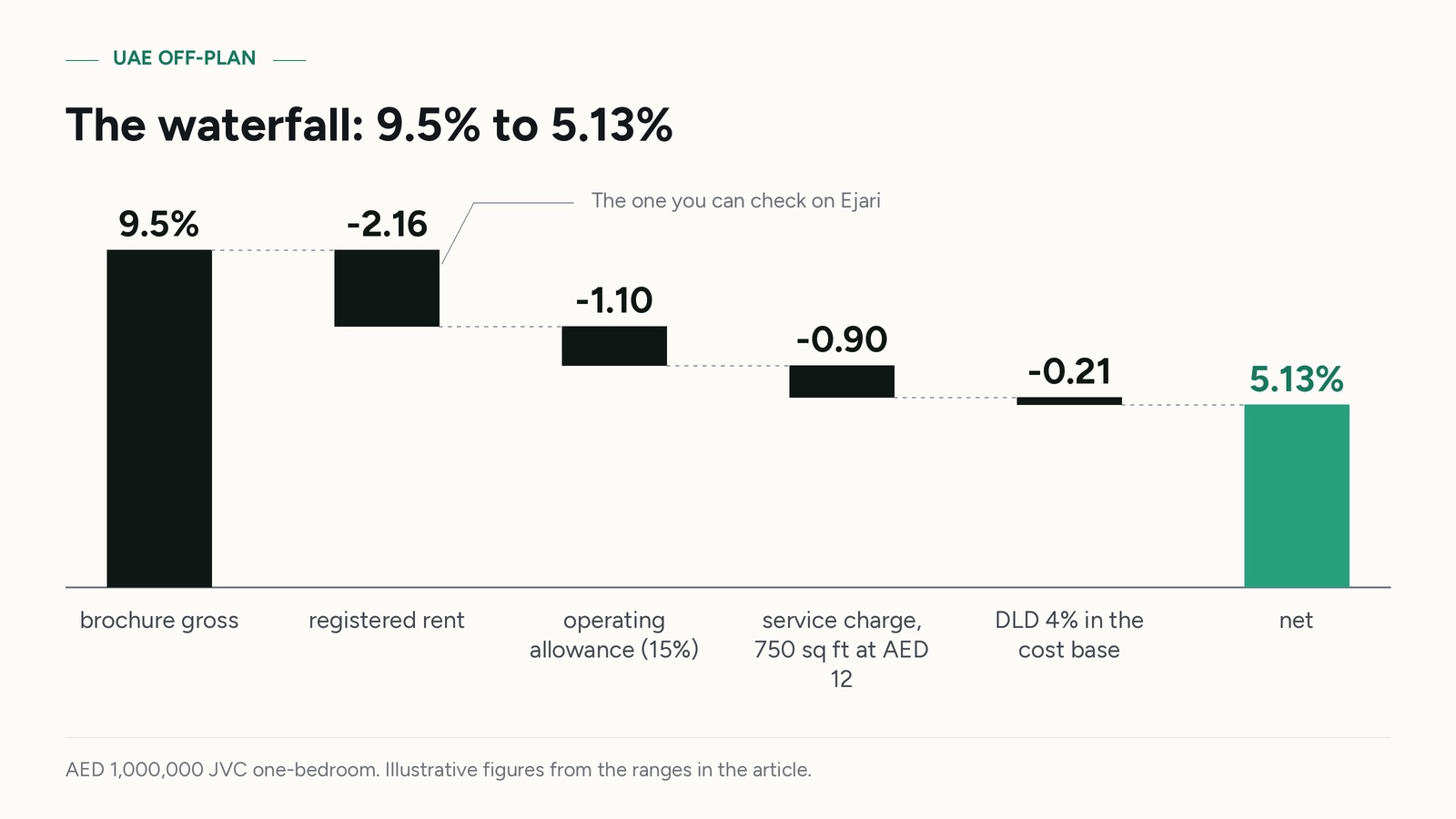
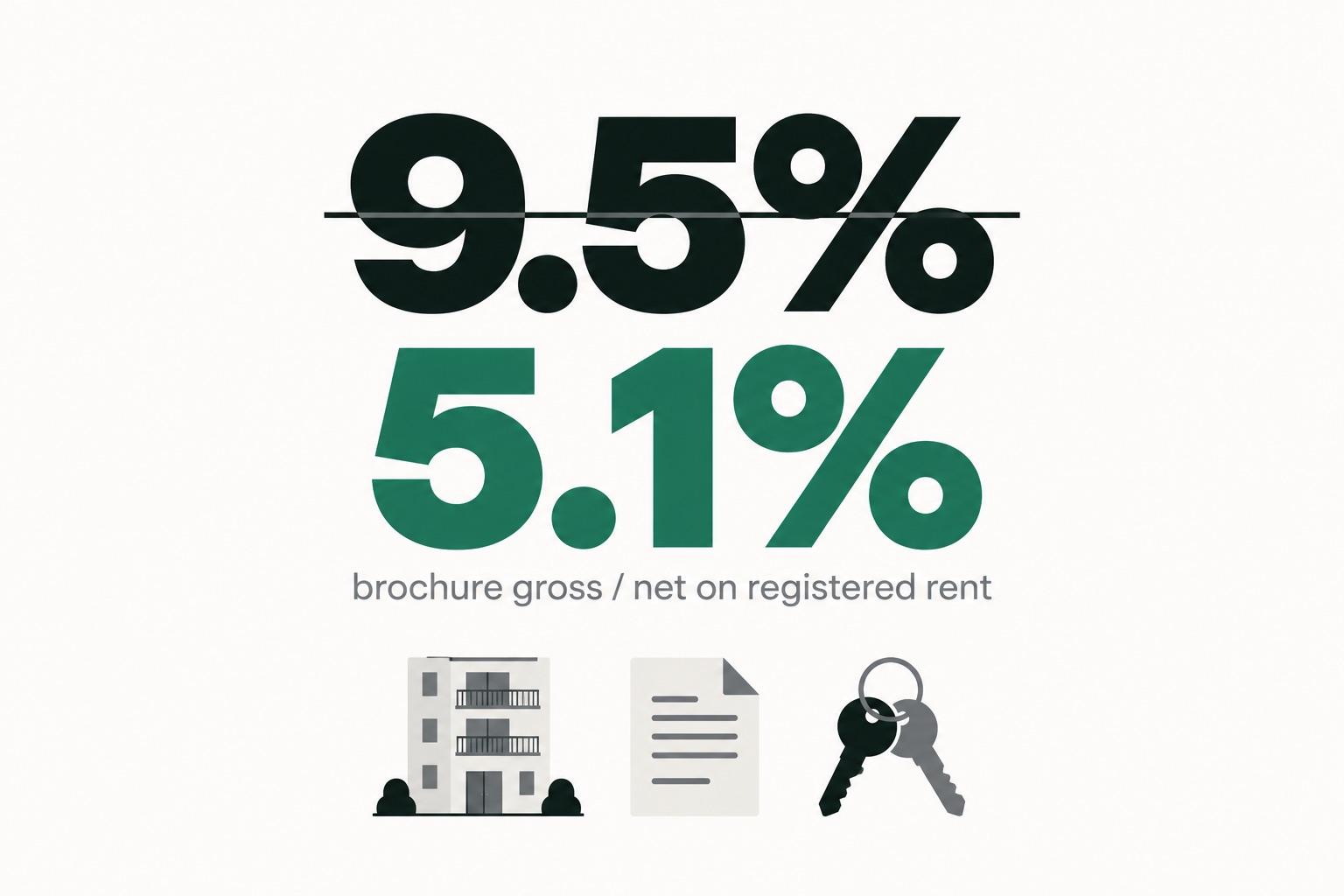
Run it through on a million-dirham one-bedroom and the shape is stark. Nine and a half per cent on the brochure. Seven and a third on registered rent. Take off a running allowance, a nine-thousand-dirham service charge and the land department fee, and you are at about five per cent net. Four and a bit points between the number that sold the unit and the number that pays you, and more than half of that gap is simply the difference between brochure rent and registered rent.
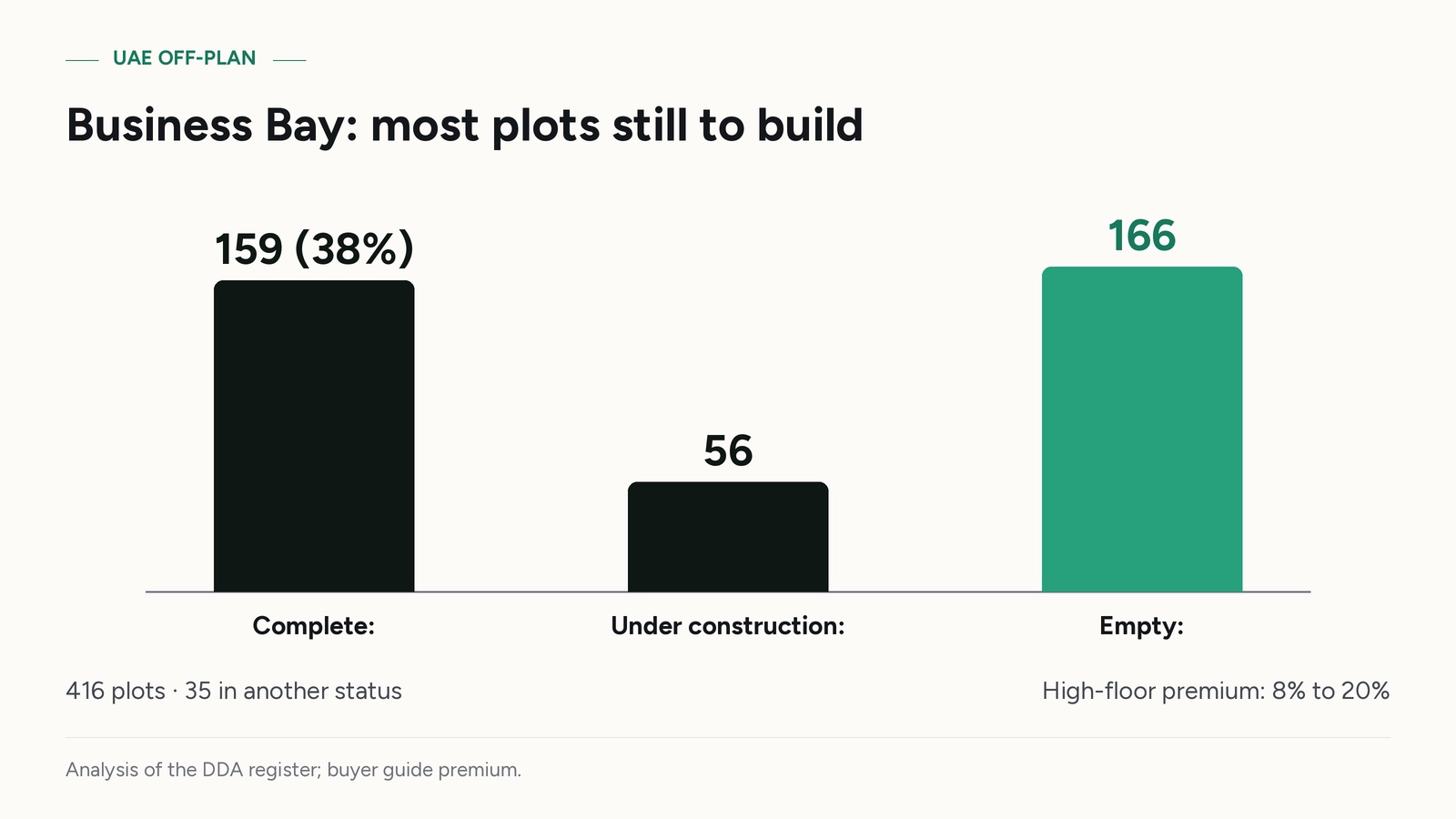
The plot register figure held up too. Fewer than four in ten plots in Business Bay are built. Anyone paying for a view there is paying for a view of the district as it is today.
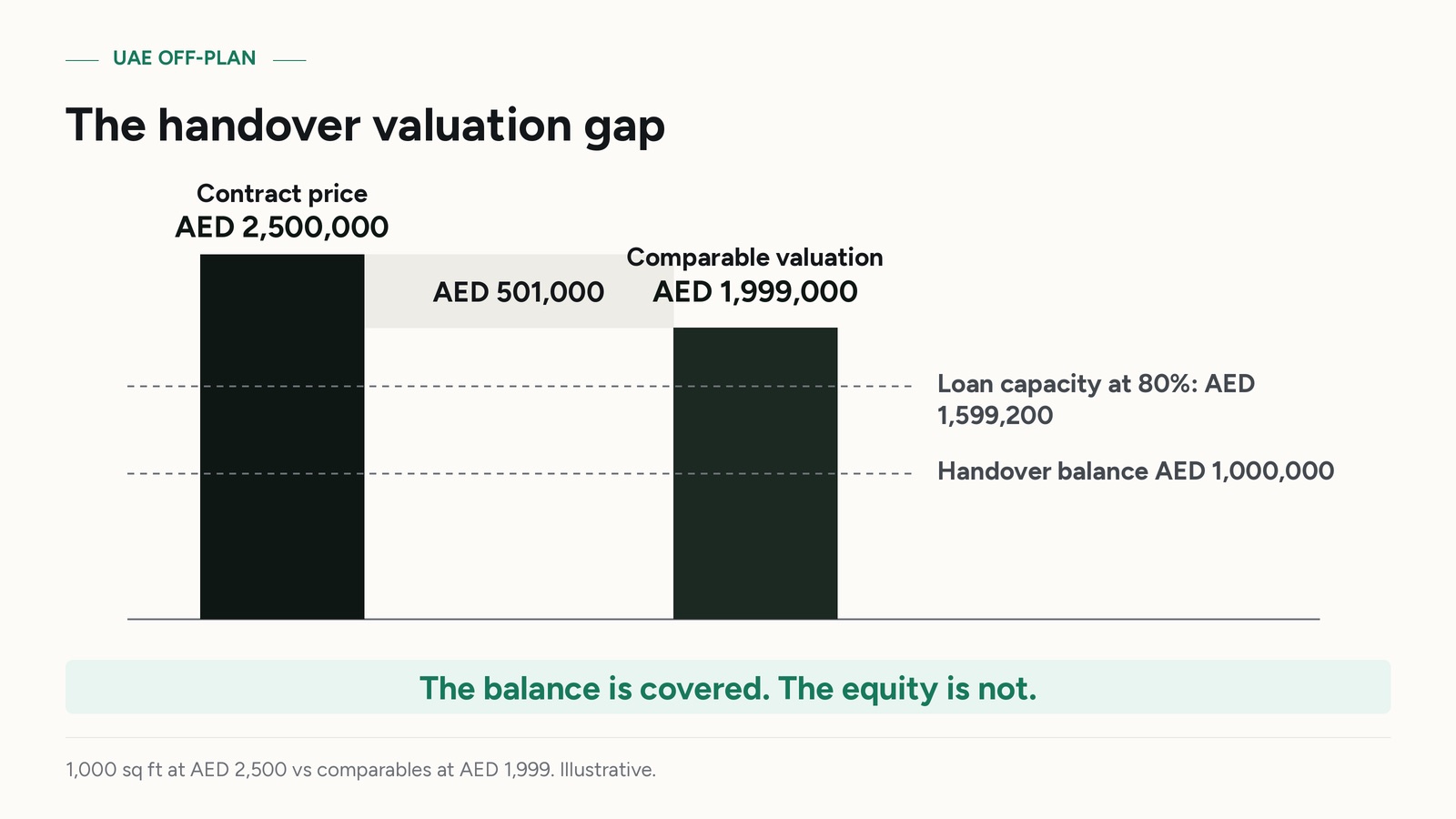
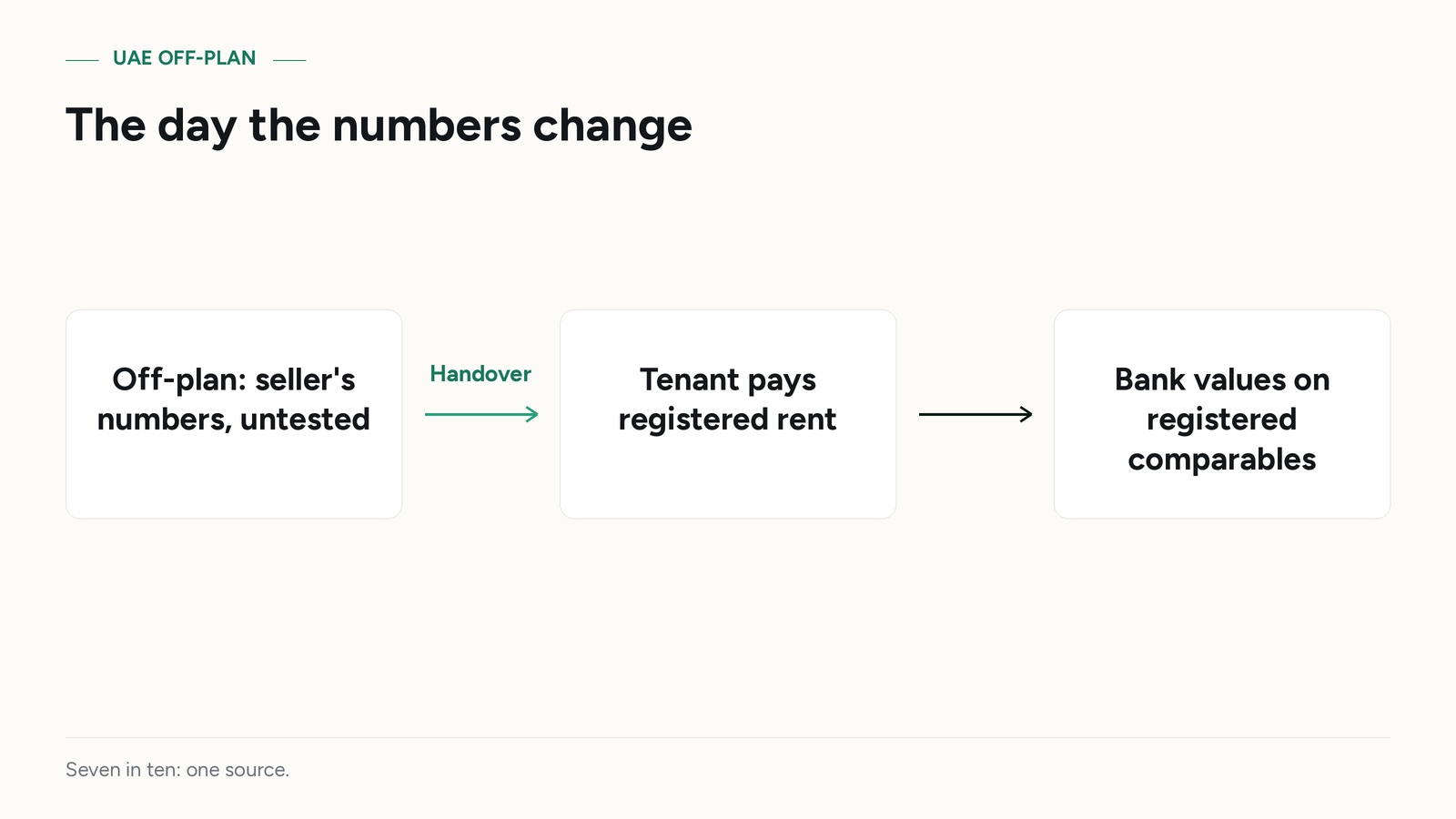
And the handover arithmetic held up, once I did it myself rather than trusting the research's version. The research said a buyer who overpaid would have to inject cash when the bank valued the unit lower. At a normal 40% handover balance, that is mostly not true: the loan still covers the balance. What the buyer loses is equity. On a unit bought 25% above comparable prices, about six hundred thousand dirhams of it on paper, and a much smaller cash release if they were planning to refinance.
That is a better finding than the one I was given. It is also one I would never have had if I had used the research's number.
Why this matters more than the property point
I have always told buyers that a projection is a forecast by the party with the unit to sell. That producing it is their job and checking it is yours. I do not think brochures are dishonest. I think they are brochures.
What I had not properly absorbed is that the same thing is true of every number that arrives already formatted. A research tool's summary. An analyst's headline. A portal's median. A colleague's WhatsApp. My own articles, for that matter. They all arrive looking finished, and the finish is exactly what stops you checking.
The five mistakes are really a question you can ask of anything. Whose number is it? If the answer is "whoever benefits if I believe it", or "I do not know", go and find the registered one.

The admission
I will say this plainly, because it would be odd to write this and not.
I have forwarded brochure yields to buyers without putting the registered figure beside them. Not often, and never as a promise, but I have done it, because it was quicker and the number was right there. Most agents have. It is the path of least resistance and the whole market runs on it.
I am not a financial adviser and I am not going to tell anyone what to buy. But I can stop forwarding numbers without their registered twin, and that is the habit I am taking from this.
What I take from it
Every number has an author. Ask who it is before you use it.
A citation is not a check. My research had citations beside every number, including the wrong ones. A source that cites itself is not a source.
And do the division. Two of the three biggest errors in this research were fixable with a calculator in under a minute. The registry is not the only thing you can check. The arithmetic is free.
Idris Dad writes about off-plan strategy across Dubai, Abu Dhabi and Ras Al Khaimah.
More on how I work with buyers at offplancrypto.com.
Nothing here is financial, investment or mortgage advice. I am a licensed real estate broker, not an adviser, and no developer, project or bank is named.